

Legal Bottlenecks Continue to Slow the Market
Vietnam’s real estate market is undergoing a major restructuring phase after several years of volatility. While mergers and acquisitions (M&A) are expected to help revive stalled projects, unlock capital, and accelerate market recovery, many transactions continue to face significant obstacles.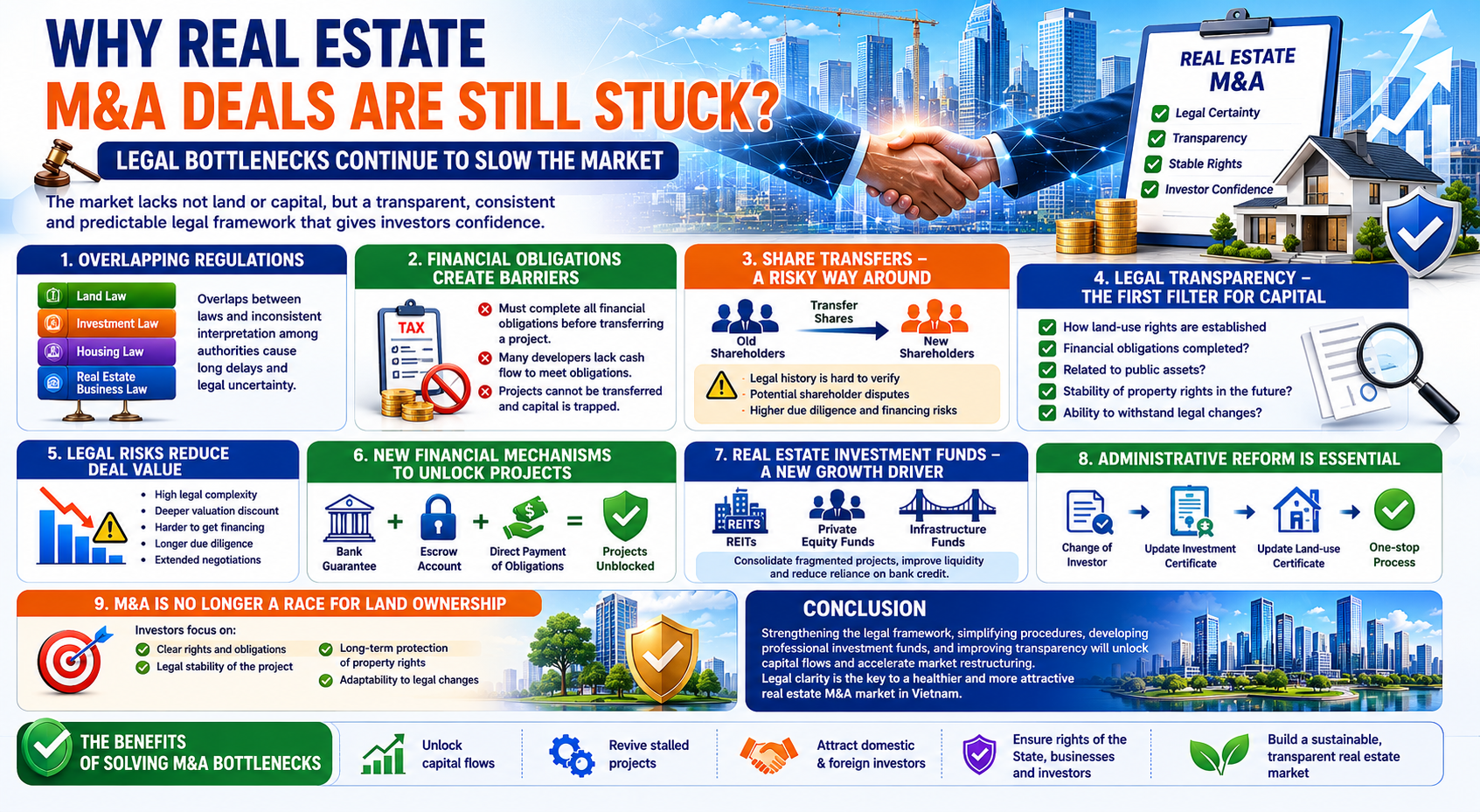
According to industry experts, what the market lacks today is not necessarily land reserves or investment capital. Instead, the biggest challenge is a transparent, consistent, and predictable legal framework that gives investors confidence over the long term.
Overlapping Regulations Remain a Major Obstacle
Speaking at a seminar on legal issues related to capital transfers, capital contributions, and investment in real estate projects in Vietnam, Mr. Tran Son Vu, Chairman of the Association for Research and Consulting on Legal Policies for Investment Activities in Vietnam, emphasized the need for stronger legal reforms.
According to Mr. Vu, improving regulations governing project transfers, capital contributions, and fundraising activities will not only help businesses overcome current difficulties but also create a more transparent, secure, and sustainable investment environment.
“The market needs a clear and synchronized legal framework to protect the legitimate interests of the State, businesses, and investors while improving the efficiency of land resource utilization in the new development phase,” he stated.
Meanwhile, Mr. Bui Dang Dung, former Vice Chairman of the National Assembly’s Finance and Budget Committee, acknowledged that recent legal reforms have improved transparency in project transfer activities and created a stronger legal basis for market restructuring and attracting both domestic and foreign investment.
However, he pointed out that overlaps among the Land Law, Investment Law, Housing Law, and Real Estate Business Law remain significant barriers. Many projects that need to be transferred or restructured still face lengthy delays because different authorities interpret and apply regulations differently.
Financial Obligations Create Additional Barriers
One of the most controversial regulations requires developers to complete all financial obligations to the State before being allowed to transfer an entire project or part of a project.
In practice, developers often invest substantial capital to acquire and prepare land. However, once development begins, many companies face cash-flow constraints and are unable to complete remaining financial obligations.
As a result:
- Projects cannot be transferred.
- New investors cannot take over development.
- Capital becomes trapped in unfinished assets.
- Market restructuring opportunities are delayed.
To address this issue, Mr. Dung proposed mechanisms that would allow financial institutions to provide guarantees or establish escrow accounts.
Under this model, funds from project buyers could be directly allocated to fulfill outstanding land-related financial obligations to the State on behalf of the seller. This would help unlock projects that are currently stalled due to unpaid taxes while ensuring that government revenues are fully collected.
The Rise of Share Transfer Transactions
Because direct project transfers remain difficult, many companies have resorted to transferring shares in project-owning companies instead.
In reality, the project changes hands through a change in ownership structure rather than through a formal project transfer.
While this approach is not prohibited by law, it creates several risks:
- Difficulty verifying the project’s legal history.
- Potential shareholder disputes.
- Increased due diligence requirements.
- Greater financing risks in the future.
This explains why international investors and financial institutions are now conducting much stricter legal reviews before committing capital.
Legal Transparency Has Become the First Filter for Capital
Attorney Truong Anh Tu, Chairman of TAT Law Firm, believes that real estate M&A transactions today are no longer simply about transferring assets. In many cases, they involve transferring an entire legal structure associated with the project.
As a result, legal compliance has become the primary filter through which investment capital flows.
If lenders previously focused mainly on collateral value, they now ask much deeper questions:
- How was the land-use right established?
- Have all financial obligations been fulfilled?
- Is the project linked to public assets?
- Can property rights remain secure if regulations change in the future?
These factors directly influence financing decisions and project valuations.
Legal Risks Directly Impact Transaction Value
Legal risks are increasingly reflected in M&A pricing.
Projects with complicated legal structures often face:
- Larger valuation discounts.
- Greater difficulty obtaining financing.
- Longer due diligence periods.
- Extended negotiations.
Conversely, projects with transparent legal documentation and completed obligations attract stronger interest from domestic and international investors.
New Financial Mechanisms Are Needed
Experts believe Vietnam needs more flexible financial solutions to revive stalled projects.
Key proposals include:
- Bank-backed transaction guarantees.
- Escrow account mechanisms.
- Direct allocation of transaction proceeds toward outstanding land obligations.
These measures could:
- Ensure the government collects revenues efficiently.
- Reduce financial pressure on existing developers.
- Accelerate project transfers.
- Speed up project redevelopment and completion.
Real Estate Investment Funds Could Become a New Growth Driver
Industry specialists also recommend accelerating the legal framework for:
- Real Estate Investment Trusts (REITs).
- Private investment funds.
- Infrastructure investment funds.
These institutions can act as professional buyers, consolidate fragmented projects, improve market liquidity, and reduce excessive reliance on bank credit.
Many developed markets have successfully adopted this model.
Administrative Reform Remains Essential
Beyond legal issues, administrative procedures after project transfers continue to slow M&A transactions.
Developers often face lengthy delays when:
- Changing project ownership.
- Updating investment certificates.
- Amending land-use certificates.
Experts recommend implementing a one-stop administrative system to simplify procedures and allow capital to flow more quickly into project redevelopment.
Real Estate M&A Is No Longer a Race for Land Ownership
According to market experts, Vietnam’s real estate M&A sector is entering a new phase.
Previously, investors competed to accumulate as much land as possible. Today, transparency and legal certainty have become far more important.
Investors are willing to commit long-term capital only when they clearly understand:
- Their rights and obligations.
- The legal stability of the project.
- The future protection of property rights.
- The project’s resilience to regulatory changes.
As a result, the biggest competition in today’s real estate M&A market is no longer about owning more land—it is about creating clearer, more stable, and more trustworthy property rights.
Conclusion
Vietnam’s real estate M&A market still holds significant growth potential, but legal bottlenecks continue to slow many transactions. Strengthening the legal framework, simplifying administrative procedures, developing professional investment funds, and improving property-right transparency will be critical to unlocking capital flows and accelerating market restructuring.
In the years ahead, legal clarity will become one of the most important factors determining project value and the attractiveness of Vietnam’s real estate M&A market.
References:
Free access to exclusive information on warehouse, factory, and land rentals in Dong Nai, Binh Duong, Long An, Ho Chi Minh City, and more.
KHU CÔNG NGHIỆP 247 is a company operating in the field of buying, selling, and leasing factories and real estate.. We are proud to be a leading provider of real estate services in Vietnam. We have a team of highly qualified and experienced real estate consultants who always place trust and credibility at the core of everything we do.
Phone: 0901 490 348
Email: datkhucongnghiep247@gmail.com
Website: datkhucongnghiep247.com.vn