
In recent years, industrial park real estate has become one of the most closely watched segments of Vietnam’s property market. Global supply chain diversification, foreign direct investment (FDI), expanding manufacturing activities, and rapid logistics development are creating growing demand for industrial land, factories, and warehouses.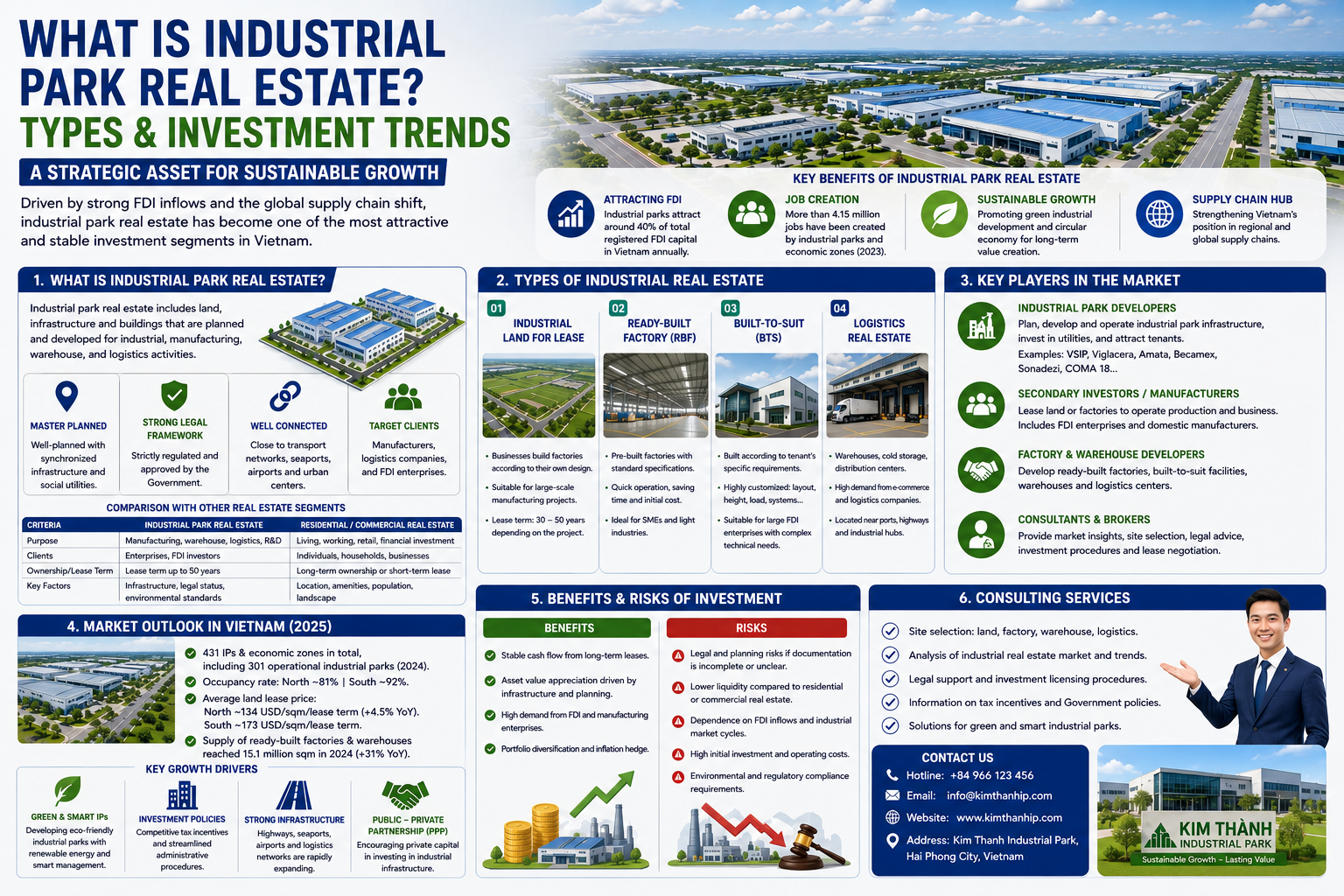
Unlike residential property, the value of industrial real estate depends not only on location but also on planning, transportation infrastructure, power supply, environmental standards, legal status, labor availability, and connectivity to supply chains.
So, what is industrial park real estate? What are the main types of industrial property? Why does this sector offer significant growth potential, and what should businesses consider before investing in or leasing industrial real estate?
This article provides a comprehensive overview.
1. What Is Industrial Park Real Estate?
1.1. Definition of Industrial Park Real Estate
Industrial park real estate refers to land, factories, warehouses, buildings, and infrastructure specifically planned and developed to support manufacturing, processing, assembly, research, storage, and logistics activities.
In simple terms, it provides dedicated space where businesses can establish and operate:
- Manufacturing plants;
- Factories;
- Warehouses;
- Logistics centers;
- Distribution centers;
- Research and development facilities;
- Supporting industrial facilities.
Unlike ordinary land plots, properties within industrial parks are typically connected to synchronized infrastructure systems, including internal roads, electricity, water supply, wastewater treatment, telecommunications, fire protection, and business support services.
1.2. Key Characteristics of Industrial Real Estate
One of the most important characteristics of industrial real estate is centralized and integrated planning.
Industrial parks are generally developed under master plans designed to create complete manufacturing ecosystems. Infrastructure developers are responsible for building roads, power and water systems, drainage, wastewater treatment facilities, and other technical infrastructure before leasing industrial land or factories to tenants.
Industrial real estate also has several distinctive characteristics.
Strict legal and planning requirements
The establishment, expansion, construction, and operation of industrial parks are subject to regulations concerning land, investment, construction, environmental protection, and industrial park management.
Long lease terms
Industrial land is generally leased according to the remaining operating term of the industrial park project. As a result, lease periods may extend for several decades, making this model suitable for companies with long-term manufacturing strategies.
Strong dependence on infrastructure
Industrial parks located near highways, seaports, airports, and logistics hubs are generally more attractive to manufacturers.
Business-oriented customer base
Unlike residential real estate, where customers are primarily individuals and households, industrial real estate mainly serves manufacturers, FDI enterprises, multinational corporations, and logistics companies.
2. How Is Industrial Real Estate Different From Residential Real Estate?
The two segments differ significantly in terms of customers, purpose of use, investment considerations, and operating requirements.
| Criteria | Industrial Park Real Estate | Residential/Commercial Real Estate |
|---|---|---|
| Main purpose | Manufacturing, warehousing, logistics, R&D | Housing, retail, offices, services |
| Customers | Companies and FDI corporations | Individuals, households, businesses |
| Operating period | Usually long-term | More flexible |
| Key factors | Infrastructure, logistics, electricity, legal status, labor | Location, amenities, population, surroundings |
| Investment scale | Generally large | From small to very large |
| Operational requirements | High technical and environmental standards | Mainly amenities and services |
This explains why evaluating an industrial property generally requires more specialized analysis than selecting residential or commercial real estate.
3. The Role of Industrial Real Estate in the Economy
Industrial real estate is not merely an investment asset class. It is also fundamental infrastructure supporting a manufacturing-based economy.
3.1. Attracting Foreign Direct Investment
When an international corporation decides to establish a factory in Vietnam, selecting a suitable manufacturing location is one of its first major decisions.
An industrial park with clear legal status, completed infrastructure, and strong logistics connectivity can significantly shorten the time required to launch a project.
Therefore, the quality of industrial parks directly affects the ability of individual provinces—and Vietnam as a whole—to compete for foreign direct investment.
3.2. Creating Jobs and Supporting Urban Development
A large industrial park may generate tens of thousands of jobs.
As factories expand, demand also increases for:
- Housing;
- Retail;
- Education;
- Healthcare;
- Food and beverage services;
- Transportation;
- Logistics services.
Industrial parks can therefore become important economic anchors for the development of surrounding urban and service areas.
3.3. Supporting Economic Restructuring
The expansion of industrial parks contributes to the transition from an agriculture-based economy toward manufacturing and services.
The arrival of major multinational manufacturers can also stimulate the development of domestic supporting industries and supplier networks.
3.4. Building Supply Chain Ecosystems
When companies from related industries cluster within the same region, networks of component suppliers, raw material providers, logistics companies, and technical service providers gradually emerge.
This creates the foundation for developing industrial clusters and domestic supply chains.
4. Four Major Types of Industrial Real Estate
Although the market contains a wide variety of products, industrial real estate can generally be divided into four main categories.
4.1. Industrial Land for Lease
Industrial land for lease is the most traditional and widely used industrial property type.
Industrial park developers complete the common infrastructure and then lease individual plots to manufacturers for factory development.
The tenant is generally responsible for:
- Designing the factory;
- Completing relevant administrative procedures;
- Constructing the facility;
- Installing production lines.
Who Should Lease Industrial Land?
Industrial land is particularly suitable for:
- Large-scale manufacturing projects;
- Companies pursuing long-term investments;
- Industries with specialized technical requirements;
- Businesses that require fully customized factories.
Manufacturers in electronics, mechanical engineering, automotive, food processing, chemicals, textiles, and component production often choose industrial land when their investment scale is sufficiently large.
4.2. Ready-Built Factory – RBF
A Ready-Built Factory (RBF) is a factory constructed in advance by a developer according to standardized specifications and offered to businesses on a ready-to-lease basis.
These facilities normally include:
- Electricity systems;
- Water supply;
- Office areas;
- Internal roads;
- Parking areas;
- Fire protection infrastructure;
- Basic technical systems.
The biggest advantage is the ability to shorten the time required to start operations.
Businesses do not have to spend many months—or potentially years—building a factory from the ground up.
Who Should Choose a Ready-Built Factory?
RBFs are particularly suitable for:
- Small and medium-sized enterprises;
- First-time foreign investors entering Vietnam;
- Component manufacturers;
- Light industrial companies;
- Businesses testing the Vietnamese market;
- Companies requiring rapid production expansion.
For these reasons, ready-built factories are becoming increasingly important within Vietnam’s industrial property market.
4.3. Built-to-Suit Factories
A Built-to-Suit (BTS) facility is a factory or warehouse developed specifically according to the tenant’s technical specifications.
Businesses may specify requirements relating to:
- Building height;
- Floor loading capacity;
- Electrical systems;
- Production layout;
- Cold storage;
- Cleanrooms;
- Automation systems;
- Environmental standards;
- Fire prevention and protection systems.
Once construction is completed, the tenant operates the facility under a long-term lease.
Built-to-Suit projects are particularly suitable for multinational corporations that apply standardized factory specifications across their global operations.
4.4. Logistics Real Estate
Logistics real estate includes:
- Warehouses;
- Cold storage facilities;
- Distribution centers;
- Logistics hubs;
- Cross-docking facilities;
- E-commerce warehouses.
Growth in e-commerce, international trade, and manufacturing is driving strong demand for these assets.
For logistics real estate, location is especially important.
Warehouses positioned near:
- Expressways;
- Seaports;
- Airports;
- Industrial parks;
- Major cities
can enjoy significant operational advantages.
5. Who Participates in the Industrial Real Estate Market?
Industrial real estate operates as an ecosystem involving several groups of stakeholders.
5.1. Industrial Park Infrastructure Developers
These companies are responsible for developing the overall industrial park.
Their primary responsibilities include:
- Land clearance and compensation;
- Site preparation;
- Road infrastructure;
- Electricity and water systems;
- Wastewater treatment;
- Technical infrastructure development;
- Attracting industrial tenants.
Major industrial park brands in Vietnam include VSIP, Viglacera, Amata, Becamex, and Sonadezi, along with many other domestic and international infrastructure developers.
5.2. Secondary Investors and Manufacturers
These are businesses that lease industrial land or factories to establish production operations.
They include:
- FDI enterprises;
- Multinational corporations;
- Vietnamese businesses;
- Logistics companies;
- Supporting-industry enterprises.
These tenants ultimately determine the occupancy rate, revenue potential, and commercial attractiveness of an industrial park.
5.3. Factory and Warehouse Developers
Some companies specialize in developing:
- Ready-Built Factories;
- Ready-Built Warehouses;
- Built-to-Suit facilities;
- Logistics centers.
They effectively bridge the gap between industrial park developers and industrial tenants.
5.4. Industrial Real Estate Consultants
Industrial property consulting has become an increasingly specialized professional service.
Consultants assist companies with:
- Site selection;
- Industrial park comparison;
- Cost analysis;
- Logistics assessment;
- Factory searches;
- Legal advisory;
- Lease negotiations;
- Initial investment procedures.
Major international property consultants operating in Vietnam include CBRE, JLL, Savills, Colliers, Cushman & Wakefield, and Knight Frank, alongside specialized domestic industrial real estate consultants.
6. Why Does Vietnam’s Industrial Real Estate Market Have Strong Potential?
Vietnam has several advantages that could strengthen its position as an important manufacturing hub in Asia.
6.1. Strategic Location Within Asian Supply Chains
Vietnam is located close to major manufacturing centers including China, South Korea, Japan, and other ASEAN economies.
This geographical position makes it easier for manufacturers to connect with regional supply chains.
6.2. Global Supply Chain Diversification
Many multinational corporations are diversifying their production footprints to reduce dependence on any single country.
Vietnam is among the beneficiaries of this trend due to:
- A strategic geographical location;
- A large workforce;
- A growing industrial park network;
- An extensive network of trade agreements;
- An increasingly attractive investment environment.
6.3. Major Investment in Transportation Infrastructure
Industrial property values are strongly influenced by infrastructure development.
Major projects such as:
- The North–South Expressway;
- Long Thanh International Airport;
- Lach Huyen Port;
- Urban ring roads;
- Interregional expressways
are helping reduce transportation times and expand the geographic reach of industrial development.
7. Key Industrial Real Estate Markets in Vietnam
Vietnam has two major industrial clusters.
Northern Vietnam
Important industrial destinations include:
- Hai Phong;
- Bac Ninh;
- Bac Giang;
- Hung Yen;
- Hai Duong;
- Quang Ninh;
- Thai Nguyen.
The region benefits from proximity to China, seaports, and a well-established electronics and high-tech manufacturing ecosystem.
Southern Vietnam
Major industrial markets include:
- Ho Chi Minh City;
- Dong Nai;
- Binh Duong;
- Tay Ninh;
- Long An;
- Ba Ria–Vung Tau.
Southern Vietnam benefits from a mature manufacturing ecosystem, a large consumer market, and well-developed logistics networks.
8. Industrial Real Estate Investment Trends
The market is gradually shifting away from traditional industrial park development toward higher-value models.
8.1. Green Industrial Parks
International investors are increasingly prioritizing ESG standards and decarbonization targets.
Future industrial parks will therefore need to incorporate:
- Renewable energy;
- Rooftop solar power;
- Water treatment and reuse;
- Waste management;
- Energy-efficient buildings.
8.2. Smart Industrial Parks
Technology is increasingly being integrated into industrial park management through:
- Internet of Things (IoT);
- Energy monitoring systems;
- Traffic management;
- Water management;
- Security systems;
- Data management platforms.
The goal is to reduce operating costs and improve production efficiency.
8.3. High-Tech Industrial Parks
Rather than focusing primarily on labor-intensive industries, many localities are prioritizing:
- Semiconductors;
- Electronics;
- Artificial intelligence;
- Medical devices;
- Biotechnology;
- Precision manufacturing;
- Supporting industries.
This transition will raise infrastructure requirements across industrial parks.
8.4. Continued Expansion of Ready-Built Factories
Speed of project implementation is becoming an important competitive advantage.
Businesses increasingly want to minimize the time spent constructing factories before production can begin.
As a result, Ready-Built Factory and Built-to-Suit products are expected to remain important segments of the industrial real estate market.
8.5. Growth of Logistics and Smart Warehouses
E-commerce and modern manufacturing are driving demand for:
- Automated warehouses;
- Cold storage;
- Distribution centers;
- 3PL and 4PL logistics facilities.
These assets will become increasingly important components of the industrial real estate ecosystem.
9. Benefits of Investing in Industrial Real Estate
Long-Term Cash Flow
Industrial tenants typically sign longer leases than residential or office tenants.
This can provide more stable revenue for property owners.
Benefits From Infrastructure Development
When a new expressway, airport, or seaport becomes operational, logistics connectivity improves and the attractiveness of nearby industrial areas can increase significantly.
Demand Supported by Real Manufacturing Activity
Unlike some highly speculative property segments, industrial real estate demand is primarily generated by actual manufacturing and logistics activities.
Exposure to FDI Growth
As Vietnam attracts additional manufacturing projects, demand for industrial land, factories, and warehouses can increase accordingly.
10. Risks of Investing in Industrial Real Estate
Strong opportunities do not mean industrial property investment is risk-free.
10.1. Legal Risks
Investors should carefully review:
- Planning status;
- Remaining land use term;
- Licenses and approvals;
- Leasing rights;
- Construction conditions;
- Environmental regulations;
- Fire prevention and protection requirements.
10.2. Location Risks
An industrial park may have a large land bank but still struggle to attract tenants if its logistics connectivity is poor.
10.3. Dependence on FDI Cycles
If global manufacturing investment slows, industrial property leasing demand may also weaken.
10.4. High Capital Requirements
Developing factories, warehouses, and industrial infrastructure generally requires substantial capital.
Investment recovery periods can also extend over many years.
10.5. High Operational Requirements
Industrial facilities must meet technical, environmental, safety, and fire prevention standards.
Investors therefore need to consider not only construction costs but also long-term operating and maintenance expenses.
11. Eight Criteria for Choosing an Industrial Park
Before leasing industrial land or a factory, companies should evaluate at least eight key factors:
- Location and distance to ports, airports, and expressways;
- Rental rates and associated fees;
- Remaining land use term;
- Power supply and available capacity;
- Water supply and wastewater treatment systems;
- Labor availability;
- Permitted industries;
- Legal status and handover schedule.
In practice, the cheapest rental rate is not necessarily the best choice.
An industrial park with a higher rental price but superior port access, better labor availability, and faster administrative procedures may significantly reduce operating costs over the project’s entire lifecycle.
12. Should Businesses Lease Industrial Land or a Ready-Built Factory?
This is one of the most common questions asked by new investors.
Industrial land may be the better choice when:
- The project is large-scale;
- The investment is long-term;
- The factory requires customized specifications;
- The company wants full control over the facility.
A ready-built factory may be preferable when:
- Operations need to begin quickly;
- The project is small or medium-sized;
- The company wants to reduce initial capital expenditure;
- The investor is testing the Vietnamese market.
Built-to-Suit may be appropriate when:
- Specialized technical specifications are required;
- The company prefers leasing rather than owning the facility;
- The business can commit to a long-term lease.
13. Is Industrial Real Estate Still Attractive?
Over the long term, Vietnam’s industrial property outlook remains closely linked to several major growth drivers:
- Foreign direct investment;
- Global supply chain diversification;
- Infrastructure development;
- Export growth;
- Logistics;
- High-tech manufacturing;
- Green transformation.
However, the market is also becoming increasingly professional and competitive.
Investors can no longer rely solely on expectations of rising land values. Successful industrial real estate investment requires careful assessment of location, actual tenant demand, occupancy rates, target industries, technical infrastructure, legal conditions, and the capabilities of the industrial park developer.
14. Conclusion
Industrial park real estate is an ecosystem encompassing industrial land, factories, warehouses, logistics centers, and other facilities supporting manufacturing activities.
Strong FDI inflows, global supply chain restructuring, logistics growth, and infrastructure investment continue to create opportunities for Vietnam’s industrial real estate market.
In the coming years, development is expected to move beyond simple expansion of industrial land supply toward green industrial parks, smart industrial parks, ready-built factories, Built-to-Suit facilities, modern logistics properties, and high-tech manufacturing ecosystems.
For manufacturers selecting a production location, the most important consideration should not simply be the lowest rental price. Instead, businesses should evaluate total long-term operating costs and the site’s ability to connect effectively with their supply chains.
15. Industrial Real Estate Consulting
For businesses looking to lease industrial land, rent a factory, find warehouse space, or identify a suitable manufacturing location in Vietnam, comparing multiple industrial parks before making a decision is essential.
A specialized industrial real estate consultant can assist with:
- Identifying suitable industrial land;
- Finding ready-built factories;
- Sourcing warehouses and logistics facilities;
- Comparing rental rates across industrial parks;
- Analyzing locations and logistics connectivity;
- Reviewing remaining land use terms;
- Assessing electricity, water, and environmental infrastructure;
- Supporting negotiations with industrial park developers;
- Assisting with initial investment procedures.
Choosing the right industrial park from the beginning can help businesses reduce project implementation time, lower logistics costs, and establish a stable foundation for manufacturing operations over the coming decades.
References:
Free access to exclusive information on warehouse, factory, and land rentals in Dong Nai, Binh Duong, Long An, Ho Chi Minh City, and more.
KHU CÔNG NGHIỆP 247 is a company operating in the field of buying, selling, and leasing factories and real estate.. We are proud to be a leading provider of real estate services in Vietnam. We have a team of highly qualified and experienced real estate consultants who always place trust and credibility at the core of everything we do.
Phone: 0901 490 348
Email: datkhucongnghiep247@gmail.com
Website: https://industrialland.com.vn/en