

Record Public Investment Plan Opens a New Growth Cycle for Real Estate
Vietnam’s medium-term public investment plan for the 2026-2030 period, with a projected total capital of approximately VND 8.22 quadrillion, is expected to become one of the strongest growth drivers for the national economy and the real estate market over the next decade.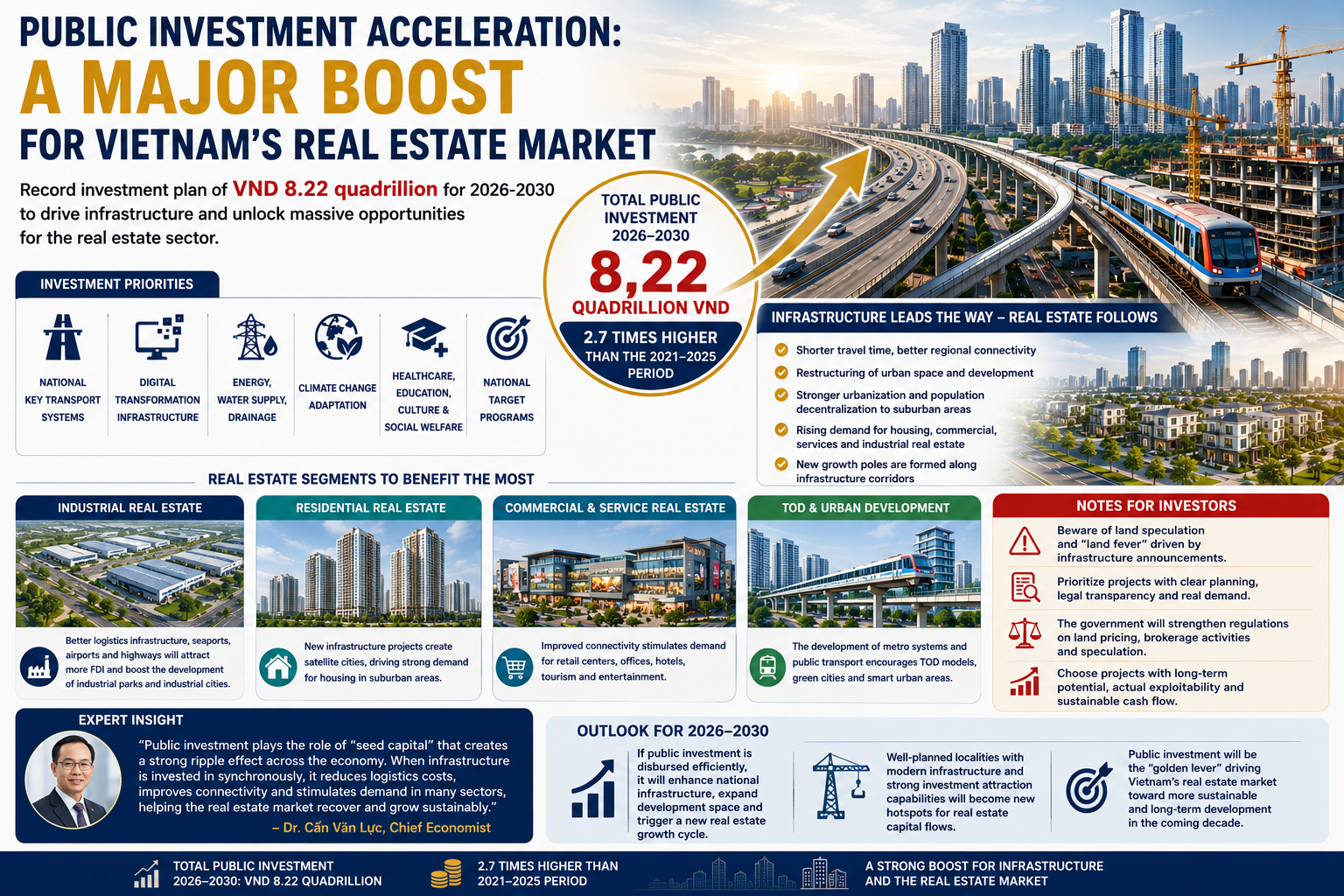
This investment scale is nearly 2.7 times larger than the 2021-2025 period, representing the largest public investment package in Vietnam’s history. Economists believe the unprecedented capital injection will not only accelerate the development of national infrastructure but also create enormous opportunities for real estate growth across multiple segments.
According to many experts, whenever infrastructure is upgraded in a synchronized manner, the real estate sector is usually among the first industries to benefit. Highways, ring roads, metro systems, airports, and seaports do more than reduce travel time — they reshape urban development patterns, expand economic corridors, and create new growth centers.
1. Vietnam Approves Its Largest-Ever Public Investment Plan
More Than VND 8.22 Quadrillion Allocated for 2026-2030
Under Resolution No. 27/2026/QH16 passed by Vietnam’s National Assembly on April 24, 2026, the country’s medium-term public investment plan for 2026-2030 is expected to reach approximately VND 8.22 quadrillion.
This marks the highest level of public investment ever approved in Vietnam and is roughly 2.7 times larger than the allocation during the 2021-2025 period.
In addition, around 10% of the central government budget will be reserved as contingency funding to address emerging tasks and unexpected challenges during implementation.
The government plans to prioritize capital allocation toward strategic infrastructure projects with strong spillover effects, including:
- National transportation networks and expressways
- Digital transformation infrastructure
- Energy and water supply systems
- Climate change adaptation projects
- Healthcare, education, and social welfare infrastructure
- National target programs
2. Infrastructure Development Creates a Powerful Push for Real Estate
Where Infrastructure Expands, Property Markets Thrive
Over the past decade, Vietnam has repeatedly demonstrated a clear pattern: wherever infrastructure improves significantly, real estate markets in those areas tend to flourish rapidly.
During the 2021-2025 period, a series of major infrastructure projects such as:
- The North-South Expressway
- Long Thành International Airport
- Ring Road 3 in Ho Chi Minh City
- Ring Road 4 in the Hanoi Capital Region
- Metro lines in Hanoi and Ho Chi Minh City
helped boost property values and increase housing supply in suburban areas and regions with improved transportation connectivity.
As infrastructure expanded, many previously underdeveloped districts quickly transformed into investment hotspots, attracting residential, commercial, and mixed-use urban projects.
3. Hanoi and Ho Chi Minh City Enter a New Urbanization Phase
Ring Roads, Metro Systems, and Expressways Fuel Satellite Cities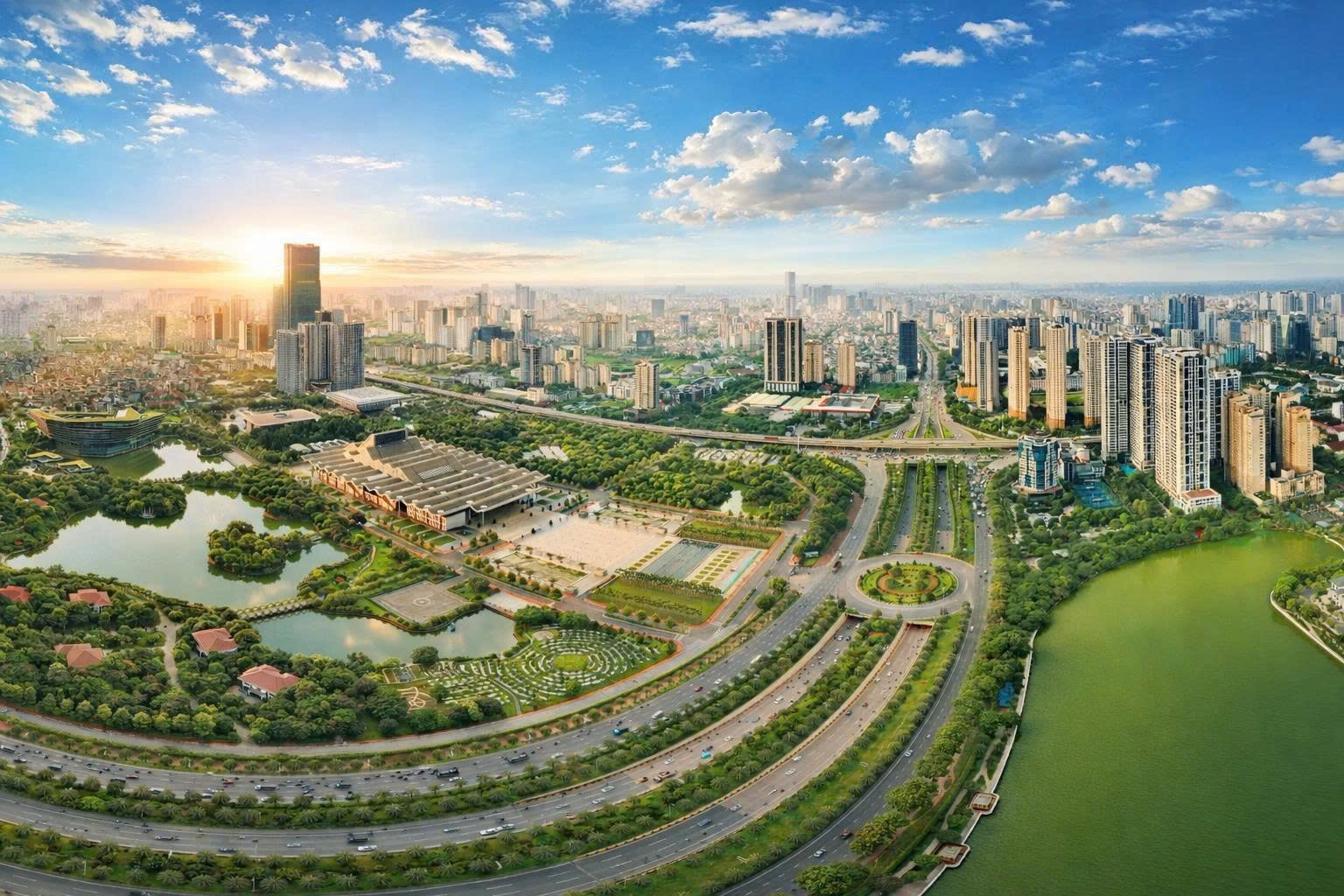
During the 2026-2030 period, the impact of public investment is expected to become even stronger as large-scale infrastructure projects continue to move forward.
In Hanoi, the development of Ring Road 4 is creating strong expectations for the western and northern districts of the capital. Areas such as:
- Hoài Đức
- Đan Phượng
- Mê Linh
- Đông Anh
are increasingly becoming destinations for large urban township developments.
Meanwhile, in southern Vietnam, ring roads and expressways connecting Ho Chi Minh City with Đồng Nai, Bình Dương, Tây Ninh, and Long An are accelerating the growth of satellite cities and suburban urban areas.
According to urban development experts, as travel time between city centers and suburban areas shortens, more residents are expected to move outward in search of better living environments and more affordable housing options.
This trend is likely to create major opportunities for residential real estate, land plots, and commercial developments in satellite urban zones.
4. Industrial Real Estate Expected to Benefit the Most
FDI and Logistics Infrastructure Support Long-Term Growth
Many experts believe industrial real estate will become the biggest beneficiary of Vietnam’s new wave of public investment.
Over the past several years, Vietnam has emerged as one of Asia’s most attractive destinations for foreign direct investment (FDI) thanks to:
- Competitive manufacturing costs
- Strategic geographic location
- Extensive free trade agreements
- Political and economic stability
The massive increase in public investment is expected to accelerate the development of:
- Regional expressways
- Seaports
- Airports
- Logistics hubs
This infrastructure expansion will create a stronger foundation for industrial parks and industrial urban areas nationwide.
According to Associate Professor Dr. Trần Kim Chung, former Deputy Director of the Central Institute for Economic Management, improved infrastructure will encourage manufacturing activities to shift toward emerging provinces rather than concentrating solely in traditional industrial centers.
As a result, provinces with abundant land reserves and strong transportation connectivity are expected to attract substantial investment flows in the coming years.
5. TOD Urban Models and Green Cities Will Expand Rapidly
Modern Infrastructure Reshapes Urban Development
One of the most important trends expected in the next decade is the rise of:
- Transit-Oriented Development (TOD)
- Green urban areas
- Smart cities
- Integrated urban townships
TOD refers to urban development models centered around public transportation systems such as metro lines and rapid transit corridors.
As metro systems, ring roads, and public transportation networks continue to improve, demand for:
- Residential housing
- Office space
- Shopping centers
- Hospitality and tourism real estate
near transportation hubs is expected to increase significantly.
This trend is considered one of the key pillars for Vietnam’s sustainable urban development strategy in the future.
6. Public Investment Becomes a “Magnet” for Real Estate Capital
Investors Prefer Areas With Clear Planning and Infrastructure
Economist Dr. Cấn Văn Lực believes public investment acts as “seed capital” that creates ripple effects across many sectors of the economy.
When infrastructure is upgraded comprehensively:
- Logistics costs decrease
- Regional connectivity improves
- Manufacturing and commerce expand
These factors stimulate demand for:
- Housing
- Offices
- Retail centers
- Tourism
- Industrial property
- Service industries
As Vietnam’s real estate market enters a restructuring phase, investment capital is increasingly flowing toward areas with:
- Transparent planning
- Strong infrastructure
- Practical commercial potential
- Long-term growth prospects
7. Experts Warn About Land Speculation Risks
Investors Should Be Cautious of Infrastructure-Driven Land Fever
Despite the enormous opportunities, experts also warn about rising speculation and land price inflation linked to infrastructure planning.
Real estate lawyer Trịnh Hữu Đức noted that property prices in areas associated with large infrastructure projects often surge rapidly, even before projects are completed or officially implemented.
This can create several negative consequences, including:
- Supply-demand imbalances
- Artificially inflated land prices
- Increased investment risks
- Social welfare challenges
To ensure sustainable market growth, experts recommend:
- Transparent planning information
- Stronger regulation of brokerage activities
- Anti-speculation measures
- Better land price management
Investors are also encouraged to focus on projects with genuine demand and long-term development potential rather than following short-term market hype.
8. Which Regions Will Benefit the Most?
Areas With Strong Infrastructure Will Attract Major Investment
According to experts, provinces and cities with:
- Well-planned urban strategies
- Modern infrastructure
- Large land reserves
- Strong investment attraction capabilities
will become key destinations for real estate capital during the next growth cycle.
Potential hotspots include:
- Hanoi and surrounding suburban districts
- Ho Chi Minh City and satellite cities
- Đồng Nai
- Bình Dương
- Long An
- Bắc Ninh
- Hải Phòng
- Quảng Ninh
These regions are already benefiting directly from major national infrastructure projects.
Outlook for Vietnam’s Real Estate Market in 2026-2030
Public Investment Expected to Become the Market’s Strongest Growth Driver
Experts generally agree that the effectiveness of public investment disbursement will play a decisive role in both economic growth and the future of Vietnam’s real estate market.
If projects are implemented on schedule and infrastructure develops in a synchronized way:
- National connectivity will improve significantly
- Urban development space will continue expanding
- The real estate market may enter a new growth cycle
On the other hand, delayed implementation or inefficient capital allocation could reduce the overall impact of public investment.
In the long term, public investment is expected to become not only a major economic recovery tool but also a “golden lever” helping Vietnam’s real estate market transition into a more sustainable development phase over the next decade.
References:
Free access to exclusive information on warehouse, factory, and land rentals in Dong Nai, Binh Duong, Long An, Ho Chi Minh City, and more.
KHU CÔNG NGHIỆP 247 is a company operating in the field of buying, selling, and leasing factories and real estate.. We are proud to be a leading provider of real estate services in Vietnam. We have a team of highly qualified and experienced real estate consultants who always place trust and credibility at the core of everything we do.
Phone: 0901 490 348
Email: datkhucongnghiep247@gmail.com
Website: datkhucongnghiep247.com.vn