
Smart operating platforms are helping industrial parks significantly reduce electricity, water, maintenance and staffing costs while shortening incident response times. One approximately 300-hectare industrial park in Northern Vietnam cut operating costs by around 18% after 12 months of using the T.SIE digital platform, while reducing incident resolution time from 24–48 hours to just 2–4 hours and raising tenant satisfaction to 94%.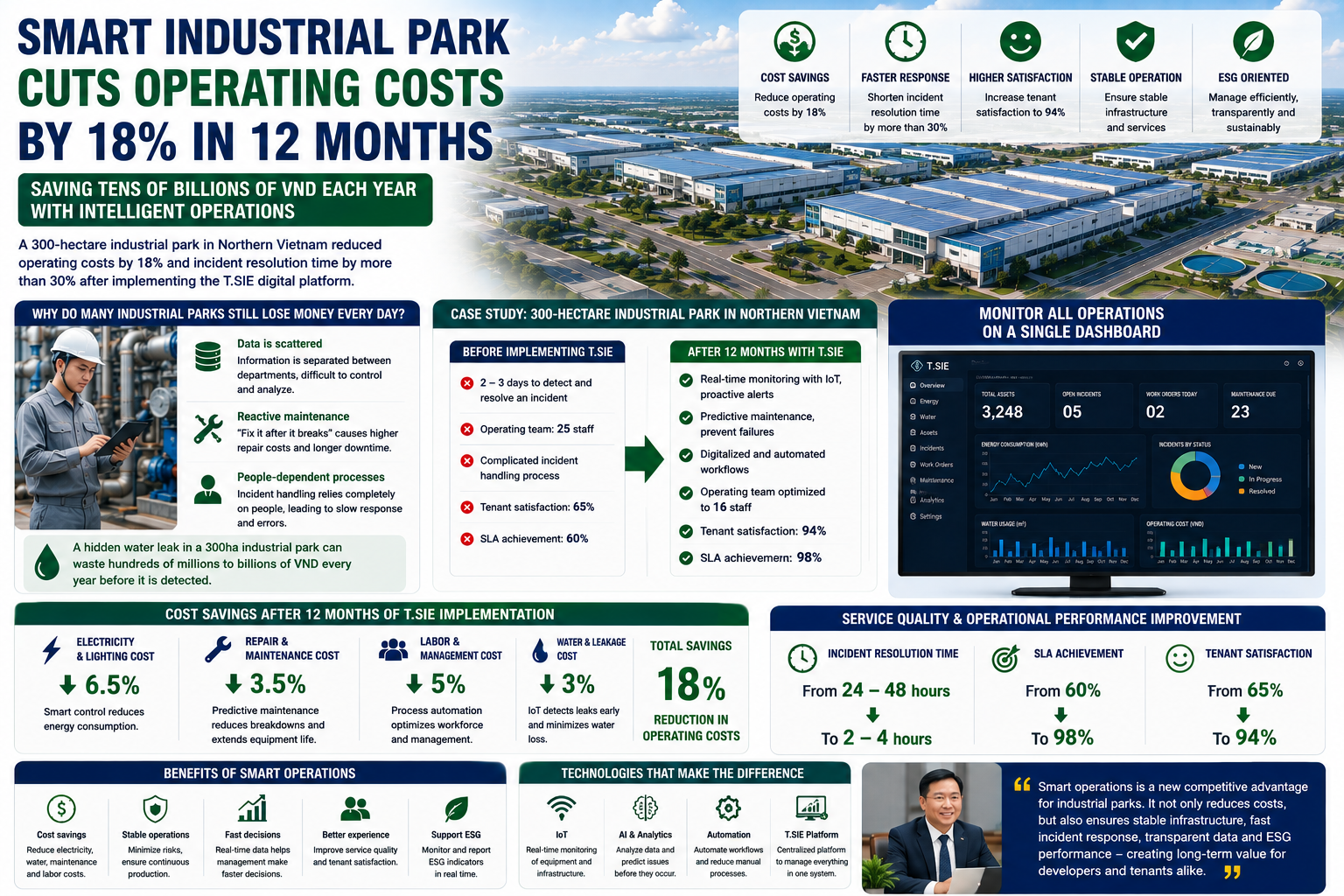
As industrial parks compete not only on rental rates and location but increasingly on service quality and infrastructure reliability, operational capability is becoming an important factor in investment decisions by foreign-invested enterprises.
An industrial park may have a strong location, competitive rents and good transport links, but if its electricity, water, lighting, security or incident-response systems are inefficient, tenants still face the risk of production disruption and higher operating costs.
This is why the concepts of smart industrial parks and digitalized industrial operations are receiving increasing attention.
Why Can Industrial Park Operating Costs Become So High?
An industrial park covering several hundred hectares may contain thousands of infrastructure assets and technical systems.
These can include:
- power substations;
- electricity distribution networks;
- water supply systems;
- drainage systems;
- lighting;
- security cameras;
- landscaping;
- pumping stations;
- wastewater treatment plants;
- internal roads;
- fire prevention systems;
- other technical equipment.
If all of these assets are still managed through spreadsheets, paperwork or disconnected software systems, the risk of cost leakage can be substantial.
The problem does not always begin with a major incident.
Many losses start with small issues that continue unnoticed for days or even months.
A Leaking Water Pipe Can Cost Hundreds of Millions of VND
In a 300-hectare industrial park, an underground water leak can be extremely difficult to detect through manual inspection.
If the leakage continues for months, losses can reach hundreds of millions of VND or more depending on severity.
Similarly, malfunctioning electrical equipment or current leakage can raise energy bills without being immediately detected by the operations team.
As an industrial park grows larger, manual inspection becomes increasingly difficult.
As a result, small losses across multiple locations can accumulate into substantial system-wide costs.
Three Major Bottlenecks in Traditional Industrial Park Operations
According to TNTech specialists, three bottlenecks are commonly found in conventional industrial park operating models.
The first is fragmented data across departments.
The technical team uses one system.
Security uses another.
Customer service, asset management and maintenance may all rely on different tools.
When these systems are disconnected, management has difficulty gaining a complete overview of the industrial park.
The second bottleneck is reactive maintenance, or the “fix it after it breaks” model.
Equipment is only repaired once a failure occurs.
This increases repair costs and the risk of operational interruptions.
The third problem is that incident-handling processes depend too heavily on people.
When an incident occurs, information often passes through several departments before reaching the responsible technician.
This slows response times significantly.
Small Losses Can Become Large Expenses at Industrial Scale
Many operating losses arise from seemingly minor issues.
For example, road lighting may continue operating at full power even when traffic has dropped sharply.
A pumping station that is not maintained on schedule may fail completely.
A leaking pipeline may waste thousands of cubic meters of water.
An electrical device operating outside normal parameters may consume excessive power continuously.
Each individual item may appear relatively small.
However, across hundreds of hectares, thousands of assets and dozens of companies operating around the clock, the cumulative effect can become enormous.
High Operating Costs Also Affect Tenants
Poor operating efficiency does not only affect the industrial park developer.
It also affects tenant companies.
An inefficient system can lead to:
- power outages;
- insufficient water supply;
- interrupted services;
- slow complaint handling;
- higher service charges;
- breaches of service-level agreements;
- disruptions to production schedules.
For manufacturers, every hour of production downtime can generate significant losses.
As a result, infrastructure reliability is becoming an increasingly important criterion in industrial park selection.
Smart Operations Are Becoming a New Competitive Advantage
For many years, industrial park competitiveness was mainly based on:
- location;
- available land;
- rental rates;
- transportation;
- labor supply.
Today, that list is expanding.
Operational capability is becoming increasingly important.
An industrial park may not offer the lowest rents but can still attract FDI tenants if it provides:
- reliable infrastructure;
- rapid incident response;
- transparent data;
- professional services;
- real-time ESG monitoring;
- real-time operating visibility.
This is an important shift in the industrial real estate market.
A 300-Hectare Industrial Park Reduced Costs by 18% in One Year
A real-world case in Northern Vietnam demonstrates the potential impact of smart operations.
The industrial park covers approximately 300 hectares and had been operating for around eight years.
Before adopting a digital operating platform, many processes were still handled conventionally.
An incident such as an underground water leak or lighting failure could take two to three days to detect and fully resolve.
The operating team consisted of 25 employees across technical operations, security and customer service.
Even with that staffing level, the team regularly faced overload.
Tenant Satisfaction Was Only Around 65%
The previous complaint-handling process involved multiple intermediate steps.
A tenant reported an issue.
The service team received the information.
The case was verified and then transferred to the technical team.
Only after that would an inspection and repair begin.
This lengthy process contributed to tenant satisfaction of only around 65%.
That was a concern because FDI companies typically expect high service quality and fast response times.
T.SIE Was Introduced to Address Operational Bottlenecks
To address these issues, the industrial park management board implemented the T.SIE smart operations platform.
After approximately 12 months of official operation, several key performance indicators improved significantly.
The platform centralized operational data within one system.
Managers could monitor many infrastructure components from a single screen.
Instead of being fragmented across departments, information became digitized and connected.
Smart Control Optimizes Industrial Park Lighting
Electricity is one of the largest operating expenses for industrial parks.
Internal road lighting may operate for thousands of hours each year.
If all lights remain at the same power level regardless of actual conditions, electricity consumption can be unnecessarily high.
Smart operations allow lighting to be adjusted according to:
- time;
- location;
- traffic volume;
- actual operating conditions.
This can reduce energy use while maintaining safety.
Electricity and Lighting Costs Fell by 6.5%
After T.SIE was implemented, electricity and lighting costs reportedly fell by approximately 6.5%.
This was the largest single category of savings.
If an industrial park spends tens of billions of VND annually on electricity, even a single-digit percentage reduction can translate into substantial savings.
This is why energy management is one of the most important applications of smart industrial park technology.
IoT Helps Detect Electricity and Water Leaks Earlier
A key element of smart operations is IoT-based monitoring.
Sensors can track:
- water flow;
- pressure;
- electricity consumption;
- equipment status;
- temperature;
- other operating indicators.
When data moves beyond normal thresholds, the system can generate immediate alerts.
This allows problems to be detected before they become more serious.
Water and Leakage Costs Fell by Around 3%
Through continuous monitoring, water-related costs and leakage reportedly decreased by approximately 3%.
The savings came from earlier leak detection and tighter control of the water supply network.
In an industrial park with tens of kilometers of pipelines, data-driven monitoring offers a major advantage over visual inspection.
Predictive Maintenance Reduces Repair Costs
Another important change is the shift from reactive maintenance toward predictive maintenance.
The conventional model works like this:
equipment fails → failure is detected → repairs begin.
Smart operations allow a different model:
data is monitored → abnormal signals are identified → maintenance is performed before a failure occurs.
This approach reduces the risk of emergency repairs.
Repair and Maintenance Costs Fell by 3.5%
After smart operations were introduced, repair and maintenance costs reportedly fell by approximately 3.5%.
The savings were not limited to materials.
They also included:
- reduced equipment downtime;
- lower emergency labor costs;
- fewer full equipment replacements;
- longer asset life.
This is one of the major benefits of predictive maintenance.
The Operating Team Was Reduced from 25 to 16 People
Before digitalization, the industrial park required 25 employees to carry out many manual tasks.
After greater automation, the optimized operating workforce reportedly fell to around 16 people.
This represents a significant reduction in staffing requirements.
However, the important point is that this was not simply a mechanical workforce cut.
Many repetitive tasks were automated, allowing staff to focus on higher-value activities.
Staffing and Management Costs Fell by Around 5%
Automation and process optimization reportedly reduced staffing and management costs by approximately 5%.
This became another important component of total savings.
For a large industrial park, the cost of technical staff, security personnel and service teams can be substantial.
Optimizing workforce structure can therefore lower costs while maintaining service quality.
Total Operating Costs Fell by Approximately 18%
Across the four main cost categories:
- electricity and lighting;
- repair and maintenance;
- staffing and management;
- water and leakage;
the industrial park recorded an overall reduction of approximately 18% in operating costs after one year.
That is a significant level of savings.
For an industrial park with annual operating expenses in the hundreds of billions of VND, an 18% reduction could potentially translate into tens of billions of VND.
Incident Resolution Time Fell from 24–48 Hours to 2–4 Hours
One of the most dramatic improvements was not purely financial.
It was response speed.
Previously, an incident could take 24–48 hours to resolve.
After digitalization, the process was reduced to approximately 2–4 hours.
That is a major improvement.
For manufacturers, incident resolution speed has a direct impact on production continuity.
SLA Compliance Rose from 60% to 98%
SLA refers to the service-level commitments between an industrial park operator and its tenants.
Before smart operations were introduced, SLA achievement stood at around 60%.
After digitalization, that figure reportedly increased to 98%.
This shows that the system did not merely reduce costs.
It also significantly improved service quality.
That is particularly important when industrial parks are targeting multinational companies.
Tenant Satisfaction Increased to 94%
After 12 months, tenant satisfaction reportedly rose from around 65% to 94%.
The improvement was driven by several factors:
- faster responses;
- greater transparency;
- better incident handling;
- more stable services;
- fewer disruptions.
In a competitive industrial property market, tenant experience can directly affect lease renewal and expansion decisions.
All Operations Can Be Monitored from One Screen
One of the biggest advantages of a digital platform is centralized information.
Managers can monitor:
- electricity;
- water;
- lighting;
- equipment;
- incidents;
- maintenance;
- customer requests;
through a single interface.
This completely changes the decision-making process.
Instead of relying on manually compiled reports, management can access near-real-time operational data.
Operational Decisions Become Data-Driven
In the past, many operational decisions depended primarily on the experience of technical staff.
Experience remains important.
However, access to data can significantly improve decision quality.
For example, the system can show:
- which equipment is consuming abnormal amounts of electricity;
- which areas experience frequent incidents;
- when lighting demand is low;
- which pipelines show signs of leakage;
- which assets require maintenance.
This allows management to allocate resources more accurately.
IoT Shifts Maintenance from Reactive to Proactive
In conventional systems, technicians often only become aware of an issue after tenants report it or equipment stops functioning.
IoT reverses this sequence.
The system can identify abnormal conditions before users notice them.
This enables technical teams to move toward proactive maintenance.
That is one of the clearest differences between traditional and smart industrial parks.
Smart Operations Help Protect Tenant Revenue
One benefit that is often overlooked is the protection of tenant revenue.
If electricity, water or other essential infrastructure is interrupted, production lines may have to stop.
The resulting losses are not limited to service costs.
They may include:
- lost output;
- delayed orders;
- higher labor costs;
- reputational damage;
- contractual penalties.
Reliable infrastructure therefore creates economic value far beyond the direct savings achieved by the industrial park operator.
FDI Companies Increasingly Care About Operational Quality
Multinational companies typically conduct detailed assessments before selecting an industrial park.
Beyond location and rents, they may evaluate:
- electricity reliability;
- water quality;
- incident response time;
- security standards;
- data reporting capability;
- ESG systems;
- support services.
A digitalized industrial park can provide clearer evidence of service quality.
That can be a meaningful competitive advantage.
Transparent Data Supports ESG Requirements
ESG is becoming an increasingly common requirement for international businesses.
To meet ESG standards, companies need data.
They must measure:
- energy;
- water;
- emissions;
- waste;
- operating efficiency.
A smart industrial park can provide this information more consistently and transparently.
This helps tenants meet reporting requirements from parent companies and international partners.
Smart Industrial Parks Can Attract Higher-Quality Tenants
In a competitive market, reducing rents is not always the best strategy.
An industrial park may be able to maintain higher rents if it provides superior services.
Companies may be willing to pay more in exchange for:
- fewer incidents;
- more stable operations;
- better data;
- faster response times.
This can help developers improve the overall quality of their tenant mix.
Digital Transformation Is More Than Buying Software
An important point is that industrial park digital transformation is not simply about purchasing a software platform.
It requires changes to the entire management model.
Typical steps may include:
- standardizing asset data;
- integrating systems;
- installing IoT sensors;
- digitizing workflows;
- establishing SLA frameworks;
- training staff;
- building dashboards;
- applying data analytics.
If only one part is implemented, the expected benefits may not be achieved.
Asset Data Is the Foundation of Smart Operations
To manage an industrial park effectively, the operator must first know exactly what assets it owns and operates.
Each asset should have information such as:
- location;
- age;
- technical specifications;
- maintenance history;
- consumption levels;
- current condition.
Once this data is standardized, the system can support analytics and forecasting.
This is a foundational step that is often underestimated.
Predictive Maintenance Can Extend Equipment Life
Equipment rarely fails without warning.
Before a breakdown, there may be signs such as:
- rising temperature;
- unusual vibration;
- higher electricity consumption;
- pressure loss.
If the system captures these signals, technicians can intervene early.
This not only reduces breakdowns but can also extend asset life.
Automation Reduces Human Error
People remain essential to industrial park operations.
However, repetitive manual tasks are more vulnerable to mistakes.
Examples include:
- forgetting to switch equipment off;
- missing maintenance schedules;
- sending requests to the wrong department;
- incomplete record keeping.
Automation helps reduce these errors.
Staff can then focus on tasks that require judgment and technical expertise.
Digital Platforms Standardize Tenant Services
When a tenant submits a request through the platform, the entire process can be recorded.
From initial submission to assignment and final resolution, data is captured.
This allows the operator to measure:
- response time;
- resolution time;
- on-time completion rate;
- service quality.
This provides the foundation for professional SLA management.
Developers Can Monitor Costs in Near Real Time
In traditional operations, cost reports are often compiled at the end of the month.
By the time abnormal costs are identified, the underlying issue may have continued for weeks.
With digital operations, data can be updated much more frequently.
Management can quickly identify:
- unusual electricity consumption;
- water loss;
- excessive equipment use;
- rising maintenance expenses.
The ability to respond early is one of the main reasons smart operations can reduce losses.
The Larger the Industrial Park, the Greater the Value of Digitalization
In a small industrial park, many tasks may still be manageable manually.
But once the site expands to hundreds of hectares and includes thousands of assets, the manual model becomes difficult to scale.
Staffing costs rise.
Visibility decreases.
The risk of mistakes increases.
The benefits of digitalization therefore tend to increase with the scale and complexity of the industrial park.
Smart Operations Could Become the New Standard
In the future, data-driven industrial park management may no longer be a special advantage.
It could become a standard requirement.
Just as green buildings are becoming increasingly common, digital operating platforms may eventually become a baseline expectation for international tenants.
Industrial parks that fail to modernize could become less competitive.
Smart Industrial Parks Align with Smart Manufacturing
Manufacturers are increasingly adopting:
- robotics;
- IoT;
- AI;
- ERP;
- automation systems.
If a smart factory is located inside an industrial park that is still managed manually, the technology gap will become increasingly obvious.
Industrial parks therefore need to transform as well.
A smart industrial ecosystem requires both smart factories and smart infrastructure.
Digital Operations Can Support Long-Term Capital Planning
Operational data is not only useful for daily management.
It can also support long-term investment planning.
For example, multi-year data can reveal:
- which areas are regularly overloaded;
- which equipment should be replaced;
- how fast electricity demand is growing;
- whether the water system has sufficient capacity.
This allows developers to make more accurate investment decisions.
The 18% Savings Did Not Come from Mechanical Cost Cutting
One important aspect of the 300-hectare case is that the savings did not result from simply reducing investment or cutting staff mechanically.
They came from changing the management model.
Electricity was used more efficiently.
Water was monitored more effectively.
Equipment was maintained at the right time.
Staff were deployed more productively.
This is the difference between cutting costs and optimizing costs.
Lower Costs While Improving Service Quality
Normally, lower costs can mean lower service quality.
Smart operations can make the opposite possible.
In the case described:
- operating costs fell by 18%;
- SLA performance rose to 98%;
- incident resolution time dropped sharply;
- tenant satisfaction increased to 94%.
This shows that digitalization can improve both financial performance and customer experience at the same time.
Every Percentage Point of Savings Matters at Industrial Park Scale
Assume an industrial park spends VND 100 billion per year on operations.
An 18% reduction would equal approximately VND 18 billion in savings.
If annual operating costs are even higher, the savings could be substantially larger.
That is why the idea of “saving tens of billions of VND every year” is realistic for large industrial parks.
Actual savings, of course, depend on the cost structure and starting condition of each project.
ROI Must Be Calculated for Each Industrial Park
Smart operating systems also require investment.
Developers need to assess return on investment based on:
- platform costs;
- IoT sensors;
- system integration;
- training;
- technology maintenance.
These costs should then be compared with:
- operating savings;
- fewer incidents;
- staffing efficiencies;
- improved services;
- stronger tenant attraction.
If the ROI is attractive, digitalization can become a strategic investment rather than simply an IT expense.
Real-Time Data Changes How Industrial Parks Are Managed
In the traditional model, managers often receive reports after events have already happened.
In a digital model, data can be updated in near real time.
This changes management from reactive to proactive.
That is the core value of smart operations.
Modern Industrial Parks Need Both Good Infrastructure and Good Operations
An industrial park can have modern infrastructure but still create problems for tenants if it is poorly operated.
Conversely, infrastructure managed through data can maintain better performance throughout its lifecycle.
Industrial park quality therefore needs to be evaluated from two perspectives:
build well and operate well.
Smart Operations Could Affect Industrial Real Estate Valuation
In the future, operational intelligence may also influence asset values.
An industrial park with:
- lower operating costs;
- satisfied tenants;
- high SLA performance;
- transparent data;
- strong ESG performance;
may command a higher market value.
This is similar to how green certifications are already affecting the valuation of offices and factories.
The New Industrial Park Competition Is About Operational Efficiency
Vietnam’s industrial real estate market is entering a new competitive phase.
Supply continues to grow.
Tenants are becoming more sophisticated.
FDI is shifting toward higher quality.
In that environment, low rents are no longer the only differentiator.
Industrial parks capable of delivering reliable infrastructure, fast service and transparent data will have a stronger competitive position.
Smart Operations Could Strengthen the Competitiveness of Vietnam’s Industrial Parks
The case of a 300-hectare industrial park reducing operating costs by approximately 18% after 12 months illustrates the potential of digital transformation.
Electricity costs fell 6.5%.
Repair costs fell 3.5%.
Staffing costs fell 5%.
Water and leakage costs fell 3%.
Incident resolution time dropped from 24–48 hours to 2–4 hours.
SLA performance rose from 60% to 98%.
Tenant satisfaction increased to 94%.
These figures show that smart operations are not merely a technology project.
They represent a new management model.
Smart Industrial Parks Could Become Part of Next-Generation FDI Infrastructure
As Vietnam shifts toward attracting high-tech FDI, industrial infrastructure must also evolve.
International investors increasingly expect:
- stable operations;
- real-time data;
- ESG compliance;
- energy efficiency;
- rapid incident response;
- professional services.
Smart industrial parks could therefore become one of the foundations supporting Vietnam’s competitiveness in the next generation of FDI.
In the era of smart manufacturing, an industrial park’s advantage no longer comes only from location or rent.
Its ability to operate efficiently every day, reduce costs for the developer and ensure stable production for tenants is increasingly becoming the true differentiator.
References:
Free access to exclusive information on warehouse, factory, and land rentals in Dong Nai, Binh Duong, Long An, Ho Chi Minh City, and more.
KHU CÔNG NGHIỆP 247 is a company operating in the field of buying, selling, and leasing factories and real estate.. We are proud to be a leading provider of real estate services in Vietnam. We have a team of highly qualified and experienced real estate consultants who always place trust and credibility at the core of everything we do.
Phone: 0901 490 348
Email: datkhucongnghiep247@gmail.com
Website: https://industrialland.com.vn/en