
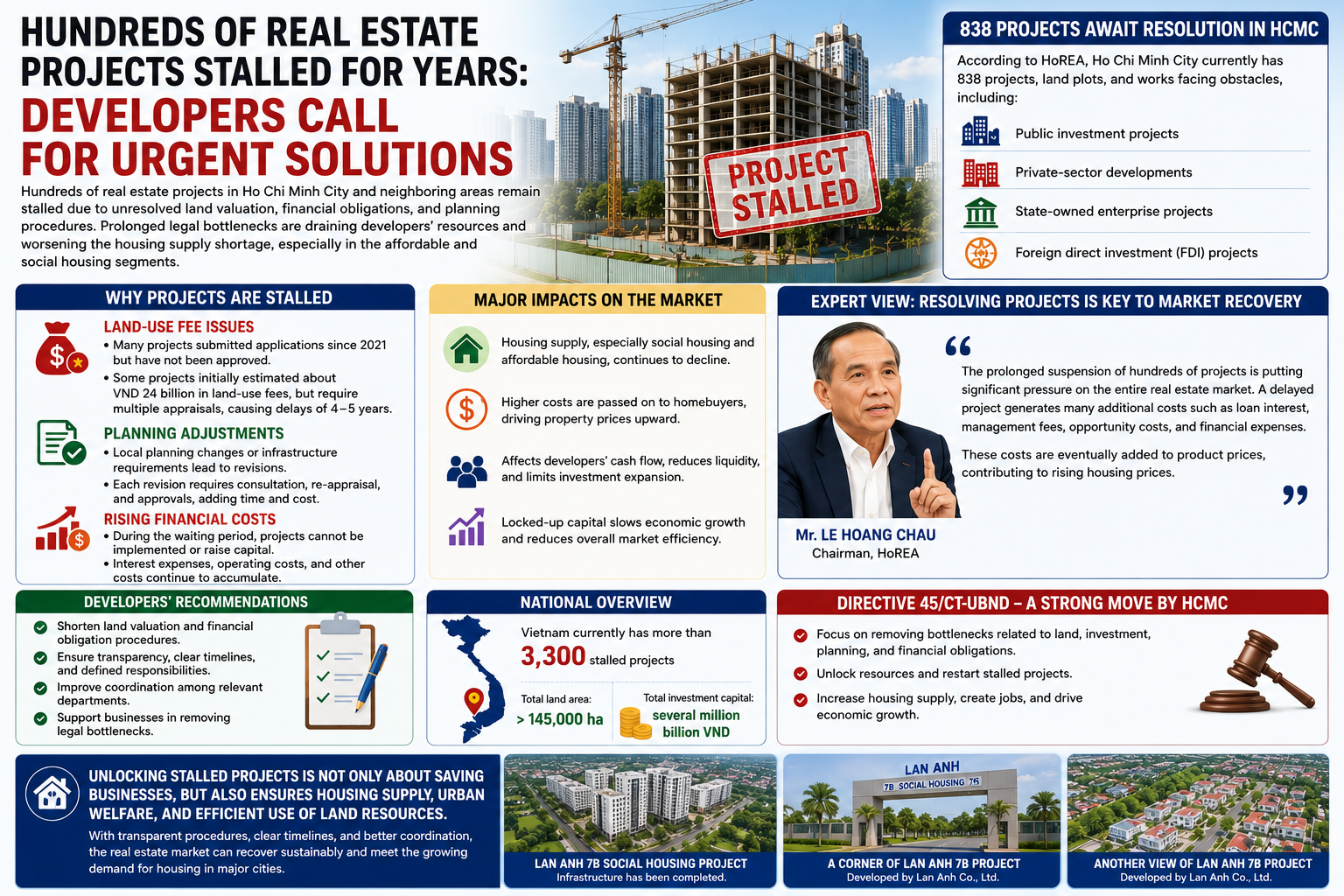
Hundreds of real estate projects in Ho Chi Minh City and neighboring areas remain stalled due to unresolved land valuation, financial obligations, and planning procedures. Industry experts warn that prolonged legal bottlenecks are not only draining developers’ financial resources but also worsening the housing supply shortage, particularly in the affordable and social housing segments.
838 Real Estate Projects Await Resolution in Ho Chi Minh City
At a recent conference implementing Directive 45/CT-UBND issued by the Ho Chi Minh City People’s Committee on resolving long-delayed projects, many real estate developers once again highlighted the ongoing challenges caused by prolonged legal procedures.
According to the Ho Chi Minh City Real Estate Association (HoREA), the city currently has 838 projects, land plots, and construction works facing obstacles that require urgent resolution. These include:
- Public investment projects
- Private-sector developments
- State-owned enterprise projects
- Foreign direct investment (FDI) projects
The large number of stalled developments represents significant economic resources that remain locked and underutilized.
Developers Do Not Avoid Financial Obligations, but Fear Endless Procedures
One of the companies most actively calling for solutions is Lan Anh Company Limited.
Speaking at the conference, Ms. Nguyen Nam Phuong, Chairwoman and CEO of Lan Anh Company, emphasized that developers are not trying to avoid financial obligations to the government. Instead, their primary concern is the excessive time required to process legal documents.
According to Ms. Phuong, several projects submitted land-use fee determination applications as early as 2021 but have yet to receive final approval. In some cases, projects initially estimated to owe approximately VND 24 billion in land-use fees had to undergo multiple rounds of appraisal by different agencies, extending procedures by four to five years.
During this waiting period, developers are often unable to:
- Continue project construction
- Raise capital from customers
- Launch sales activities
- Recover invested capital
Meanwhile, interest expenses, operating costs, and infrastructure maintenance costs continue to accumulate.
Rising Land Values Increase Financial Pressure
Many developers report that their projects are funded entirely by private capital.
They have already:
- Negotiated land acquisition with residents
- Built transportation infrastructure
- Completed technical infrastructure systems
However, as infrastructure improvements increase land values, developers worry that revised land valuations may significantly raise their financial obligations.
Some projects have nearly completed internal infrastructure but remain suspended while awaiting final land valuation approvals.
This situation ties up large amounts of capital, reduces investment efficiency, and increases liquidity pressure.
Planning Adjustments Create Additional Delays
Beyond land valuation issues, many projects face delays due to planning adjustments required by changing urban development strategies and infrastructure requirements.
Each planning revision often requires developers to:
- Hire consulting firms
- Seek approval from multiple agencies
- Reassess project documentation
- Await official approvals
These additional procedures increase costs and further delay project implementation.
Affordable Housing Supply Continues to Decline
According to Lan Anh Company’s proposals, the developer is currently seeking solutions for eight projects covering hundreds of hectares, including:
- Social housing developments
- Affordable housing projects
- Residential communities serving genuine housing demand
The prolonged delays are directly reducing housing supply in a market where demand remains extremely strong.
Other developers, including Hoang Quan Real Estate Corporation, have reported similar difficulties, particularly with social housing projects that have remained frozen for years due to lengthy legal procedures.
Financial Costs Continue to Push Housing Prices Higher
According to Mr. Le Hoang Chau, Chairman of HoREA, the continued suspension of hundreds of projects is creating substantial pressure across the real estate market.
When projects are delayed for years, developers face numerous additional expenses, including:
- Bank loan interest
- Administrative costs
- Opportunity costs
- Operational expenses
- Financial management costs
Ultimately, these expenses are incorporated into product pricing, contributing to rising housing costs.
This is considered one of the key reasons why property prices in major Vietnamese cities have remained elevated for many years.
Legal Overlaps Remain the Biggest Bottleneck
HoREA identifies overlapping regulations related to:
- Land administration
- Investment procedures
- Urban planning
- Construction regulations
- Financial obligations
as one of the primary causes of project delays.
A single project often requires multiple rounds of review by different agencies before receiving final approval.
In many cases, land valuation procedures alone can take between three and five years.
This makes it difficult for developers to:
- Plan finances accurately
- Estimate investment costs
- Secure funding
- Develop long-term business strategies
Unlocking Stalled Projects Is Essential for Market Recovery
According to HoREA, Vietnam currently has more than 3,300 delayed projects, covering over 145,000 hectares and representing investments worth trillions of Vietnamese dong.
In Ho Chi Minh City alone, resolving stalled projects could:
- Increase housing supply
- Create jobs
- Unlock investment capital
- Boost government revenue
- Support economic growth
Directive 45/CT-UBND is expected to become an important policy tool for removing bottlenecks related to land, investment, planning, and financial obligations.
Developers Seek Transparency and Predictable Timelines
Many businesses argue that the market does not need special incentives but rather:
- Transparent procedures
- Consistent regulations
- Stable policies
- Clearly defined processing timelines
When administrative processes become more predictable and responsibilities are clearly assigned among agencies, developers can better manage cash flow, control costs, and accelerate project implementation.
Outlook for Vietnam’s Real Estate Market in 2026
As housing demand in Ho Chi Minh City and other major urban centers remains strong, resolving long-delayed projects is not only critical for developers but also essential for balancing supply and demand.
If legal bottlenecks are effectively addressed, hundreds of projects could resume construction, significantly increasing housing supply—particularly in the affordable and social housing segments.
This would help support a more sustainable recovery of Vietnam’s real estate market while contributing to urban development, social welfare, and more efficient use of land resources in the years ahead.
References:
Free access to exclusive information on warehouse, factory, and land rentals in Dong Nai, Binh Duong, Long An, Ho Chi Minh City, and more.
KHU CÔNG NGHIỆP 247 is a company operating in the field of buying, selling, and leasing factories and real estate.. We are proud to be a leading provider of real estate services in Vietnam. We have a team of highly qualified and experienced real estate consultants who always place trust and credibility at the core of everything we do.
Phone: 0901 490 348
Email: datkhucongnghiep247@gmail.com
Website: datkhucongnghiep247.com.vn