

Vietnam’s Tax Authority has released detailed guidance on tax declaration and payment procedures for individuals and households earning income from real estate rental activities. The new regulations aim to simplify tax administration, encourage compliance, and improve transparency in the rapidly growing property rental market.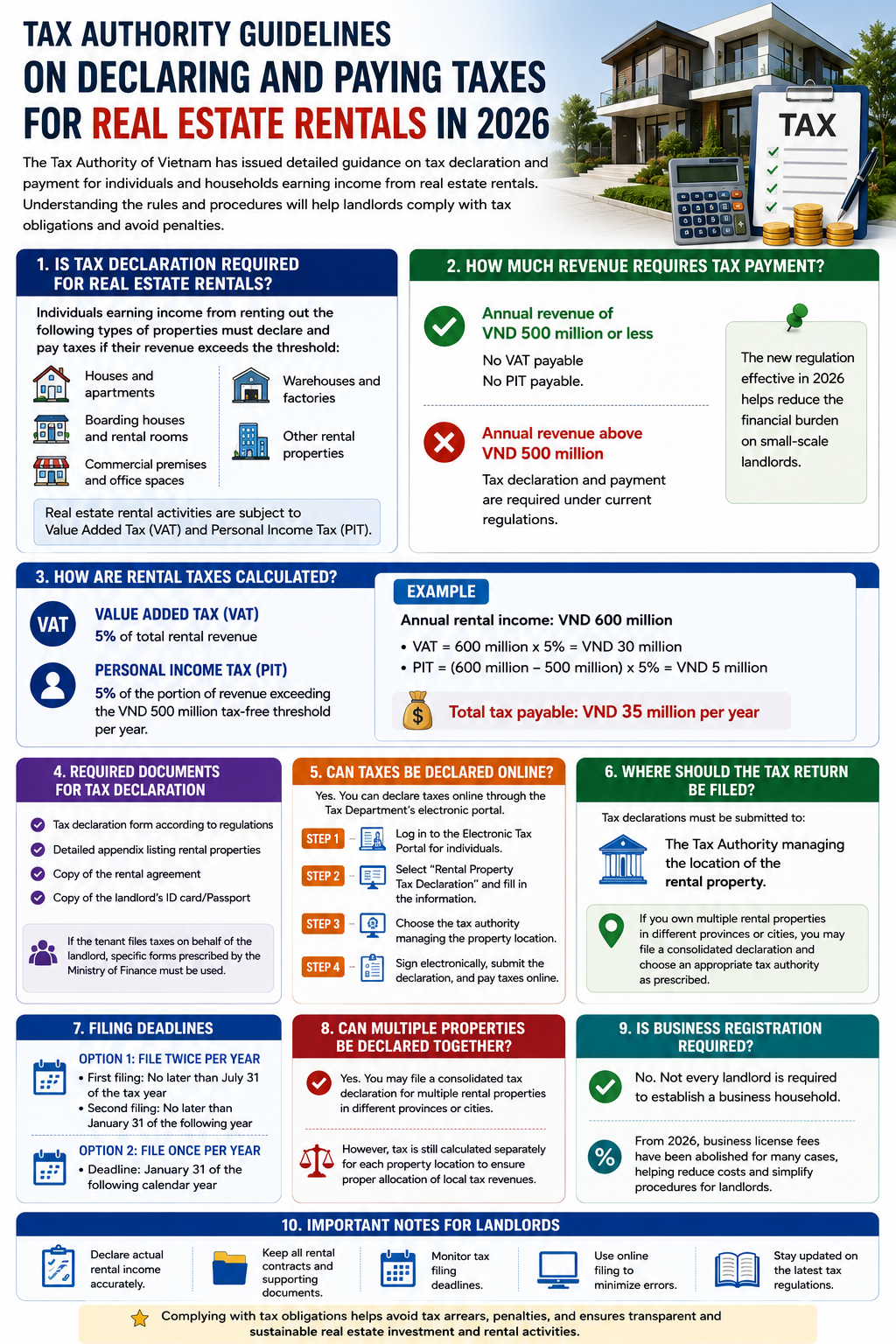
As Vietnam’s real estate sector continues to expand, rental properties such as apartments, houses, office spaces, warehouses, and commercial premises have become important sources of income for many individuals. Understanding tax obligations is therefore essential to avoid legal risks, penalties, and unexpected tax liabilities.
Real Estate Rental Activities Subject to Taxation
According to the latest guidance from the Tax Authority, individuals generating income from leasing or renting out real estate assets are required to declare taxes when their annual rental revenue exceeds the prescribed threshold.
Taxable rental assets include:
- Residential houses
- Apartments and condominiums
- Boarding houses and rental rooms
- Commercial premises
- Office buildings
- Warehouses
- Factories and industrial facilities
- Other real estate properties generating rental income
The applicable taxes generally include:
Value Added Tax (VAT)
and
Personal Income Tax (PIT)
The regulations apply to both long-term and short-term rental agreements.
Revenue Threshold for Tax Liability
One of the most significant updates is the revenue threshold used to determine tax obligations.
Annual rental revenue of VND 500 million or less
Individuals whose total rental revenue does not exceed VND 500 million per year are exempt from both:
- Value Added Tax (VAT)
- Personal Income Tax (PIT)
This exemption is intended to support small-scale landlords and reduce administrative burdens.
Annual rental revenue above VND 500 million
When total rental income exceeds VND 500 million annually, taxpayers are required to declare and pay taxes according to current regulations.
The threshold is calculated based on total revenue generated from all rental contracts during the tax year.
How Rental Property Taxes Are Calculated
The Tax Authority has clarified the tax rates applicable to rental income.
Value Added Tax (VAT)
VAT is calculated at:
5% of total rental revenue
Personal Income Tax (PIT)
PIT is calculated at:
5% of taxable rental income
Example
If a landlord earns:
VND 600 million per year
from leasing a property:
- VAT = VND 600 million × 5% = VND 30 million
- PIT = Taxable portion according to applicable regulations
The total tax payable will depend on the final assessment by the tax authority based on declared revenue and supporting documentation.
Required Documents for Tax Declaration
Individuals filing rental-property taxes must prepare a complete dossier that typically includes:
Tax declaration form
The official declaration form issued by the Ministry of Finance.
Property rental schedule
A detailed appendix listing rental properties and associated revenues.
Rental contract
A copy of the signed lease agreement between landlord and tenant.
Identification documents
A copy of the landlord’s Citizen Identification Card or Passport.
Additional documentation may be requested depending on the specific circumstances of the rental arrangement.
Online Tax Declaration System
Vietnam continues to accelerate digital transformation within its tax administration system.
To facilitate compliance, landlords are encouraged to use the electronic tax portal.
Benefits of online tax filing
- Faster processing times
- Reduced paperwork
- Convenient tax payment options
- Real-time status tracking
- Lower compliance costs
The online system allows taxpayers to submit declarations, calculate tax obligations, and make payments electronically without visiting tax offices.
Steps to Declare Rental Property Taxes Online
The Tax Authority recommends the following process:
Step 1
Log in to the Electronic Tax Portal for Individual Taxpayers.
Step 2
Select the category:
“Rental Property Tax Declaration”
Step 3
Provide information regarding:
- Property location
- Rental revenue
- Contract duration
- Tenant information
Step 4
Review and verify all information.
Step 5
Submit the declaration electronically.
Step 6
Complete tax payment through approved online payment channels.
Where Should Tax Returns Be Filed?
Under current regulations, tax declarations must generally be submitted to:
The Tax Authority managing the location of the rental property
This ensures local authorities can properly monitor and administer rental income within their jurisdiction.
For taxpayers owning multiple rental properties in different provinces or cities, consolidated declarations may be permitted under certain conditions.
Filing Deadlines for Rental Property Taxes
The Tax Authority allows taxpayers to choose between different declaration methods.
Semi-annual declaration
Taxpayers may submit declarations twice each year:
- First declaration: No later than July 31
- Second declaration: No later than January 31 of the following year
Annual declaration
Alternatively, taxpayers may choose to submit a single declaration covering the entire year.
The deadline is generally:
January 31 of the following calendar year
Meeting filing deadlines is important to avoid late-payment penalties and administrative sanctions.
Multiple Rental Properties and Consolidated Filing
A notable improvement in the 2026 guidance is the ability for landlords with multiple properties to simplify their filing process.
Instead of submitting separate declarations for each location, eligible taxpayers may:
File a consolidated tax declaration
covering multiple rental properties across different provinces and cities.
This change reduces paperwork while maintaining transparency in tax administration.
Is Business Registration Required?
The Tax Authority clarified that:
Not every landlord is required to establish a business household
Whether registration is required depends on the scale and nature of rental activities.
For many individual landlords, tax obligations can be fulfilled without creating a formal business entity.
Additionally, the removal of certain administrative fees in 2026 further reduces compliance costs.
Common Mistakes Landlords Should Avoid
Tax experts recommend that landlords pay close attention to several key issues.
Underreporting rental income
Failure to declare actual revenue may result in:
- Tax reassessment
- Administrative penalties
- Interest charges
Missing filing deadlines
Late submission can trigger financial penalties.
Incomplete documentation
Landlords should retain:
- Rental contracts
- Payment records
- Tax declarations
- Supporting correspondence
for future reference and inspections.
Impact on Vietnam’s Rental Property Market
Industry experts believe the updated guidance will help create a more transparent and efficient rental property market.
The new regulations are expected to:
- Improve tax compliance
- Increase state budget revenues
- Simplify administrative procedures
- Encourage digital tax management
- Enhance transparency in real estate transactions
At the same time, the exemption threshold for smaller landlords helps support individuals who rely on rental income as a supplementary source of earnings.
Conclusion
The latest guidance issued by Vietnam’s Tax Authority provides a clearer framework for declaring and paying taxes on real estate rental income. As the rental property market continues to grow, understanding and complying with tax regulations has become increasingly important for landlords.
By taking advantage of online filing systems, maintaining accurate records, and submitting declarations on time, property owners can minimize legal risks while ensuring sustainable and transparent investment activities.
References:
Free access to exclusive information on warehouse, factory, and land rentals in Dong Nai, Binh Duong, Long An, Ho Chi Minh City, and more.
KHU CÔNG NGHIỆP 247 is a company operating in the field of buying, selling, and leasing factories and real estate.. We are proud to be a leading provider of real estate services in Vietnam. We have a team of highly qualified and experienced real estate consultants who always place trust and credibility at the core of everything we do.
Phone: 0901 490 348
Email: datkhucongnghiep247@gmail.com
Website: datkhucongnghiep247.com.vn