
Vietnam’s Real Estate Market Enters a New Competitive Phase
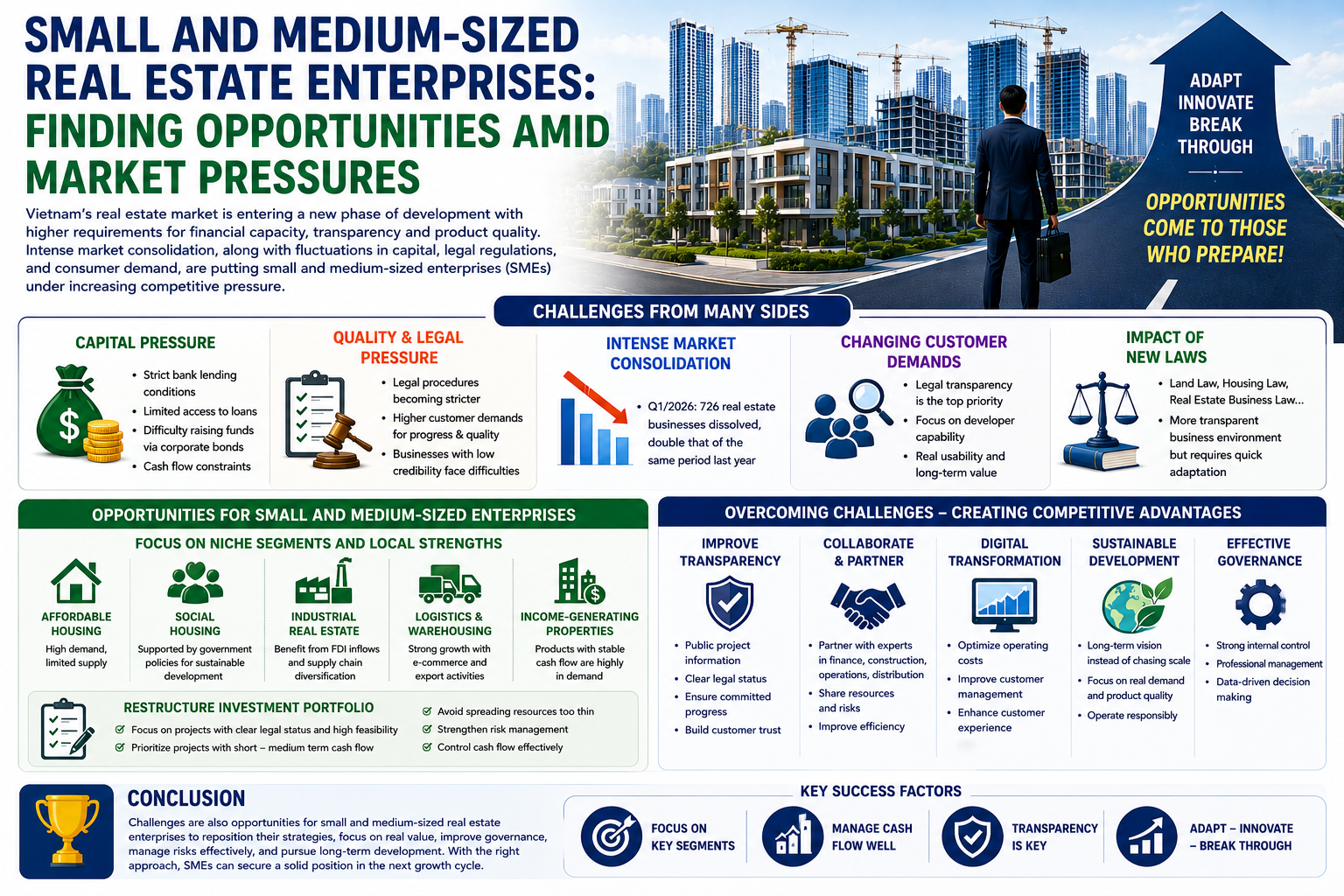
Vietnam’s real estate market is entering a new stage of development, characterized by higher requirements for financial capacity, transparency, governance, and product quality. Following a period of rapid growth and market volatility, the industry is undergoing a significant restructuring process.
In this environment, small and medium-sized real estate enterprises (SMEs) face increasing challenges but also new opportunities to reposition themselves and pursue sustainable growth.
Capital Access Remains a Major Challenge
According to official statistics, 726 real estate companies ceased operations during the first quarter of 2026, double the number recorded during the same period last year. This highlights the intense market consolidation currently taking place.
One of the biggest pressures facing SMEs is access to capital.
Many businesses continue to struggle with:
- Strict bank lending requirements.
- Incomplete project legal documentation.
- Limited financial resources.
- Difficulties raising funds through corporate bonds.
Meanwhile, investors are becoming more selective, favoring companies with strong reputations, transparent financial reporting, and projects capable of generating stable cash flow.
Customers Demand Greater Transparency and Product Quality
Following recent market fluctuations, customer expectations have changed significantly.
Homebuyers are no longer focused solely on location or potential price appreciation. Instead, they increasingly prioritize:
- Project legality and transparency.
- Developer credibility and capability.
- Construction progress.
- Long-term usability and investment value.
- Product quality.
This shift creates additional pressure on businesses that have not yet established strong brands or proven project execution capabilities.
New Legal Framework Brings Both Opportunities and Challenges
The implementation of new regulations under:
- The Land Law.
- The Housing Law.
- The Real Estate Business Law.
is helping create a more transparent business environment for the industry.
However, these regulations also require companies to quickly adapt their operations, strengthen governance, and ensure compliance with new legal standards.
Businesses that fail to adapt may face greater difficulties in project development and financing activities.
Market Consolidation Is an Inevitable Trend
Industry experts believe that the current consolidation process is a natural stage in the development of Vietnam’s real estate market.
Rather than competing through rapid expansion and scale alone, the market is increasingly emphasizing:
- Investment efficiency.
- Product quality.
- Corporate governance.
- Financial transparency.
- Risk management capability.
This trend is expected to eliminate poorly managed businesses while creating better opportunities for professional developers with long-term strategies.
SMEs Need Differentiated Strategies
In today’s competitive environment, small and medium-sized developers may find it difficult to compete directly with large corporations on massive urban projects covering hundreds of hectares.
Instead, they can focus on niche segments and local markets where they possess advantages such as:
- Better understanding of local demand.
- Strong community relationships.
- Greater operational flexibility.
- Faster decision-making processes.
These strengths often allow smaller companies to compete effectively despite limited resources.
Affordable Housing and Industrial Real Estate Offer New Opportunities
Experts believe that sectors driven by genuine market demand will continue to provide growth opportunities.
Promising segments include:
Affordable Housing
Demand for affordable homes remains significantly higher than available supply.
Social Housing
The government continues to prioritize social housing development through various support policies involving credit and land allocation.
Industrial Real Estate
This segment benefits from supply chain diversification and increasing foreign direct investment (FDI) into Vietnam.
Logistics and Warehousing
Rapid growth in e-commerce and export activities is driving demand for logistics facilities.
Income-Generating Properties
Properties capable of producing stable rental income are attracting increasing investor interest compared with purely speculative products.
Portfolio Restructuring Is Essential
In the current market environment, companies should review and restructure their investment portfolios.
Resources should be concentrated on:
- Projects with clear legal status.
- Projects capable of being launched quickly.
- Projects generating short- and medium-term cash flow.
- Products that meet genuine market demand.
At the same time, businesses should avoid spreading resources across too many projects or relying excessively on debt financing.
Transparency Has Become a Survival Factor
Customer trust is becoming one of the most valuable assets for real estate businesses.
To strengthen credibility, companies should:
- Publicly disclose project information.
- Ensure legal transparency.
- Maintain construction schedules.
- Fulfill commitments to customers.
- Improve after-sales services.
The more transparent a company is, the easier it becomes to attract customers and secure investment capital.
Collaboration Can Enhance Competitiveness
Rather than developing projects independently, SMEs can collaborate with partners that possess strengths in:
- Finance.
- Construction.
- Property management.
- Sales and distribution.
- Technology.
Strategic partnerships help reduce resource pressure, share risks, and improve investment efficiency.
Digital Transformation Is No Longer Optional
Technology adoption is becoming a critical factor for success in the real estate industry.
Digital transformation can help businesses:
- Reduce operating costs.
- Improve customer management.
- Enhance sales performance.
- Deliver better customer experiences.
- Increase transparency and efficiency.
For SMEs, embracing technology can significantly strengthen competitiveness in an increasingly demanding market.
Conclusion
The ongoing consolidation of Vietnam’s real estate market is creating unprecedented pressure on small and medium-sized enterprises. However, it also presents an opportunity for businesses to restructure, improve governance, and focus on segments driven by real demand.
Companies that successfully manage cash flow, maintain transparency, accelerate digital transformation, and pursue long-term development strategies will be well-positioned to secure a sustainable place in the next growth cycle of Vietnam’s real estate market.
References:
Free access to exclusive information on warehouse, factory, and land rentals in Dong Nai, Binh Duong, Long An, Ho Chi Minh City, and more.
KHU CÔNG NGHIỆP 247 is a company operating in the field of buying, selling, and leasing factories and real estate.. We are proud to be a leading provider of real estate services in Vietnam. We have a team of highly qualified and experienced real estate consultants who always place trust and credibility at the core of everything we do.
Phone: 0901 490 348
Email: datkhucongnghiep247@gmail.com
Website: datkhucongnghiep247.com.vn