

Real Estate Remains a Key Growth Engine for Vietnam’s Economy
At the Vietnam Real Estate Forum 2026, themed “The Real Estate Market in a New Growth Model,” policymakers, industry experts, and business leaders reaffirmed the critical role of real estate in Vietnam’s economic development.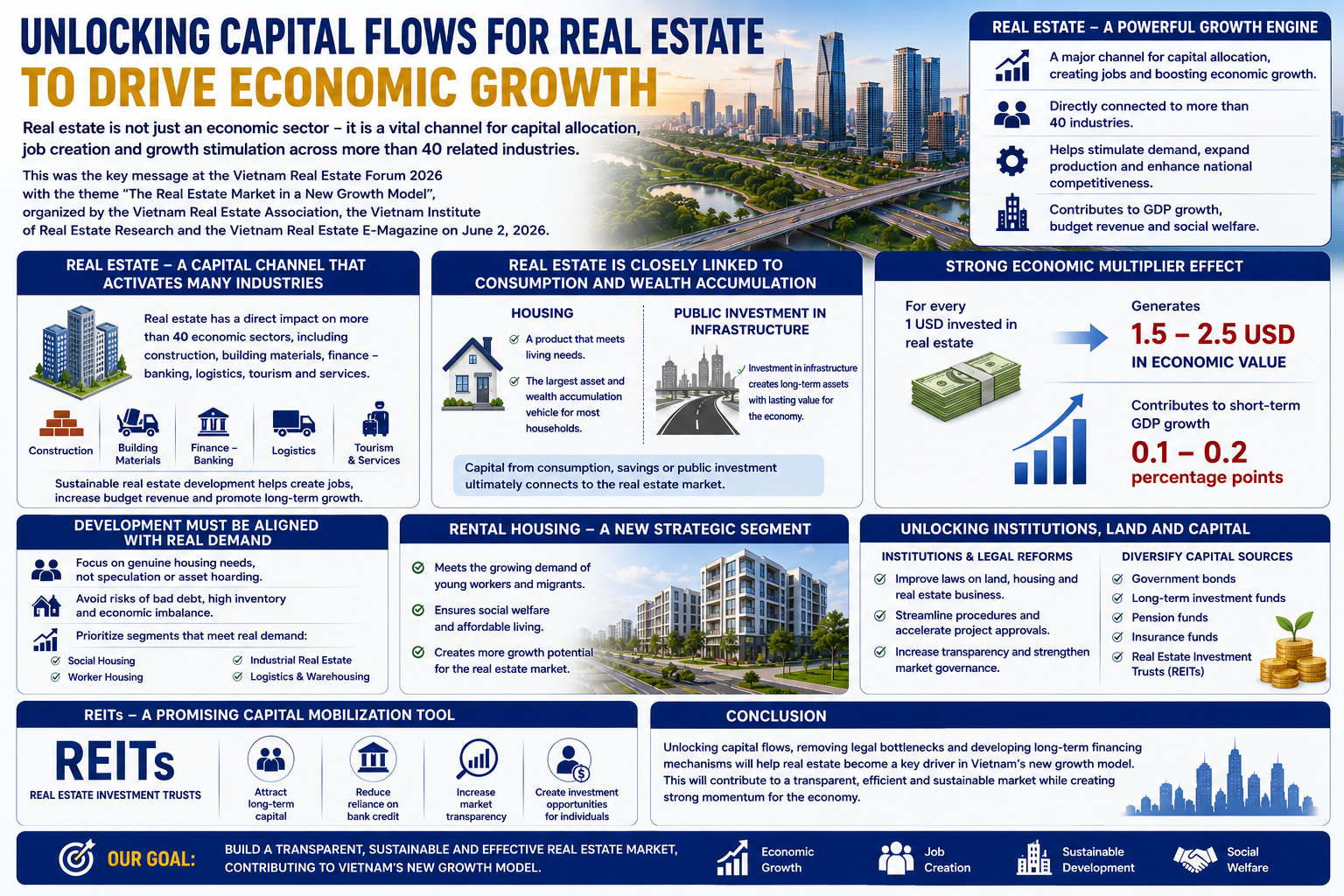
Real estate is not merely a standalone economic sector. It serves as a major channel for capital allocation, job creation, and economic stimulation across more than 40 related industries, including construction, building materials, banking, finance, logistics, tourism, and services.
As Vietnam seeks new drivers of economic growth, unlocking capital flows into the real estate sector is increasingly viewed as a strategic solution to support sustainable development.
Real Estate Creates Strong Spillover Effects Across the Economy
According to Nguyen Van Khoi, Chairman of the Vietnam Real Estate Association, the real estate sector has direct linkages with a wide range of industries.
Every real estate project generates demand and economic activity in sectors such as:
- Construction materials and steel production
- Transportation and logistics
- Banking and insurance services
- Architecture and interior design
- Retail and commercial services
As a result, a healthy and sustainable real estate market contributes significantly to overall economic growth and employment generation.
Real Estate Is Closely Linked to Consumption and Wealth Accumulation
Professor Dr. Hoang Van Cuong, Member of the 15th National Assembly and Vice Chairman of the Vietnam Economic Science Association, emphasized that real estate is deeply connected to two fundamental components of GDP: consumption and capital accumulation.
Housing serves both as:
- A consumer product meeting residential needs
- The largest asset and wealth accumulation vehicle for most households
At the same time, public investment in transportation infrastructure, industrial zones, and urban development creates long-term assets that contribute to national economic productivity.
Therefore, capital originating from consumption, savings, or public investment ultimately has strong connections to the real estate market.
Every Dollar Invested in Real Estate Can Generate Up to $2.5 in Economic Value
Research presented at the Vietnam Real Estate Forum 2026 highlighted the sector’s strong multiplier effect on the economy.
Key Economic Contributions of Real Estate
| Indicator | Value |
|---|---|
| Economic value generated by every USD invested | USD 1.5 – 2.5 |
| Contribution to short-term GDP growth | 0.1 – 0.2 percentage points |
| Related industries affected | More than 40 sectors |
These figures underscore the importance of real estate as a strategic economic growth driver.
Real Estate Development Must Focus on Genuine Demand
Experts also warned that real estate can only fulfill its role as a growth engine when it is aligned with real market demand.
If the market becomes dominated by speculation and asset hoarding rather than actual housing and business needs, capital can become trapped in unproductive assets.
Potential consequences include:
- Rising bad debts
- Increasing inventory levels
- Supply-demand imbalances
- Reduced capital efficiency
Therefore, future development should focus on demand-driven segments such as:
- Social housing
- Worker housing
- Rental housing
- Industrial real estate
- Logistics and warehouse facilities
Rental Housing Emerges as a New Strategic Segment
One of the most discussed topics at the forum was the growing importance of affordable rental housing.
According to Deputy Minister of Construction Nguyen Van Sinh, Vietnam’s rapid urbanization and expanding workforce are creating substantial demand for:
- Affordable housing
- Long-term rental apartments
- Worker accommodation near industrial parks
- Housing for foreign experts and skilled workers
The development of rental housing is expected to improve social welfare while creating new growth opportunities for the real estate market.
Removing Legal Bottlenecks and Increasing Housing Supply
To transform real estate into a sustainable growth driver, the Ministry of Construction is working closely with other ministries to improve the legal framework governing:
- Land management
- Housing development
- Real estate business activities
- Urban planning
- Social housing policies
The objective is to reduce administrative procedures, accelerate project approvals, increase housing supply, and improve market transparency.
Diversifying Capital Sources for Real Estate Development
According to Dr. Le Xuan Nghia, Member of the National Financial and Monetary Policy Advisory Council, capital remains one of the biggest challenges facing Vietnam’s real estate sector.
Rental housing and long-term real estate projects often require investment horizons of 10 to 20 years, while the banking system primarily provides short- and medium-term financing.
To address this issue, Vietnam should explore additional funding channels, including:
- Government bonds
- Long-term investment funds
- Pension funds
- Insurance funds
- Real Estate Investment Trusts (REITs)
These instruments can provide stable and sustainable financing for future development.
REITs: A Promising Capital Mobilization Tool
Real Estate Investment Trusts (REITs) are considered one of the most effective mechanisms for attracting long-term capital into the real estate sector.
Benefits of REITs include:
- Mobilizing long-term investment capital
- Reducing dependence on bank credit
- Increasing market transparency
- Expanding investment opportunities for individuals
In many developed economies, REITs play a significant role in financing rental housing, logistics facilities, and commercial real estate projects.
Vietnam is expected to gradually develop this investment model in the coming years.
Positive Outlook for Vietnam’s Real Estate Market
Experts believe that if legal, land-use, and financing challenges are addressed effectively, the real estate sector will continue to play a central role in Vietnam’s new economic growth model.
Redirecting capital toward segments that meet genuine demand—including social housing, rental housing, industrial real estate, and logistics infrastructure—will contribute to a healthier and more sustainable market.
Conclusion
Real estate is far more than a single economic sector; it is a vital link connecting investment, consumption, infrastructure development, and industrial growth. As Vietnam transitions toward a more sustainable and innovation-driven economy, unlocking capital flows, improving legal frameworks, and developing long-term financing mechanisms will be crucial to maximizing the sector’s economic contribution. These efforts will help create a more transparent, efficient, and resilient real estate market while supporting Vietnam’s long-term growth ambitions.
References:
Free access to exclusive information on warehouse, factory, and land rentals in Dong Nai, Binh Duong, Long An, Ho Chi Minh City, and more.
KHU CÔNG NGHIỆP 247 is a company operating in the field of buying, selling, and leasing factories and real estate.. We are proud to be a leading provider of real estate services in Vietnam. We have a team of highly qualified and experienced real estate consultants who always place trust and credibility at the core of everything we do.
Phone: 0901 490 348
Email: datkhucongnghiep247@gmail.com
Website: datkhucongnghiep247.com.vn