

Vietnam shifts toward next-generation FDI: Not just capital, but technology, capabilities, and value creation
As competition for foreign direct investment becomes increasingly intense, Vietnam is sending a clear message about its next-generation FDI strategy: the country is no longer focused solely on attracting registered capital volume, but is shifting toward investment quality, innovation, technology transfer, and stronger integration with domestic enterprises.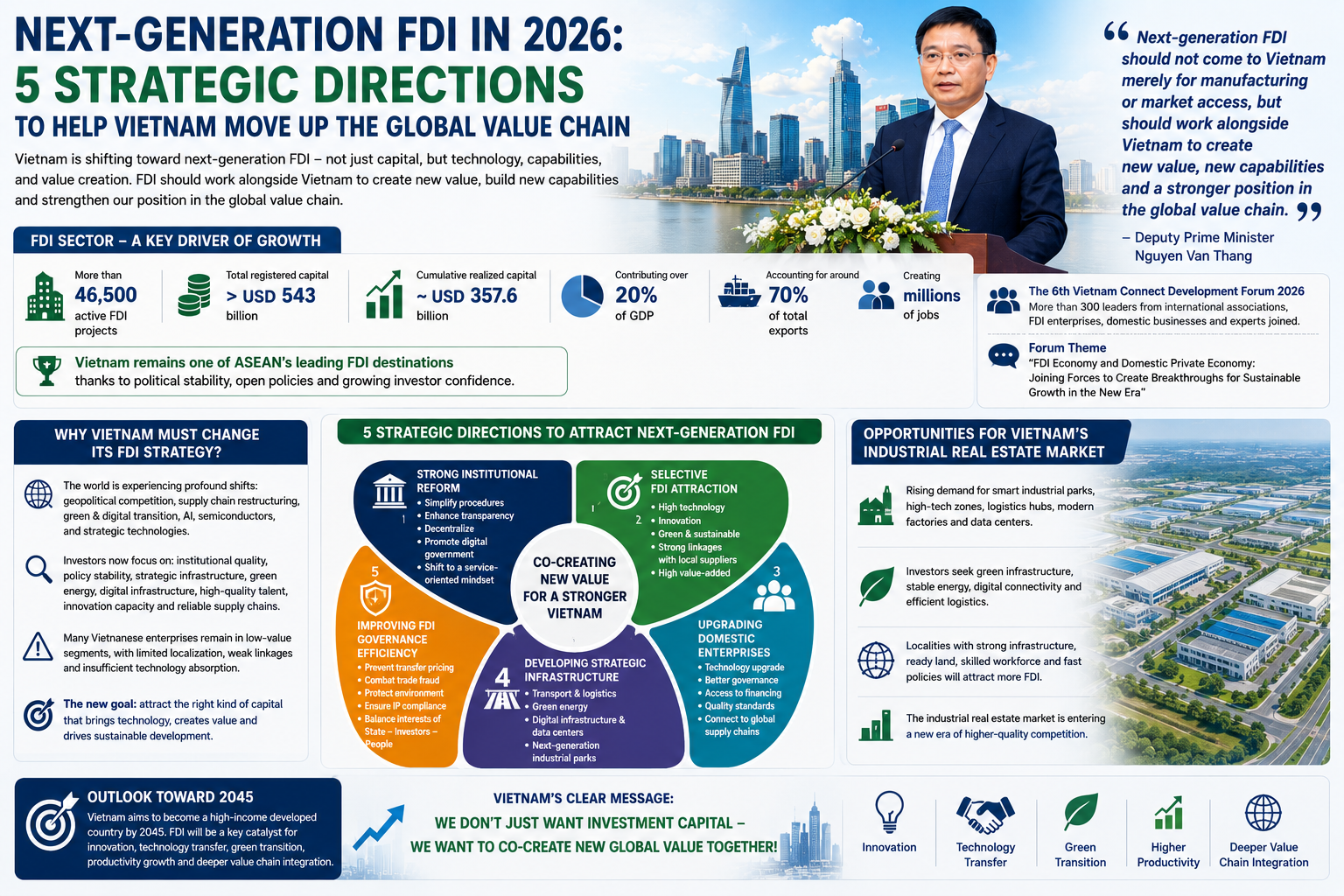
Deputy Prime Minister Nguyen Van Thang emphasized that next-generation FDI should not come to Vietnam merely for manufacturing or market access, but should work alongside Vietnam to create new value, new capabilities, and a stronger position in the global value chain. This marks an important transformation in Vietnam’s economic development strategy for the next phase.
How are more than 46,500 FDI projects contributing to Vietnam’s economy?
The FDI sector remains a major growth engine
After decades of opening up to international investment, the FDI sector continues to play a critical role in Vietnam’s economy.
According to official figures:
- More than 46,500 active FDI projects
- Total registered capital exceeding USD 543 billion
- Cumulative realized capital reaching approximately USD 357.6 billion
- Contributing over 20% of GDP
- Accounting for around 70% of total export turnover
- Creating millions of jobs nationwide
These figures demonstrate that foreign investment is not just a major capital source, but also a driver in building Vietnam’s modern production ecosystem.
Vietnam remains one of ASEAN’s leading FDI destinations
While global FDI flows have declined across many regions, Vietnam continues to maintain its position among ASEAN’s top investment destinations.
This reflects:
- Political stability
- Open investment policies
- Improving manufacturing capacity
- Strategic positioning within regional supply chains
- Strong confidence from the international business community
Major global corporations in sectors such as:
- Electronics
- Semiconductors
- High technology
- Energy
- Logistics
- Financial services
- Innovation
are continuing to expand their presence in Vietnam.
Why Vietnam must change its FDI attraction strategy
The global investment game has changed
In the past, major advantages for developing countries included:
- Low labor costs
- Tax incentives
- Low production costs
- Abundant industrial land
Today, investors care far more about:
- Institutional quality
- Policy transparency
- Investment predictability
- Strategic infrastructure
- Green energy
- Digital infrastructure
- Data centers
- High-quality talent
- Innovation capability
- Strong domestic supply chains
This shift requires Vietnam to rethink its FDI strategy.
Vietnam can no longer rely on being a low-cost manufacturing base
The reality is that many Vietnamese businesses still participate mainly in lower-value segments of global supply chains.
Current limitations include:
- Low localization rates
- Limited technology absorption capacity
- Weak FDI-domestic business linkages
- Shortage of tier-1 and tier-2 suppliers
- Lower-than-expected spillover effects
As a result, Vietnam’s new goal is not simply attracting more capital—but attracting the right kind of capital.
5 major strategic directions for attracting next-generation FDI
1. Strong institutional reform
Vietnam will continue improving the investment environment through:
- Reducing administrative procedures
- Increasing transparency
- Expanding decentralization
- Accelerating nationwide digital transformation
- Improving one-stop administrative mechanisms
- Shifting from regulatory control to development support
This is especially critical as international investors increasingly prioritize policy stability.
2. Selective FDI attraction
Vietnam is moving away from broad-based investment attraction.
Priority sectors include:
- Semiconductors
- Artificial intelligence (AI)
- Electronics
- Biotechnology
- Pharmaceuticals
- Clean energy
- Data infrastructure
- Advanced materials
- Modern logistics
- Strategic technologies
- Financial services
- Innovation ecosystems
Investor selection criteria will include:
- Technology intensity
- Value-added contribution
- Land-use efficiency
- Environmental sustainability
- Ability to connect with Vietnamese enterprises
3. Upgrading domestic enterprises
A long-term strategic priority is helping Vietnamese businesses integrate more deeply into global supply chains.
Key solutions include:
- Digital transformation support
- Technology upgrades
- Improved access to financing
- Better governance standards
- International quality certification
- Connections with multinational corporations
The goal is not just increasing participation, but building Vietnamese suppliers capable of becoming tier-1 and tier-2 partners.
4. Developing strategic infrastructure
Next-generation FDI requires world-class infrastructure.
Key priorities include:
- Expressways
- Logistics infrastructure
- Seaports
- Energy infrastructure
- Green electricity
- Digital infrastructure
- Data centers
- Next-generation industrial parks
- AI-ready infrastructure
This foundation will be essential for attracting high-tech industries.
5. Improving FDI governance efficiency
Vietnam will continue supporting compliant investors while strengthening oversight against:
- Transfer pricing
- Trade fraud
- Environmental violations
- Outdated technologies
- Intellectual property violations
The objective is to balance the interests of:
- The government
- Investors
- Citizens
- Sustainable development goals
What opportunities does this create for Vietnam’s industrial real estate market?
Next-generation FDI will reshape industrial land demand
The new FDI wave is expected to drive demand for:
- Smart industrial parks
- Digital infrastructure
- High-tech zones
- Logistics hubs
- Modern factory spaces
- Data centers
- AI-enabled warehousing
Locations with advantages such as:
- Strong infrastructure
- Ready industrial land
- Fast policy support
- Skilled workforce
will attract significantly more investment.
Next-generation industrial parks will become the new standard
Today’s investors are no longer simply looking for cheap land.
They want:
- Green infrastructure
- Reliable energy supply
- Strong digital capacity
- Logistics connectivity
- Technology ecosystems
- Responsive local government support
This is why Vietnam’s industrial real estate market is entering a new era of higher-quality competition.
Vietnam’s FDI outlook toward 2045
Vietnam aims to become a high-income developed country by 2045.
To achieve that goal, FDI must serve as a catalyst for:
- Innovation
- Technology transfer
- Domestic business upgrading
- Green transition
- Productivity growth
- Deeper value chain integration
The message is clear: Vietnam does not simply want investment capital—it wants to co-create new global value with strategic investors.
References:
Free access to exclusive information on warehouse, factory, and land rentals in Dong Nai, Binh Duong, Long An, Ho Chi Minh City, and more.
KHU CÔNG NGHIỆP 247 is a company operating in the field of buying, selling, and leasing factories and real estate.. We are proud to be a leading provider of real estate services in Vietnam. We have a team of highly qualified and experienced real estate consultants who always place trust and credibility at the core of everything we do.
Phone: 0901 490 348
Email: datkhucongnghiep247@gmail.com
Website: datkhucongnghiep247.com.vn