
After nearly four decades of attracting foreign direct investment, Vietnam is entering a new turning point: shifting from the mindset of “the more capital, the better” toward selectively attracting high-quality FDI with advanced technology and strong spillover effects on domestic enterprises. In this new development phase, success should no longer be measured only by registered capital or export value, but by how effectively Vietnamese companies can absorb technology, move deeper into global value chains, and gradually master their own production capabilities.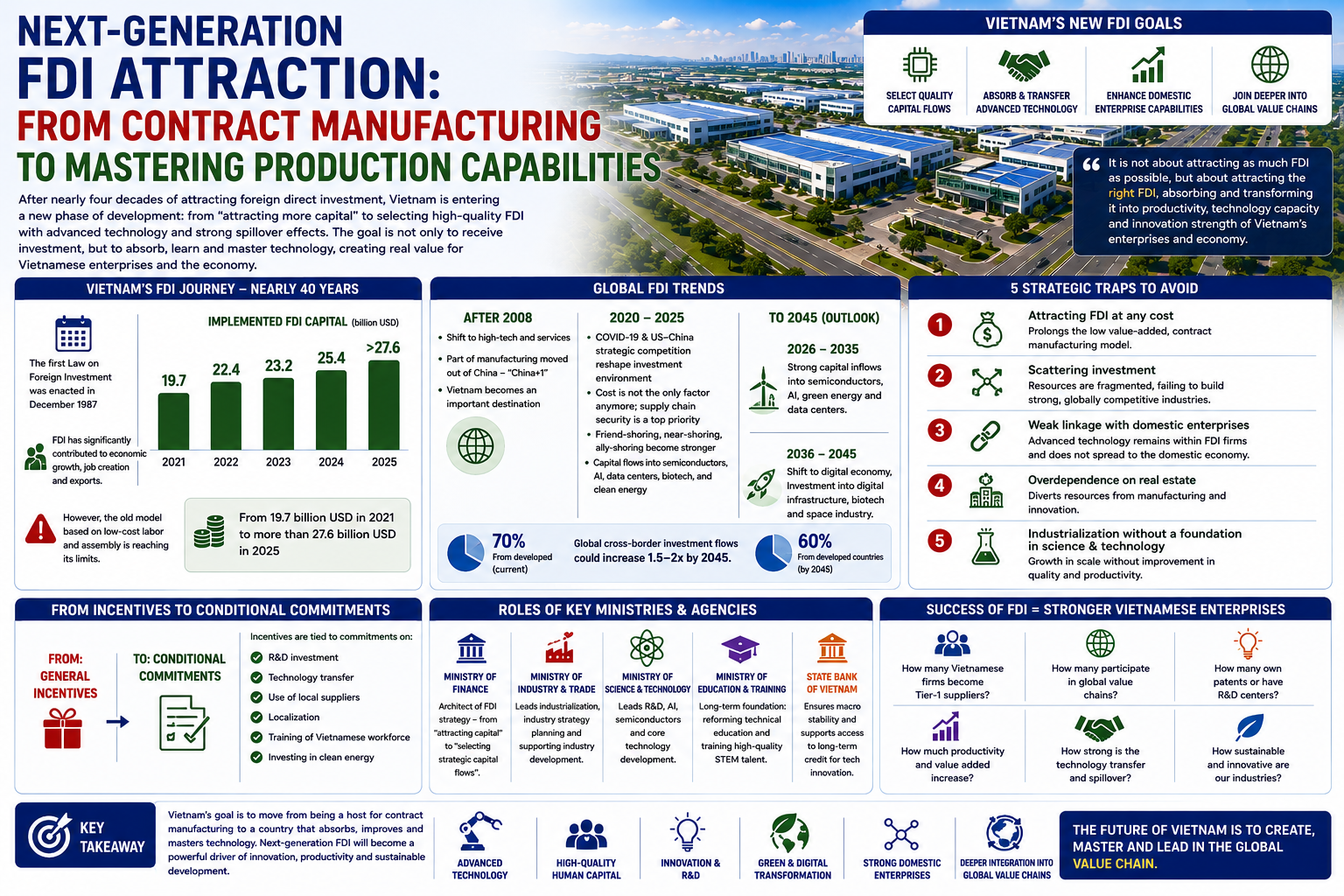
FDI has played a major role in Vietnam’s industrialization process for nearly four decades.
The foreign-invested sector has helped expand manufacturing capacity, create jobs, increase exports, and turn Vietnam into an important link in global supply chains.
However, a growth model based heavily on low-cost labor, contract manufacturing, and assembly is gradually revealing its limitations.
As technology, data, artificial intelligence, and supply-chain resilience increasingly become the foundations of competitiveness, Vietnam must change the way it approaches FDI.
From “Attracting Capital” to “Creating Development Value”
Nearly 40 years after Vietnam’s first Law on Foreign Investment was enacted in December 1987, the country has built a substantial FDI base.
Annual implemented FDI has continued to rise.
According to the figures cited, implemented FDI increased from approximately USD 19.7 billion in 2021 to more than USD 27.6 billion in 2025.
This is an important achievement and reflects international investors’ confidence in Vietnam’s economy.
However, focusing only on capital volume may overlook a strategic issue.
That issue is the still-limited spillover of FDI into the domestic economy.
The Old FDI Model Is Reaching Its Limits
For many years, Vietnam benefited from several key advantages:
- Abundant labor
- Competitive costs
- Large industrial land reserves
- Proximity to major Asian manufacturing centers
- A broad network of free trade agreements
These factors helped Vietnam attract substantial manufacturing, assembly, and contract production projects.
However, the way the world generates growth has changed.
Modern competitiveness increasingly depends on:
- Technology
- Data
- R&D
- Automation
- Intellectual property
- High-quality human capital
- Innovation ecosystems
This means Vietnam must upgrade its FDI attraction model.
Global Capital Is Shifting Toward High Technology
After the 2008 global financial crisis, global FDI began to shift more strongly toward high technology and services.
At the same time, part of global manufacturing moved away from China, creating the “China+1” trend.
Vietnam emerged as one of the major beneficiaries.
During 2020–2025, the COVID-19 pandemic and strategic competition between the United States and China further reshaped the global investment environment.
Low cost was no longer the only decisive factor.
Supply-chain security increasingly became a top priority.
Friend-Shoring, Near-Shoring and Ally-Shoring Are Becoming More Prominent
Global corporations are restructuring supply chains in several ways.
These include:
- Friend-shoring: relocating production to countries considered economically and politically reliable.
- Near-shoring: moving production closer to end markets.
- Ally-shoring: prioritizing investment in strategic partner countries.
These trends are changing the global FDI map.
Investment is increasingly flowing into:
- Semiconductors
- Artificial intelligence
- Data centers
- Biotechnology
- Clean energy
- Digital infrastructure
These are also the sectors Vietnam should target if it wants to upgrade FDI quality.
2026–2035 Could Be the Most Important Period for Supply-Chain Restructuring
According to the outlook cited, by 2045, global cross-border investment flows could increase to 1.5–2 times their current size.
However, the structure of these flows is expected to change significantly.
The 2026–2035 period is expected to be the phase during which global corporations complete a major portion of their supply-chain restructuring.
Investment could flow strongly into:
- Semiconductors
- AI
- Green energy
- Data centers
This period could be decisive for Vietnam.
If the country misses this opportunity, the technology gap with more advanced economies could widen further.
2036–2045 Could Mark a Deeper Shift into the Global Digital Economy
During 2036–2045, investment trends are expected to move further into new technology sectors.
These may include:
- Digital infrastructure
- Biotechnology
- Space industries
- Data systems
- Next-generation core technologies
This suggests that future competition for FDI will no longer be based mainly on land and labor.
It will increasingly become a competition over technology capabilities and the ability to absorb knowledge.
The Question Is No Longer “How Much FDI Can Vietnam Attract?”
One of the most important changes in mindset concerns how FDI performance should be measured.
In the past, localities were often evaluated based on:
- Total registered capital
- Number of projects
- Industrial land leased
- Number of FDI enterprises
In the new phase, more important questions include:
- What sectors does the FDI target?
- Does it contain core technology?
- Does it include R&D in Vietnam?
- Does it use domestic suppliers?
- Does it train Vietnamese workers?
- Does it help Vietnamese firms upgrade their capabilities?
These are the indicators that better reflect the real value of next-generation FDI.
Resolution 10-NQ/TW Marks a Shift in Development Thinking
According to the article, Resolution No. 10-NQ/TW dated June 8, 2026 on developing the foreign-invested economic sector marks an important transition from the mindset of “attracting capital” toward “creating development value.”
One of its most notable aspects is that Vietnamese enterprises are placed at the center of the strategy.
FDI is no longer viewed as a separate part of the economy.
Instead, it must be integrated into the broader national development ecosystem.
Vietnamese Enterprises Must Truly “Learn” the Technology
This is the core issue.
Vietnam has successfully attracted many multinational corporations.
However, most domestic companies still participate in lower-value parts of FDI supply chains.
Typical activities include:
- Contract manufacturing
- Assembly
- Packaging
- Raw material supply
- Simple components
Meanwhile, higher-value activities such as:
- Design
- R&D
- Software
- Core technology
- Intellectual property
remain largely controlled by foreign companies.
Contract Manufacturing Does Not Automatically Mean Technology Ownership
A country can manufacture a large volume of high-tech products without actually owning high technology.
This distinction is critical.
If modern factories are located in Vietnam but:
- Design is conducted overseas
- Technology is owned overseas
- Core machinery is imported
- Control software is imported
- Key components are imported
- R&D decisions are made at foreign headquarters
then the amount of technology retained domestically remains limited.
Vietnam’s goal therefore cannot simply be to “host high-tech factories.”
The goal must be to learn, absorb, improve, and gradually master technology.
Five Strategic Traps Vietnam Must Avoid
According to the article, Vietnam needs to avoid five major traps in the next phase of FDI attraction.
Trap 1: Attracting FDI at Any Cost
If Vietnam continues prioritizing project quantity, it may attract many investments but still remain trapped in low-value-added production.
This would prolong the contract manufacturing model.
Trap 2: Spreading Investment Too Thinly
If resources are distributed across too many sectors, Vietnam may fail to build globally competitive strategic industries.
In technology competition, ecosystem scale matters.
Trap 3: FDI Remaining Disconnected from Domestic Enterprises
If FDI companies operate as isolated “islands,” technology and orders will have limited spillover effects.
This remains one of the country’s biggest structural weaknesses.
Trap 4: Excessive Dependence on Real Estate
If too much capital, land, and financial resources are concentrated in real estate, manufacturing and innovation may be starved of resources.
Trap 5: Industrialization Without a Science and Technology Foundation
An economy can expand manufacturing scale but still struggle to improve productivity if it lacks R&D and core technology.
Vietnam Needs Fewer Projects, but Better Projects
In the new phase, the objective should not be to maximize the number of FDI projects.
What matters is selecting projects with strong spillover effects.
For example:
A USD 500 million project that includes R&D, uses Vietnamese suppliers, and trains domestic engineers may generate more long-term value than a USD 2 billion project focused only on assembly.
This reflects a qualitative shift in how investment should be evaluated.
FDI Success Should Be Measured by the Maturity of Vietnamese Enterprises
An important future indicator is how many Vietnamese enterprises can move up the supply chain.
For example:
- How many become Tier-1 suppliers?
- How many supply components directly to major global corporations?
- How many own patents?
- How many operate R&D centers?
- How many export technology?
These are more meaningful indicators of real FDI spillover.
Becoming a Tier-1 Supplier Is a Critical Milestone
In industrial supply chains, Tier-1 suppliers typically provide directly to major manufacturers.
To achieve this status, companies must meet demanding standards in:
- Quality
- Scale
- Delivery
- ESG
- Management
- Technology
If more Vietnamese companies can reach this level, national production capability will improve significantly.
The Race for Tax Incentives and Cheap Land Has Reached Its Limits
For many years, localities competed for FDI through:
- Tax incentives
- Low land rents
- Infrastructure support
- Reduced initial investment costs
But as the global minimum tax and international investment standards change, this model is becoming less effective.
High-tech investors increasingly care about:
- Institutional quality
- Policy stability
- Protection of ownership rights
- Administrative efficiency
- Human resources
- Energy
- Digital infrastructure
These are more sustainable competitive advantages.
Institutions Are Becoming a Form of “Soft Infrastructure”
In attracting next-generation FDI, institutions can be as important as highways or industrial parks.
An attractive investment environment requires:
- Clear laws
- Transparent procedures
- Stable policies
- Effective dispute resolution
- Predictability
For billion-dollar investments, stability over 20–30 years can be critical.
From Incentives to Conditional Commitments
One of the key proposed changes is to move from general incentives toward conditional incentives.
The government could provide stronger support if companies commit to:
- Establishing R&D centers
- Transferring technology
- Using Vietnamese suppliers
- Training Vietnamese engineers
- Increasing localization
- Investing in clean energy
In this model, incentives are no longer simply “given away.”
They become tools exchanged for long-term development value.
FDI Must Serve the National Development Strategy
FDI should not become an end in itself.
It should support the industries Vietnam wants to develop.
For example, if Vietnam identifies semiconductors as a strategic sector, FDI policy should aim to build a complete semiconductor ecosystem.
Not just packaging plants.
But also:
- Chip design
- Materials
- Equipment
- R&D
- Engineer training
- Supporting industries
This is how national capabilities are built.
Vietnamese Enterprises Must Be at the Center of High-Tech Industrialization
A sustainable FDI strategy cannot depend solely on foreign companies.
Vietnamese firms must be given the conditions to grow.
This requires:
- Long-term financing
- Technology innovation funds
- R&D support
- Market access
- Linkages with FDI corporations
- Management training
If domestic companies remain weak, FDI spillover effects will remain limited.
R&D Is the Foundation for Technology Absorption
If Vietnam wants to learn technology, it must have research capabilities.
Simply operating machines provided by foreign firms does not create technology ownership.
Vietnam therefore needs strong investment in:
- Laboratories
- R&D centers
- Universities
- Research institutes
- University–industry cooperation
This is the foundation for absorbing and improving technology.
STEM Becomes a Strategic National Priority
High-quality human capital is a decisive factor in the new FDI competition.
Industries such as:
- AI
- Semiconductors
- Robotics
- Biotechnology
- Data
all require large numbers of engineers and scientists.
STEM education is therefore no longer merely an education issue.
It is industrial policy.
The State Must Play a Strategic Enabling Role
In the new model, the government’s role should go beyond licensing and administration.
The state must act as a strategic enabler.
This includes:
- Identifying priority sectors
- Building ecosystems
- Connecting FDI with domestic companies
- Investing in infrastructure
- Developing talent
- Supporting R&D
This is a model used by many successful industrial economies.
The Ministry of Finance Should Act as the Architect of FDI Strategy
According to the viewpoint presented, the Ministry of Finance should shift its focus from “attracting capital” to “selecting strategic capital flows.”
This requires project evaluation criteria based on quality.
For example:
- Technology
- R&D
- Employment
- Domestic linkages
- ESG
- Added value
rather than registered capital alone.
The Ministry of Industry and Trade Should Lead Industrialization
The Ministry of Industry and Trade should play a central role in sector strategy.
Particularly in developing:
- Supporting industries
- Supply chains
- High-tech manufacturing
- Export capacity
This would ensure FDI policy is closely linked with industrialization goals.
The Ministry of Science and Technology Should Lead R&D, AI and Semiconductors
As technology becomes a decisive factor, the role of science and technology policy becomes increasingly important.
Key priorities should include:
- R&D
- AI
- Semiconductors
- Core technologies
- Technology transfer
These sectors can generate long-term competitive advantage.
The Ministry of Education and Training Provides the Long-Term Foundation
High-tech talent cannot be created in just a few years.
It requires a long-term process.
Technical education and STEM therefore need substantial reform.
Links between schools and enterprises also need to become much stronger.
The State Bank Has a Role in Supporting Technological Innovation
Technological upgrading requires long-term capital.
Many Vietnamese firms currently struggle to access it.
The financial system therefore needs to support:
- Medium- and long-term credit
- Innovation funds
- R&D financing
- Machinery upgrading
Without capital, domestic firms will struggle to upgrade enough to participate in FDI supply chains.
The Risk of Technology Dependence Must Be Taken Seriously
One of the risks of high-tech FDI is dependence on a small number of global technology corporations.
If Vietnam becomes overly dependent on:
- Operating systems
- Digital platforms
- Chips
- Equipment
- Software
its strategic autonomy will remain limited.
FDI attraction must therefore go hand in hand with developing domestic technology capabilities.
Diversifying FDI Partners Is Essential
To reduce dependency risks, Vietnam should diversify investment sources.
The country should not rely too heavily on any single nation or corporation.
A diversified FDI structure helps:
- Reduce geopolitical risk
- Increase technology competition
- Expand learning opportunities
- Improve bargaining power
This is especially important in a volatile global environment.
Next-Generation Industrialization Must Be Linked to the Green Transition
Next-generation FDI cannot be separated from ESG.
Multinational corporations increasingly require:
- Renewable energy
- Lower emissions
- Green supply chains
- Recycling
- Resource efficiency
Vietnam’s industrial parks must therefore also upgrade.
Green and eco-industrial parks will become increasingly important infrastructure for attracting high-quality FDI.
Digital Infrastructure Becomes a New Competitive Advantage
Semiconductors, AI, and data centers all depend heavily on digital infrastructure.
Vietnam needs investment in:
- Fiber networks
- Data centers
- Cloud infrastructure
- Reliable electricity
- Cybersecurity
These will form the foundation for attracting the next generation of technology industries.
Vietnam Needs Ecosystems, Not Isolated Projects
A single major project is not enough to create a strong industry.
A full ecosystem is required.
For semiconductors, for example, that includes:
- Design
- Manufacturing
- Packaging
- Testing
- Materials
- Equipment
- Talent
- R&D
Only when these elements are present can Vietnam retain more value domestically.
Next-Generation Industrial Parks Will Play a Major Role
Industrial parks are no longer simply places where land is leased.
In the era of next-generation FDI, industrial parks can become platforms connecting:
- FDI enterprises
- Vietnamese companies
- R&D
- Universities
- Logistics
- Suppliers
This creates an ideal environment for technology transfer and localization.
Industrial Real Estate Must Also Change How It Competes
Vietnam’s industrial real estate market will be directly affected by the new FDI strategy.
Industrial parks seeking high-quality projects will need to invest in:
- Green energy
- Digital infrastructure
- R&D
- ESG
- Workforce
- Logistics
Competing through cheap land alone will become increasingly unsustainable.
Vietnam Needs to Move from “Assembly” to “Design”
An important step up the value chain is moving from manufacturing into design.
If Vietnam can participate in product design, much more value can be retained domestically.
That is why the country needs to strengthen:
- Chip design
- Software
- Industrial design
- Product engineering
These are core elements of national technological capability.
From Low-Tier Supplier to Strategic Supplier
Many Vietnamese enterprises are still positioned in lower tiers of global supply chains.
The long-term objective is to move upward.
For example:
Simple supplier → Tier-2 supplier → Tier-1 supplier → technology partner
This process may take many years.
But if successful, Vietnamese firms will become less dependent on contract manufacturing orders.
Next-Generation FDI Must Create Stronger Vietnamese Enterprises
This may be the most important measure of all.
After 10–20 years of attracting high-tech FDI, if Vietnamese companies remain weak, the strategy will not have achieved its objective.
By contrast, if more domestic companies emerge with:
- Technology
- Brands
- R&D
- Global exports
- High-level supply-chain participation
then FDI will truly have created development value.
Looking Toward 2045: Where Does Vietnam Want to Stand?
This is the central strategic question.
Vietnam can continue to be a major manufacturing center.
But a higher ambition is to become a country capable of:
- Designing
- Researching
- Mastering technology
- Producing high-value products
- Building globally competitive enterprises
If that happens, Vietnam will move to a higher position in the global value chain.
From an FDI-Receiving Country to a Country That Masters Production Capabilities
The most important transformation in Vietnam’s next development phase is not about how many additional billions of dollars it can attract.
It is about turning those capital flows into:
- Productivity
- Technology
- Strong domestic companies
- Skilled human resources
- R&D
- National production capabilities
This is the transition from receiving FDI to absorbing FDI.
Next-Generation FDI Attraction: From Contract Manufacturing to Mastering Production Capabilities
Nearly 40 years of FDI attraction have helped Vietnam build an important industrial foundation.
But the next phase requires a fundamentally different approach.
FDI cannot simply be a source of capital.
It must become a tool for building national capabilities.
Vietnam needs to select better projects.
Vietnamese enterprises need deeper linkages with foreign investors.
R&D must be strengthened.
High-tech human resources must be developed faster.
Institutions must become more transparent and predictable.
Industrial parks must evolve into technology ecosystems.
Most importantly, technology must genuinely spill over into the domestic economy.
If Vietnam can achieve this, it can move from being primarily a contract manufacturing and assembly hub into a country capable of absorbing, improving, and gradually mastering technology.
That is the real value of next-generation FDI.
Five Major Priorities for Vietnam’s Next-Generation FDI Strategy
1. Select strategic capital flows: Prioritize semiconductors, AI, green energy, data centers, biotechnology, and other high-tech industries.
2. Strengthen FDI–domestic enterprise linkages: Enable Vietnamese companies to participate more deeply in supply chains.
3. Develop R&D and core technologies: Move from assembly toward research, design, and technology ownership.
4. Invest strongly in STEM and high-quality human resources: Build the long-term foundation for high-tech industrialization.
5. Shift from broad incentives to conditional incentives: Link incentives to technology transfer, localization, R&D, and workforce training.
References:
Free access to exclusive information on warehouse, factory, and land rentals in Dong Nai, Binh Duong, Long An, Ho Chi Minh City, and more.
KHU CÔNG NGHIỆP 247 is a company operating in the field of buying, selling, and leasing factories and real estate.. We are proud to be a leading provider of real estate services in Vietnam. We have a team of highly qualified and experienced real estate consultants who always place trust and credibility at the core of everything we do.
Phone: 0901 490 348
Email: datkhucongnghiep247@gmail.com
Website: https://industrialland.com.vn/en