
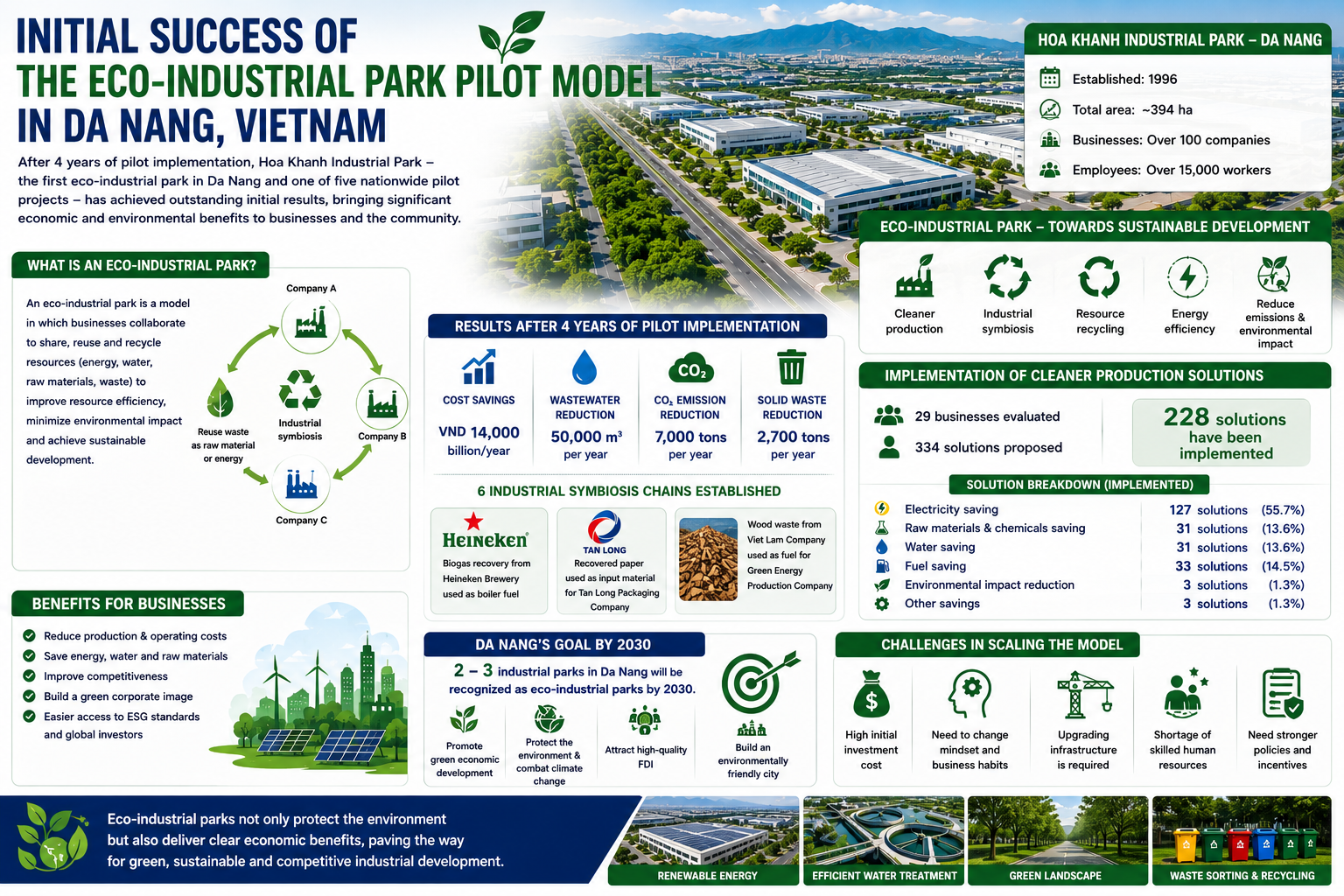
As Vietnam accelerates its green growth transition and sustainable industrial development strategy, the eco-industrial park (EIP) model is emerging as a critical direction for the future of industrial real estate and manufacturing. After four years of pilot implementation, Hoa Khanh Industrial Park in Da Nang has demonstrated highly encouraging initial results, delivering both environmental and economic benefits while setting a practical benchmark for sustainable industrial transformation nationwide.
Eco-Industrial Parks: The Future of Sustainable Industrial Development
Traditional industrial parks have long played a key role in Vietnam’s industrialization, export growth, and job creation. However, alongside economic achievements, many industrial zones have faced increasing challenges:
- environmental pollution
- high energy consumption
- excessive water usage
- rising industrial waste
- carbon emissions
- growing operating costs
These challenges have made the transition toward eco-industrial parks (EIP) an urgent priority.
An eco-industrial park combines industrial production with environmental sustainability, where businesses collaborate to optimize resource use, share infrastructure, recycle waste, and reduce emissions.
The model aligns with:
- Vietnam’s National Green Growth Strategy
- Sustainable Development Goals (SDGs) 2030
- Net Zero commitments
- global ESG investment requirements
Hoa Khanh Industrial Park: A Pioneer in Eco-Industrial Transformation
Established in 1996, Hoa Khanh Industrial Park has been one of Da Nang’s major industrial zones, contributing significantly to local economic development.
However, after decades of operation, the industrial park also encountered structural limitations:
- aging infrastructure
- environmental pressure
- inefficient resource consumption
- increasing sustainability requirements
To address these issues, Hoa Khanh Industrial Park was selected as:
- the first industrial park in Da Nang
- one of only five industrial parks in Vietnam
to pilot the transition toward an eco-industrial park model.
This initiative reflects Vietnam’s strategic commitment to industrial modernization while supporting sustainable economic growth.
How Does an Eco-Industrial Park Work?
Unlike conventional industrial parks, eco-industrial parks operate based on several core principles.
1. Cleaner Production
Businesses reduce consumption of:
- electricity
- water
- fuel
- raw materials
- chemicals
Through:
- technology upgrades
- process optimization
- energy-efficient equipment
2. Industrial Symbiosis
This is the most important element.
Waste from one company becomes input material for another.
Examples:
- waste paper → packaging production
- biogas → boiler fuel
- wood waste → renewable energy fuel
This significantly reduces industrial waste while improving cost efficiency.
3. Resource Circularity
The goal is to maximize resource efficiency through:
- recycling
- reuse
- waste recovery
- shared utilities
This lowers production costs and environmental impact.
4. ESG and Sustainable Development Compliance
Global investors increasingly prioritize:
- carbon reduction
- green manufacturing
- renewable energy adoption
- sustainable supply chains
Eco-industrial parks are becoming major competitive advantages in attracting premium FDI.
Strong Initial Results After Four Years
After four years of implementation, Hoa Khanh Industrial Park has delivered measurable results.
29 Enterprises Evaluated
A comprehensive assessment program was conducted for participating businesses.
334 Cleaner Production Solutions Proposed
Of these:
228 solutions have already been implemented
Breakdown:
- 127 electricity-saving solutions
- 31 raw material and chemical-saving solutions
- 31 water-saving solutions
- 33 fuel-saving solutions
- 3 environmental impact reduction initiatives
- 3 additional optimization measures
This demonstrates strong corporate participation.
Significant Economic Benefits
One common misconception is that green transformation increases operating costs.
Hoa Khanh’s pilot proves otherwise.
Participating businesses achieved:
Annual Savings:
- approximately VND 14,000 billion
Environmental Impact Reduction:
- 50,000 cubic meters less wastewater
- 7,000 tons less CO₂ emissions
- 2,700 tons less solid waste
This confirms that sustainability can directly improve profitability.
Industrial Symbiosis Creates Real Value
The most innovative achievement is the successful creation of six industrial symbiosis chains.
Practical examples:
Heineken Da Nang Brewery
Recovered biogas from brewery operations is reused as boiler fuel.
Tan Long Packaging
Uses recycled paper waste from neighboring manufacturers as production input, reducing procurement costs.
Green Energy Producers
Wood waste from industrial manufacturers is reused as biomass fuel.
This model delivers:
- lower waste disposal
- lower energy costs
- reduced emissions
- stronger business collaboration
- more resilient industrial ecosystems
Why Eco-Industrial Parks Matter for FDI Attraction
Today’s international investors no longer focus only on:
- cheap land
- tax incentives
- labor costs
They increasingly demand:
- ESG compliance
- Net Zero transition plans
- renewable energy infrastructure
- wastewater efficiency
- environmental reporting
- sustainable supply chains
Industries with strong ESG requirements include:
- semiconductors
- electronics
- EV manufacturing
- advanced manufacturing
- international logistics
Eco-industrial parks therefore provide a major competitive advantage.
Da Nang’s Expansion Plans
Under its environmental city development strategy through 2030, Da Nang aims to establish:
2–3 officially recognized eco-industrial parks by 2030.
This supports broader goals including:
- green urban development
- sustainable industrialization
- climate resilience
- premium FDI attraction
If successfully expanded, Da Nang could become Vietnam’s benchmark for sustainable industrial development.
Challenges to Scaling the Model
Despite positive results, several obstacles remain.
High Initial Investment Costs
Technology upgrades require substantial capital.
Business Mindset Transformation
Not all companies are ready to change traditional production models.
ESG Talent Shortage
Skilled sustainability and environmental management professionals remain limited.
Legacy Infrastructure Constraints
Older industrial parks require costly modernization.
Policy Support
More incentive mechanisms will be needed to accelerate nationwide adoption.
Outlook for Vietnam’s Eco-Industrial Park Market
As:
- global supply chains continue restructuring
- ESG becomes mandatory
- Net Zero commitments strengthen
- FDI competition intensifies
eco-industrial parks are no longer optional.
They are becoming the new standard.
Potential growth markets include:
- Da Nang
- Hai Phong
- Bac Ninh
- Dong Nai
- Binh Duong
- Long An
- Ba Ria – Vung Tau
Conclusion
The pilot transformation of Hoa Khanh Industrial Park clearly demonstrates that eco-industrial development can deliver both economic efficiency and environmental sustainability.
Vietnam’s future industrial competitiveness will no longer depend solely on land availability or rental pricing.
The true winners will be those capable of building green, smart, integrated industrial ecosystems.
References:
Free access to exclusive information on warehouse, factory, and land rentals in Dong Nai, Binh Duong, Long An, Ho Chi Minh City, and more.
KHU CÔNG NGHIỆP 247 is a company operating in the field of buying, selling, and leasing factories and real estate.. We are proud to be a leading provider of real estate services in Vietnam. We have a team of highly qualified and experienced real estate consultants who always place trust and credibility at the core of everything we do.
Phone: 0901 490 348
Email: datkhucongnghiep247@gmail.com
Website: datkhucongnghiep247.com.vn