

Rental Housing Becomes a Strategic Priority in the New Development Phase
On the afternoon of June 1, 2026, in Hải Phòng, Prime Minister Lê Minh Hưng chaired a meeting with leaders from Hải Phòng, Quảng Ninh, Bắc Ninh, Hưng Yên, and Ninh Bình to implement the rental housing development policy under the direction of General Secretary and President Tô Lâm.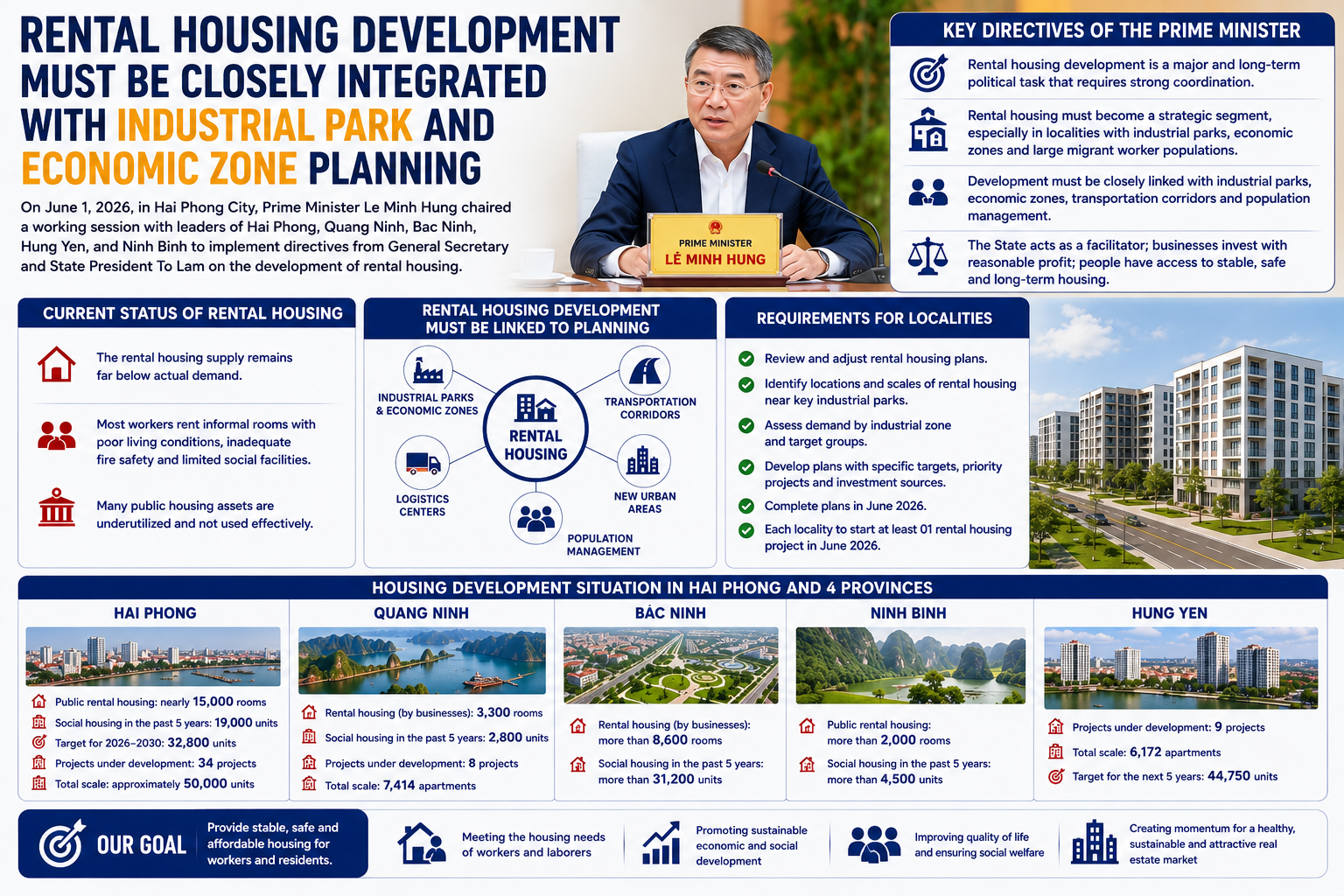
At the meeting, the Prime Minister emphasized that rental housing development is no longer a short-term solution but has become a long-term strategic priority, particularly for localities with a high concentration of industrial parks, economic zones, and migrant workers.
Amid rapid industrialization, the demand for stable, safe, and affordable housing for workers, experts, and employees continues to rise significantly. Ensuring adequate rental housing supply is increasingly important to support workforce stability, improve living standards, and sustain economic growth in key industrial regions across Vietnam.
Rental Housing Supply Remains Far Below Demand
Prime Minister Le Minh Hung emphasized that the current supply of rental housing remains insufficient compared to actual demand.
A large proportion of workers and migrant laborers continue to rely on informal rental accommodations, many of which face challenges such as:
- Poor living conditions.
- Inadequate fire prevention and safety standards.
- Limited social infrastructure.
- Lack of stable and long-term housing options.
At the same time, a significant amount of public housing assets remains underutilized, highlighting the need for more effective housing development policies.
Rental Housing Must Become a Strategic Segment
For many years, Vietnam’s housing policies focused primarily on homeownership and residential property sales.
However, the Government now aims to develop both commercial housing and rental housing simultaneously.
According to the Prime Minister, rental housing should become a strategic and long-term segment, particularly in localities that host:
- Industrial parks.
- Economic zones.
- Manufacturing hubs.
- Large migrant worker populations.
This approach is expected to better support workforce mobility and sustainable industrial development.
Housing Development Must Align with Industrial and Economic Planning
One of the key messages from the meeting was that rental housing development must be closely linked to broader economic planning.
Future rental housing projects should be integrated with:
- Industrial parks.
- Economic zones.
- Transportation corridors.
- Urban development plans.
- Population management strategies.
This integrated planning model will help workers access housing closer to their workplaces while reducing transportation pressures and improving overall quality of life.
It will also support the long-term development of industrial real estate and regional economic growth.
Government Acts as Facilitator While Businesses Drive Investment
Prime Minister Le Minh Hung stressed that the Government does not intend to subsidize housing entirely, nor can it leave the market to regulate itself completely.
Instead, the Government will serve as a facilitator by:
- Establishing development plans.
- Improving legal frameworks.
- Introducing supportive policies.
- Providing financial tools and incentives.
- Ensuring transparent market conditions.
Meanwhile, private enterprises will be encouraged to invest in rental housing projects while maintaining reasonable profitability.
This balanced approach aims to ensure both investor confidence and affordable housing access for citizens.
Provinces Required to Accelerate Rental Housing Planning
The Prime Minister instructed Hai Phong, Quang Ninh, Bac Ninh, Hung Yen, and Ninh Binh to urgently review and adjust their rental housing development plans.
Local authorities must:
- Identify suitable project locations.
- Determine development scale.
- Assess housing demand by industrial zone and target group.
- Prioritize investment projects.
- Allocate development resources.
- Complete planning documents within June 2026.
Each locality is expected to commence construction of at least one rental housing project during June and continue implementing larger projects in the third and fourth quarters of the year.
Hai Phong Leads in Social and Rental Housing Development
According to the Ministry of Construction, Hai Phong has emerged as one of Vietnam’s leading localities in social housing and rental housing development.
Hai Phong Housing Statistics
| Indicator | Result |
|---|---|
| Public rental housing units | Nearly 15,000 rooms |
| Social housing completed over the past five years | More than 19,000 units |
| Target for 2026–2030 | 32,800 units |
| Projects currently under development | 34 projects |
| Total planned units | Approximately 50,000 units |
These figures highlight Hai Phong’s proactive approach to providing housing for workers and low-income residents.
Bac Ninh, Quang Ninh, Hung Yen, and Ninh Binh Accelerate Development
Bac Ninh
- More than 8,600 rental rooms developed by private enterprises.
- Over 31,200 social housing units completed during the past five years.
Quang Ninh
- Approximately 3,300 rental rooms.
- More than 2,800 social housing units completed.
- Eight new projects under development, totaling 7,414 apartments.
Hung Yen
- Nine housing projects currently under construction.
- Approximately 6,172 apartments planned.
- Target of 44,750 units over the next five years.
Ninh Binh
- More than 2,000 public rental rooms.
- Over 4,500 social housing units completed in the past five years.
These efforts demonstrate strong commitment from local governments to expanding rental housing supply and supporting sustainable urban development.
Rental Housing Creates New Opportunities for Vietnam’s Real Estate Market
Industry experts believe that rental housing will become one of the fastest-growing segments of Vietnam’s real estate market.
Key demand drivers include:
- Industrial workers.
- Skilled laborers.
- Foreign experts.
- Logistics professionals.
- Young urban workers.
As industrial parks continue to expand and foreign investment increases, demand for professionally managed rental housing is expected to rise significantly.
This trend creates substantial opportunities for real estate developers and institutional investors.
Conclusion
Vietnam is entering a new phase of housing development in which rental housing plays a strategic role alongside traditional homeownership models. By integrating rental housing planning with industrial parks, economic zones, transportation infrastructure, and urban development strategies, the country aims to improve living standards, support industrial growth, and enhance investment attractiveness. With strong government support and active participation from local authorities and businesses, the rental housing sector is expected to become a major growth driver in Vietnam’s real estate market over the coming years.
References:
Free access to exclusive information on warehouse, factory, and land rentals in Dong Nai, Binh Duong, Long An, Ho Chi Minh City, and more.
KHU CÔNG NGHIỆP 247 is a company operating in the field of buying, selling, and leasing factories and real estate.. We are proud to be a leading provider of real estate services in Vietnam. We have a team of highly qualified and experienced real estate consultants who always place trust and credibility at the core of everything we do.
Phone: 0901 490 348
Email: datkhucongnghiep247@gmail.com
Website: datkhucongnghiep247.com.vn