

Industrial Land Constraints Drive a Shift Toward Innovation
As industrial land availability gradually declines, Ho Chi Minh City is accelerating its transition from labor-intensive manufacturing and assembly operations to research and development (R&D), high-tech industries, and higher-value positions within global supply chains.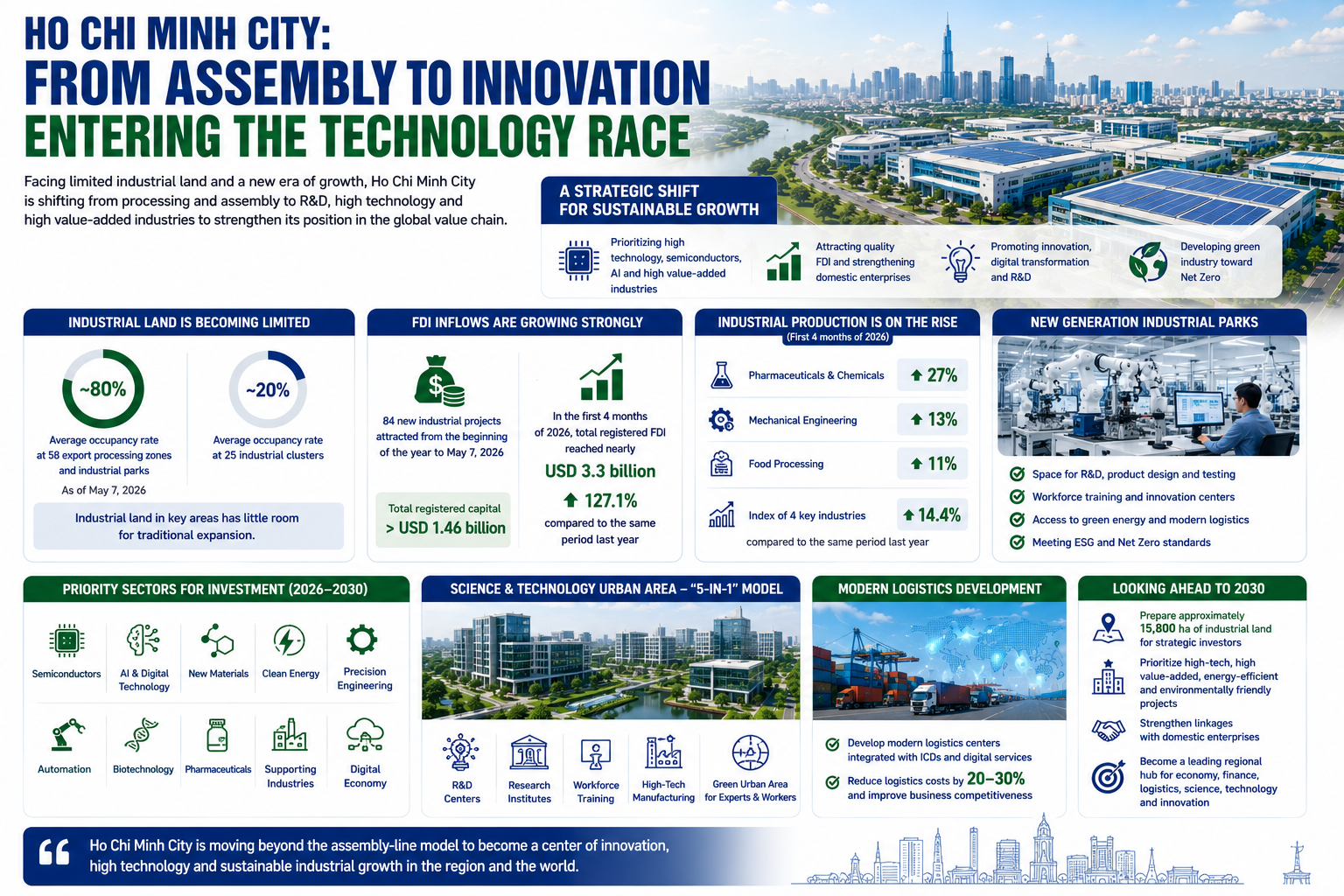
Once recognized as Vietnam’s largest industrial production center, Ho Chi Minh City attracted numerous manufacturing and assembly projects from multinational corporations over the past decades. However, rapid urbanization and economic expansion have significantly reduced the room for traditional growth models.
As of May 7, 2026, the average occupancy rate across 58 export processing zones and industrial parks in the city reached approximately 80%, while 25 industrial clusters recorded an average occupancy rate of nearly 20%.
These figures indicate that industrial land resources in many key areas are becoming increasingly limited. Instead of continuing to rely on traditional assembly and processing industries, Ho Chi Minh City is now focusing on technology-driven growth, innovation, and high-value-added industries.
This transformation aligns with the city’s broader development strategy. According to the Government Portal of Vietnam, Ho Chi Minh City is shifting toward a growth model centered on science and technology, innovation, and digital transformation to improve competitiveness and economic quality in an increasingly integrated global economy.
Prioritizing Semiconductors, AI, and Advanced Industries
Mr. Bui Ta Hoang Vu, Director of the Ho Chi Minh City Department of Industry and Trade, stated that during the city’s next development phase, industrial growth will be driven by innovation, high technology, supporting industries, and stronger domestic enterprises.
This vision is reflected in the city’s investment attraction strategy for 2026–2030. Priority sectors include:
- Semiconductor manufacturing
- Integrated circuit design and production
- New materials
- Clean energy
- Precision engineering
- Automation
- Artificial Intelligence (AI)
- Biotechnology
- Pharmaceuticals
- Digital technologies
Investment trends are already reflecting this strategic shift.
From the beginning of 2026 through May 7, Ho Chi Minh City attracted 84 new industrial projects with registered capital exceeding US$1.46 billion.
During the first four months of 2026 alone, total registered FDI reached nearly US$3.3 billion, representing a 127.1% increase compared to the same period last year.
Industrial production has also shown positive momentum. During the first four months of 2026, the production index of the city’s four key industrial sectors increased by 14.4% year-on-year. Notably:
- Pharmaceuticals and chemicals rose by 27%
- Mechanical engineering increased by 13%
- Food processing grew by 11%
Creating Space for Value Beyond Manufacturing
Industrial parks are no longer judged solely by the amount of available land or factory space.
Today’s investors increasingly seek environments that support:
- Research and development
- Product design
- Technology testing
- Workforce training
- Collaboration with innovation centers
According to Mr. Nguyen The Duy, Vice Chairman and Deputy CEO of Becamex Corporation, industries such as semiconductors, electronics, artificial intelligence, and data centers require more than production facilities. They also need ecosystems that support innovation and long-term development.
Investors now place significant emphasis on:
- Access to renewable energy
- Modern logistics infrastructure
- Highly skilled labor
- Research and development ecosystems
- ESG compliance
- Net Zero commitments
Science and Technology Urban Areas: A New Development Model
This trend is driving the emergence of new industrial development models.
One notable example is the Northern Ho Chi Minh City Science and Technology Urban Area developed by Becamex under a “5-in-1” model that integrates:
- R&D Centers
- Research Institutes
- Workforce Training Facilities
- High-Tech Manufacturing Zones
- Green Urban Areas for Experts and Employees
The objective is not only to attract manufacturing investments but also to encourage companies to establish research, design, and innovation centers in Vietnam.
This represents a crucial step toward increasing Vietnam’s role in the global value chain.
Strengthening Domestic Enterprises
While foreign-invested enterprises continue to play an important role in technology transfer, management expertise, international standards, and export market expansion, city leaders emphasize that the long-term foundation of sustainable industrial growth lies in the strength of Vietnamese enterprises.
Therefore, alongside attracting high-tech FDI projects, Ho Chi Minh City is actively supporting domestic businesses through:
- Digital transformation
- Technological innovation
- Improved management capabilities
- Development of supporting industries
- Greater participation in global supply chains
Building a Regional Hub for Technology and Logistics
Ho Chi Minh City is also positioning itself as a leading regional center for economics, finance, logistics, science, technology, and innovation.
According to city officials, maintaining a strong commitment to green industry, high technology, and innovation—while building globally competitive Vietnamese enterprises—will enable Ho Chi Minh City to move beyond its traditional role as Vietnam’s largest manufacturing center and become a key link in regional and global value chains.
For the 2025–2030 period, the city plans to prepare approximately 15,800 hectares of industrial land to meet the needs of strategic investors.
However, city leaders emphasize that the quality of investment is more important than the quantity of land. Priority will be given to projects that:
- Utilize advanced technology
- Generate high added value
- Promote energy efficiency
- Protect the environment
- Strengthen linkages with domestic enterprises
At the same time, Ho Chi Minh City is developing modern logistics centers integrated with inland container depots (ICDs) and digital logistics services, with the goal of reducing logistics costs by 20–30% and improving business competitiveness.
Conclusion
Ho Chi Minh City is undergoing a significant transformation from a traditional manufacturing hub into a center for innovation, research, and high technology. By prioritizing semiconductors, AI, advanced manufacturing, green industry, and modern logistics, the city is positioning itself to become one of Southeast Asia’s leading technology and innovation destinations while strengthening its role in global value chains.
References:
Free access to exclusive information on warehouse, factory, and land rentals in Dong Nai, Binh Duong, Long An, Ho Chi Minh City, and more.
KHU CÔNG NGHIỆP 247 is a company operating in the field of buying, selling, and leasing factories and real estate.. We are proud to be a leading provider of real estate services in Vietnam. We have a team of highly qualified and experienced real estate consultants who always place trust and credibility at the core of everything we do.
Phone: 0901 490 348
Email: datkhucongnghiep247@gmail.com
Website: datkhucongnghiep247.com.vn