
Amid growing risks from heavy rainfall, flooding, and increasingly extreme weather conditions, Bac Ninh Province is accelerating measures to upgrade drainage systems across several key industrial parks. The proposed investment budget is approximately VND 55 billion, focusing on dredging drainage canals, clearing water flows, upgrading irrigation infrastructure, and improving pumping station capacity.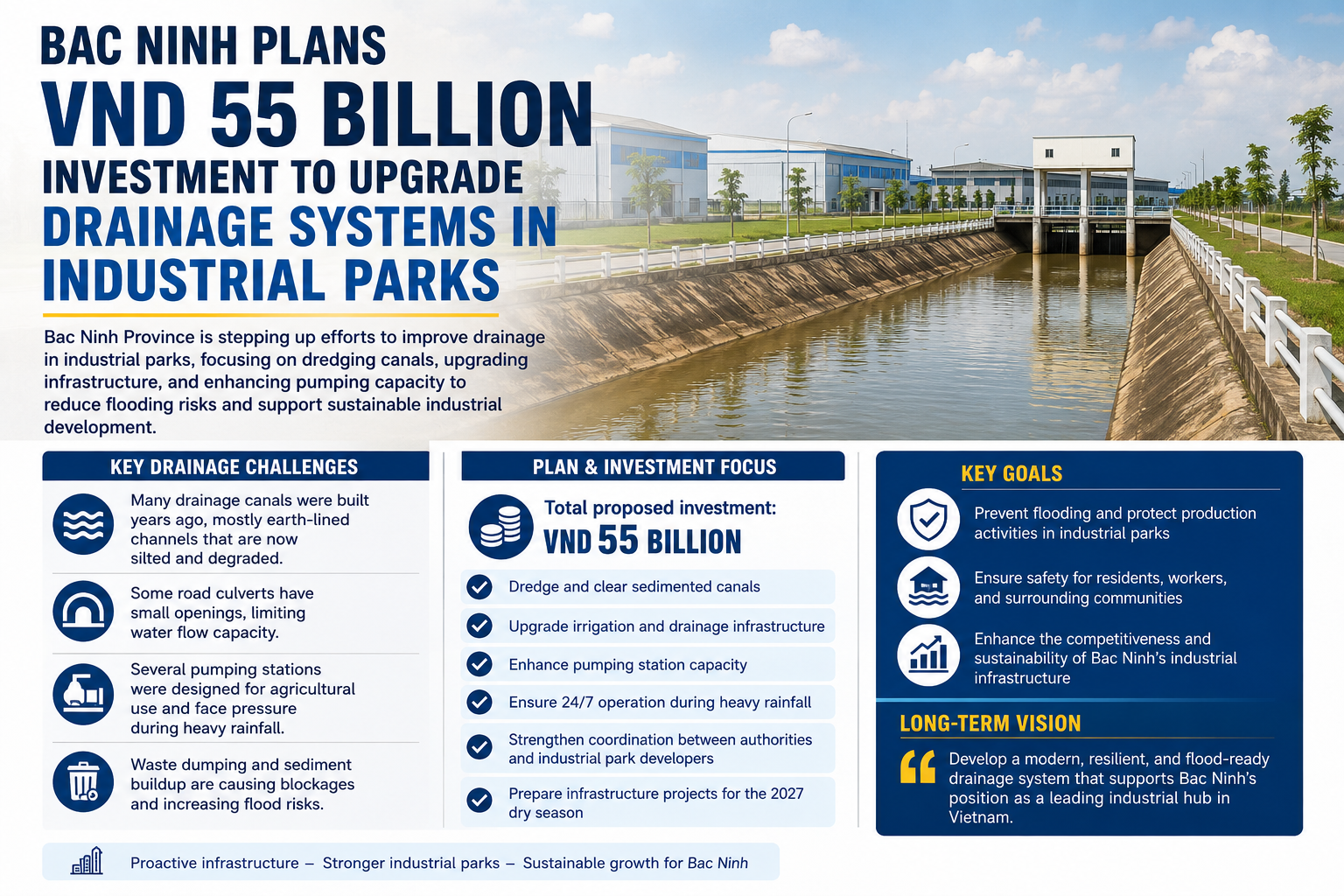
On August 11, 2026, Bac Ninh Provincial Party Secretary Nguyen Hong Thai chaired a meeting to review the current status and proposed solutions for industrial park drainage systems in Bac Ninh, as the province prepares for increasingly complex rainy and stormy weather conditions.
The meeting focused not only on addressing immediate flooding risks but also on developing long-term solutions aligned with the province’s industrial, urban, and irrigation infrastructure planning.
Drainage Infrastructure at Several Bac Ninh Industrial Parks Has Deteriorated
According to the Bac Ninh Department of Agriculture and Environment, the drainage system serving industrial parks across the province currently meets basic operational requirements.
However, several areas are facing bottlenecks that could increase the risk of localized flooding during prolonged periods of heavy rainfall.
One of the main challenges is that many drainage canals were constructed years ago, with a large proportion remaining earth-lined channels.
Over time, sediment accumulation has reduced water-flow capacity, narrowed canal cross-sections, and caused deterioration in several sections.
In addition, some road culverts have relatively small openings that are no longer sufficient to handle the growing volume of stormwater generated by rapid urbanization and industrial development.
This issue is particularly important because Bac Ninh is one of northern Vietnam’s major industrial manufacturing centers, with a high concentration of industrial parks and factories.
Quế Võ Industrial Parks Face Multiple Sedimentation Bottlenecks
At the Quế Võ Industrial Park, Quế Võ Expansion Industrial Park, and Quế Võ Expansion 2 Industrial Park, several important drainage canals have experienced significant sedimentation, including:
- Kim Đôi Canal;
- Kim Đôi 2 Canal;
- Kim Đôi 7 Canal;
- Kim Đôi 9 Canal.
Several road culverts along Kim Đôi 9 Canal are also considered insufficient for current drainage requirements.
If these bottlenecks are not dredged and upgraded in a timely manner, they could significantly affect the area’s drainage capacity during periods of intense rainfall.
In industrial parks with a high concentration of factories, even a small number of drainage bottlenecks can result in localized flooding, disrupting internal traffic, logistics operations, and manufacturing activities.
Nam Son – Hap Linh and Yen Phong Industrial Parks Require Canal Upgrades
At Nam Son – Hap Linh Industrial Park, the Hien Luong Canal and Drainage Canal No. 2 have deteriorated and suffered from sediment buildup.
Similarly, several drainage canals serving Yen Phong Industrial Park have also deteriorated after years of operation.
Yen Phong is one of Bac Ninh’s most important industrial areas, hosting numerous large-scale manufacturing facilities and foreign-invested enterprises.
Therefore, maintaining reliable drainage capacity is not only important for disaster prevention but also directly affects the stability of the province’s investment environment and industrial supply chains.
As industrial parks become increasingly occupied, the amount of paved and built-up surface area also increases.
This means significantly larger volumes of rainwater must be discharged within shorter periods of time.
As a result, drainage infrastructure must be recalculated and upgraded based on current industrial development levels rather than relying solely on designs developed many years ago.
Pumping Stations at Quang Chau Industrial Park Under Pressure During Heavy Rainfall
At Quang Chau Industrial Park and Quang Chau Expansion Industrial Park, one of the major concerns is the pumping station system.
Several pumping stations were constructed many years ago, and their original design capacity was primarily intended to support agricultural production.
As the surrounding area has been transformed into a major industrial hub, the volume of water requiring drainage has increased significantly.
During prolonged periods of heavy rainfall, pumping stations must operate for longer periods, placing considerable pressure on machinery and equipment.
If this situation continues, the risk of system overload or technical failures may increase.
Bac Ninh is therefore considering solutions that go beyond regular maintenance, including upgrading pumping capacity to meet the requirements of modern industrial development.
Several Other Industrial Parks Also Need Urgent Canal Dredging
Drainage deterioration is not limited to only a few industrial areas.
Industrial parks including:
- Dinh Tram;
- Van Trung;
- Song Khe – Noi Hoang;
- Viet Han;
- Viet Han Expansion;
- Hoa Phu;
also have drainage canals affected by sedimentation, deterioration, or narrowing of water-flow cross-sections.
These canals need to be dredged and upgraded to improve drainage capacity, especially during periods of concentrated heavy rainfall.
Improving the drainage system has therefore become one of the province’s urgent infrastructure priorities in order to reduce localized flooding risks across industrial zones.
Bac Ninh Proposes VND 55 Billion for Priority Drainage Projects
To improve industrial park drainage capacity in 2026 and subsequent years, the Bac Ninh Department of Agriculture and Environment has proposed a number of priority investment projects with a total estimated budget of approximately VND 55 billion.
The investment would focus on urgent measures including:
dredging and clearing sedimented canals; removing water-flow bottlenecks; upgrading irrigation infrastructure; maintaining pumping stations; strengthening electricity systems supporting drainage pumps; and addressing areas facing high flooding risks.
This investment is considered increasingly necessary as climate change contributes to more frequent extreme rainfall events.
For industrial parks covering hundreds of hectares, the economic damage caused by a prolonged flooding event could far exceed the cost of proactive drainage infrastructure investment.
Pumping Systems Must Be Ready to Operate 24/7 During Heavy Rainfall
One of Bac Ninh’s key measures is to strengthen inspections and maintenance of the entire pumping system.
Irrigation infrastructure operators have been instructed to regularly inspect:
pumps, electrical substations, backup power sources, and related operational equipment.
During periods of prolonged heavy rainfall, the system must be capable of operating 24 hours a day, seven days a week in order to quickly reduce water levels and minimize flooding risks.
At the same time, local authorities, the Bac Ninh Industrial Parks Management Board, and industrial park infrastructure developers are expected to cooperate in addressing illegal dumping of waste and construction debris into drainage canals.
Garbage and construction materials dumped into canals are among the factors that can restrict water flows and significantly reduce drainage efficiency.
Industrial Park Developers Must Proactively Assess Drainage Systems
Under Bac Ninh’s proposed approach, responsibility for drainage management does not rest solely with government agencies or irrigation infrastructure operators.
Industrial park infrastructure developers must also proactively evaluate drainage systems both inside and outside their industrial parks.
If overload risks, bottlenecks, or potential flooding areas are identified, developers are expected to coordinate with irrigation management agencies and propose appropriate solutions.
This approach is particularly important because internal industrial park drainage systems are directly connected to external canals and irrigation infrastructure.
Investing only in internal drainage systems may not solve the problem if external infrastructure is unable to receive and discharge the water effectively.
Bac Ninh Orders Detailed Identification of Drainage Bottlenecks
Bac Ninh Vice Chairman Le Xuan Loi noted that weather conditions are becoming increasingly extreme and unpredictable.
Recent disaster-response experience has demonstrated that prevention measures need to be implemented proactively and flexibly, without complacency.
The Department of Agriculture and Environment has been assigned to continue working with relevant agencies to identify specific drainage bottlenecks.
Once these locations have been identified, responsible authorities must organize dredging and water-flow clearance.
For areas where existing drainage canals cannot be widened because of roads, residential areas, or existing buildings, the province has requested alternative solutions.
Possible measures may include increasing pumping capacity, developing additional drainage routes, or upgrading the existing drainage system to improve overall capacity.
Bac Ninh Prepares Irrigation Pumping Projects for the 2027 Dry Season
Another important requirement highlighted by Bac Ninh Provincial Party Secretary Nguyen Hong Thai is the early preparation of documents and procedures for investment in irrigation and drainage pumping infrastructure.
Preparatory work is expected to be completed during 2026 so that construction can be implemented during the 2027 dry season.
Carrying out construction during the dry season is expected to reduce weather-related disruptions and facilitate canal dredging, infrastructure improvements, and irrigation upgrades.
Bac Ninh also plans to develop coordination mechanisms between irrigation infrastructure management companies and industrial park infrastructure developers.
These mechanisms are intended to strengthen flood and storm prevention while ensuring that drainage operations do not unnecessarily disrupt business and manufacturing activities.
Priority Funding for Urgent Drainage Infrastructure
Bac Ninh Provincial Party Secretary Nguyen Hong Thai requested that the provincial Department of Finance prioritize funding for urgent disaster-prevention and drainage infrastructure projects.
Meanwhile, the Department of Agriculture and Environment has been instructed to complete investment preparation procedures in advance.
The goal is to ensure that projects can begin immediately once funding is allocated, avoiding delays caused by incomplete administrative procedures.
Ongoing projects must also be accelerated, particularly those directly affecting the safety of:
industrial parks, factories, residential areas, urban zones, and transportation infrastructure.
Drainage Capacity Is Becoming a Key Industrial Park Infrastructure Factor
When selecting industrial locations, investors traditionally focus on factors such as location, land rental prices, electricity supply, water supply, transportation infrastructure, and labor availability.
However, amid climate change, flood resilience and drainage capacity are becoming increasingly important components of industrial park infrastructure.
Industrial parks with inadequate drainage systems may face numerous risks, including:
manufacturing disruptions, warehouse flooding, damaged materials, logistics interruptions, increased insurance costs, and electrical safety risks.
For high-tech and electronics manufacturers, potential losses can be even greater because machinery and production systems often involve extremely high capital investment.
As a result, investment in drainage infrastructure is no longer simply a disaster-prevention issue. It is increasingly connected to the competitiveness of industrial parks.
Bac Ninh Strengthens Infrastructure as a Major Industrial Hub
Bac Ninh is one of Vietnam’s most highly industrialized provinces and is home to numerous industrial parks and foreign-invested enterprises.
Rapid development of factories, industrial parks, urban areas, and transportation infrastructure is placing increasing pressure on traditional irrigation and drainage systems.
Many canals originally designed primarily for agricultural drainage must now also serve densely developed industrial areas.
This makes the comprehensive upgrading of irrigation infrastructure, drainage canals, and pumping stations an inevitable requirement as industrial development continues.
Bac Ninh’s decision to review drainage systems comprehensively in 2026 demonstrates a gradual shift from responding to flooding incidents toward proactively preventing infrastructure risks.
Industrial Safety Must Go Hand in Hand With Residential Safety
Bac Ninh Provincial Party Secretary Nguyen Hong Thai emphasized that Bac Ninh is one of Vietnam’s key industrial development centers.
Therefore, disaster prevention and drainage management must be given high priority.
The objective is not only to protect businesses operating within industrial parks and industrial clusters but also to ensure the safety of residents, residential communities, urban areas, and locations particularly vulnerable to natural disasters.
Government agencies and relevant organizations have therefore been instructed to prepare proactively and well in advance in order to avoid being caught unprepared by extreme weather events.
Flood-Resilient Infrastructure Could Strengthen Bac Ninh’s Industrial Real Estate Market
From a market perspective, continued investment in drainage infrastructure could have a positive impact on Bac Ninh’s industrial real estate sector.
For manufacturing companies, particularly foreign-invested enterprises, operational stability under different weather conditions is an important consideration when selecting an investment location.
An industrial park with strong drainage systems, reliable electricity infrastructure, convenient transportation connections, and effective disaster-prevention mechanisms can significantly reduce long-term operational risks.
Therefore, the proposed VND 55 billion investment, together with broader plans to upgrade irrigation and drainage infrastructure, is not only intended to address short-term flooding risks.
It could also contribute to improving the overall quality and competitiveness of Bac Ninh’s industrial park infrastructure.
Over the longer term, these improvements could support the province’s ability to attract high-tech manufacturing, electronics production, and other high-value-added industrial projects.
References:
Free access to exclusive information on warehouse, factory, and land rentals in Dong Nai, Binh Duong, Long An, Ho Chi Minh City, and more.
KHU CÔNG NGHIỆP 247 is a company operating in the field of buying, selling, and leasing factories and real estate.. We are proud to be a leading provider of real estate services in Vietnam. We have a team of highly qualified and experienced real estate consultants who always place trust and credibility at the core of everything we do.
Phone: 0901 490 348
Email: datkhucongnghiep247@gmail.com
Website: https://industrialland.com.vn/en