

Nearly 20 years after its establishment, Dai Kim Industrial Park in Ha Tinh has yet to become the economic growth engine it was expected to be. From policy changes and infrastructure limitations to unfinished projects and investor withdrawals, Dai Kim Industrial Park reflects the broader challenges of attracting industrial investment in border economic zones.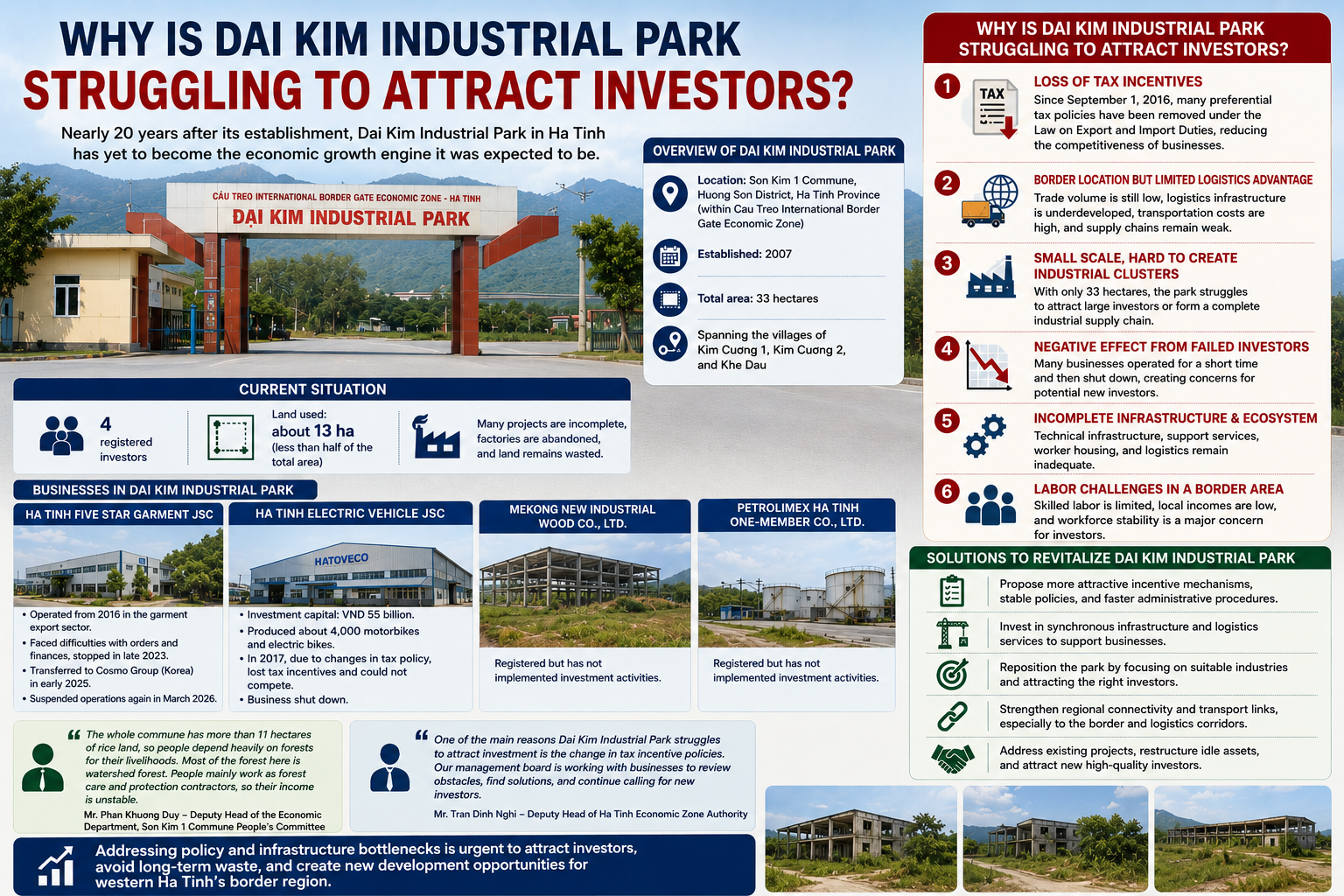
Dai Kim Industrial Park: High Expectations, Modest Reality
Located within the Cau Treo International Border Gate Economic Zone in Son Kim 1 Commune, Ha Tinh Province, Dai Kim Industrial Park was established in 2007 with a total planned area of approximately 33 hectares.
At the time, the industrial park was expected to become a major catalyst for economic development in western Ha Tinh, particularly by leveraging its strategic proximity to the international border for trade, logistics, and manufacturing.
However, nearly two decades later, the reality is far less optimistic.
Instead of becoming a vibrant industrial destination, Dai Kim Industrial Park remains sparsely occupied, with abandoned land, underutilized factories, and several stalled investment projects.
This is not merely the story of one industrial park—it is a case study in the structural difficulties of developing industrial investment in remote border regions.
Current Situation: Limited Investors and Short-Lived Projects
As of now, Dai Kim Industrial Park has attracted only four registered investors, covering approximately 13 hectares, which means less than half of the available land has been utilized.
Among them:
Ha Tinh Five Star Garment Joint Stock Company
This company became the first investor to begin operations in 2016, focusing on export garment manufacturing.
However, due to order shortages and financial challenges, the company ceased operations in late 2023.
The factory was later transferred to South Korean investor Cosmo Group in early 2025 and resumed operations.
Yet by March 2026, operations were suspended again.
Ha Tinh Electric Vehicle Joint Stock Company
Another notable project was the electric vehicle and household electrical equipment manufacturing project, with total investment of approximately VND 55 billion.
The company reportedly produced around 4,000 motorcycles and electric motorbikes, but quickly encountered financial difficulties and shut down operations.
Attempts to shift business activities into wood pellet production and animal feed manufacturing were later halted because those operations did not align with the company’s original registered business scope.
Other Registered Investors
The remaining investors include:
- Mekong New Industrial Wood Co., Ltd.
- Petrolimex Ha Tinh One-Member Co., Ltd.
However, neither has implemented the investment activities originally committed.
The result is a landscape of idle factories, unfinished infrastructure, and prolonged land inefficiency.
Why Is Dai Kim Industrial Park Struggling to Attract Investors?
1. Loss of Tax Incentives: The Biggest Blow
One of the most significant reasons is the loss of preferential tax treatment.
Previously, the Cau Treo International Border Gate Economic Zone benefited from tax and customs mechanisms similar to a non-tariff zone, which made the area attractive for manufacturers and trading businesses.
However, after Vietnam’s Law on Export and Import Duties took effect on September 1, 2016, many of those incentives were removed.
This dramatically weakened the competitiveness of businesses operating in the zone.
The direct impact included:
- Higher production input costs
- Reduced pricing competitiveness
- Disrupted business models
- Greater difficulty competing with businesses in other industrial parks
The experience of Ha Tinh Electric Vehicle Joint Stock Company is a clear example.
Once tax incentives disappeared, its cost structure became uncompetitive, ultimately forcing closure.
For an industrial park whose original value proposition relied heavily on policy incentives, this was a critical setback.
2. Border Location Has Not Become a Logistics Advantage
In theory, proximity to an international border should be a major strategic advantage.
In practice, however, that advantage has not translated into strong investor demand.
Reasons include:
- Limited cross-border trade volume
- Underdeveloped logistics networks
- Lack of modern warehousing infrastructure
- Absence of industrial support ecosystems
- High transportation costs
Unlike industrial parks near seaports, airports, or major urban consumption centers, Dai Kim Industrial Park is located relatively far from Vietnam’s key economic hubs.
As a result, investors must carefully evaluate:
- Logistics costs
- Delivery times
- Labor availability
- Customer accessibility
In today’s highly competitive investment environment, location remains a decisive factor.
3. Small Scale Limits Cluster Development
Dai Kim Industrial Park covers only 33 hectares, which is relatively small compared to modern industrial parks.
This creates several disadvantages:
- Limited appeal for large-scale investors
- Restricted expansion potential
- Difficulty forming supply chain clusters
- Lower infrastructure investment efficiency
Today’s investors generally favor industrial parks that offer:
- Large-scale development potential
- Existing industrial ecosystems
- Integrated logistics support
- Long-term expansion opportunities
Dai Kim currently struggles to meet these expectations.
4. Investor Failures Damage Market Confidence
Industrial parks with a history of failed projects often face reputational challenges.
New investors tend to assess previous operational outcomes when evaluating risk.
At Dai Kim:
- Garment manufacturing failed
- Electric vehicle production shut down
- Registered projects never commenced
This naturally raises concerns:
- Why did previous investors fail?
- Was the problem market-related or structural?
- Is infrastructure sufficient?
- Are policy conditions stable?
Once investor confidence declines, attracting new capital becomes significantly harder.
5. Incomplete Infrastructure and Weak Business Ecosystem
A successful industrial park requires more than available land.
Investors evaluate the full ecosystem, including:
- Stable power supply
- Industrial water access
- Wastewater treatment
- Telecommunications
- Logistics infrastructure
- Worker housing
- Business support services
If these supporting systems are incomplete, investors face higher setup and operating costs.
This becomes especially problematic for foreign manufacturers.
6. Workforce Challenges in a Border Region
Labor availability is another important concern.
Son Kim 1 remains an economically challenged area where many residents depend on forest-related livelihoods.
However, modern industrial operations require workers with:
- Technical skills
- Stable employment availability
- Manufacturing discipline
- Ability to adapt to industrial processes
If investors perceive labor supply risks, investment decisions become more cautious.
What Does Dai Kim Need to Recover?
Competitive Policy Incentives
If the previous tax advantages cannot be restored, alternative support mechanisms should be considered:
- Preferential land rental pricing
- Local tax support
- Infrastructure subsidies
- Faster investment approval processes
Industry Repositioning
Rather than pursuing broad industrial attraction, Dai Kim should focus on sectors aligned with its geographic strengths:
- Agricultural and forestry processing
- Border logistics
- Warehousing
- Cross-border trade services
- Light manufacturing
Stronger Regional Connectivity
Improved transport links are essential.
The industrial park needs better integration with:
- National highways
- Logistics corridors
- Other economic zones
- Cross-border trade infrastructure
Redevelopment of Idle Assets
Unused factories and abandoned assets should be addressed quickly through:
- Asset transfer
- Redevelopment
- Functional conversion
- Re-marketing to new investors
Conclusion
The story of Dai Kim Industrial Park demonstrates a crucial lesson:
Industrial success cannot rely solely on planning expectations.
Sustainable investment attraction requires:
- Stable policy frameworks
- Competitive infrastructure
- Strategic location advantages
- Efficient logistics
- Strong industrial ecosystems
If these bottlenecks are addressed effectively, Dai Kim Industrial Park could still regain its intended role as a growth engine for western Ha Tinh’s border economy.
References:
Free access to exclusive information on warehouse, factory, and land rentals in Dong Nai, Binh Duong, Long An, Ho Chi Minh City, and more.
KHU CÔNG NGHIỆP 247 is a company operating in the field of buying, selling, and leasing factories and real estate.. We are proud to be a leading provider of real estate services in Vietnam. We have a team of highly qualified and experienced real estate consultants who always place trust and credibility at the core of everything we do.
Phone: 0901 490 348
Email: datkhucongnghiep247@gmail.com
Website: datkhucongnghiep247.com.vn