
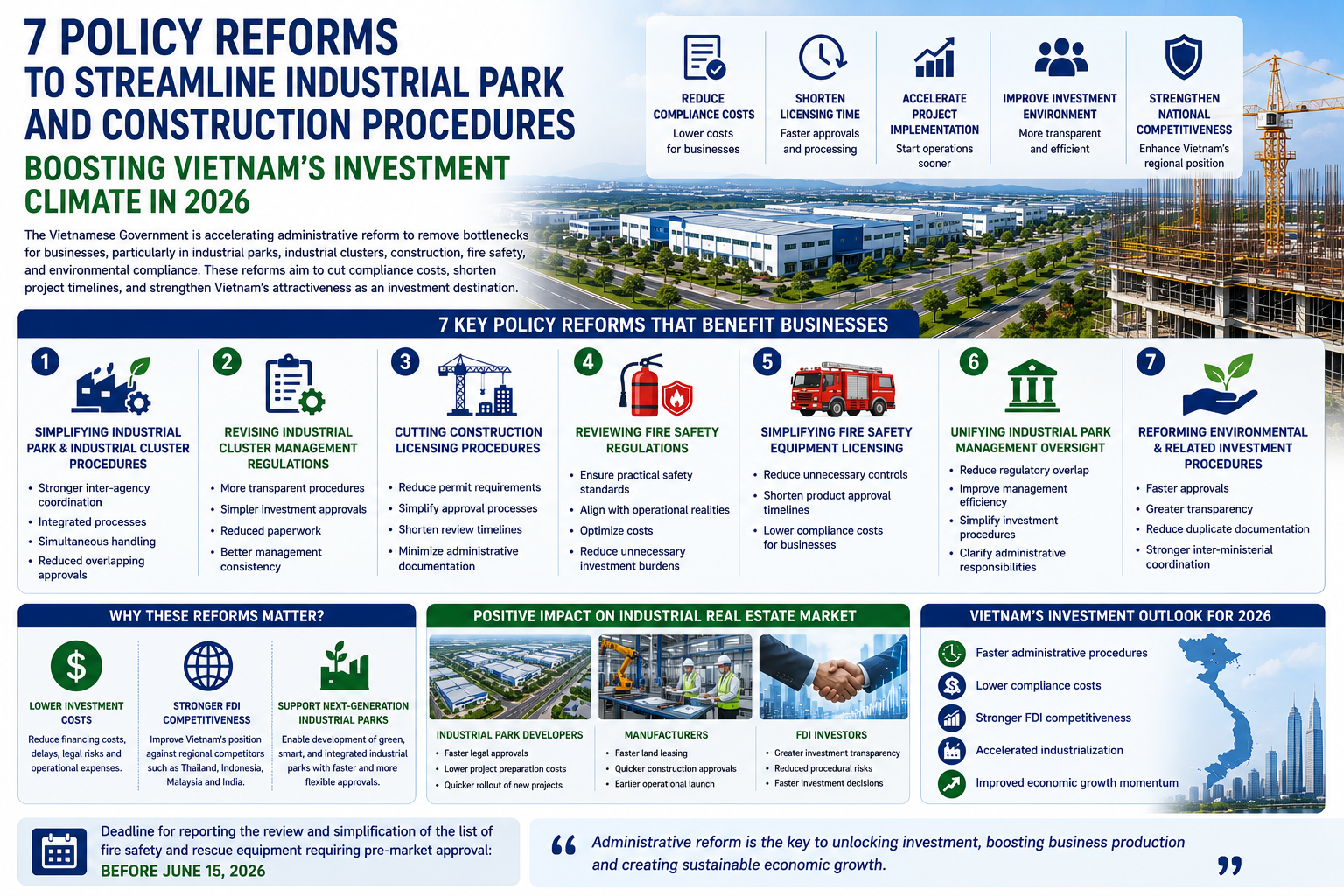
The Vietnamese government is accelerating administrative reform to remove bottlenecks for businesses, particularly in industrial parks, industrial clusters, construction, fire safety, and environmental compliance. The review, reduction, and simplification of administrative procedures are expected to significantly lower compliance costs, shorten project timelines, and strengthen Vietnam’s attractiveness as an investment destination in the next growth cycle.
Administrative Reform Creates New Momentum for Industrial Development
Under the latest directive from the Prime Minister, ministries and government agencies are stepping up efforts to simplify key administrative procedures to support investment and business operations.
Priority areas under review include:
- fire prevention and firefighting (PCCC)
- industrial park licensing
- industrial cluster approvals
- environmental impact assessments
- construction permits
The main objectives are:
- reducing compliance costs for businesses
- shortening licensing timelines
- accelerating project implementation
- improving the investment climate
- strengthening national competitiveness
7 Key Policy Reforms That Benefit Businesses
1. Simplifying Industrial Park and Industrial Cluster Procedures
One of the most important reforms focuses on streamlining the establishment and expansion process for industrial parks and industrial clusters.
The new direction includes:
- stronger inter-agency coordination
- integrated administrative processes
- simultaneous procedure handling
- reduced overlapping approvals
This will help businesses save significant time during project development.
2. Revising Industrial Cluster Management Regulations
The Ministry of Industry and Trade is finalizing amendments to regulations governing industrial cluster management and development.
Expected benefits include:
- more transparent procedures
- simpler investment approvals
- reduced paperwork
- better management consistency
This is especially positive for manufacturing SMEs.
3. Cutting Construction Licensing Procedures
Construction approvals have long been one of the most time-consuming hurdles for businesses.
This reform focuses on:
- reducing permit procedures
- simplifying construction approval processes
- shortening review timelines
- minimizing administrative documentation
This is particularly important for factory, warehouse, and logistics projects.
4. Reviewing Fire Safety Regulations
Fire prevention and firefighting regulations have been a major challenge for many businesses in recent years.
The updated direction aims to ensure:
- practical safety standards
- compliance aligned with operational realities
- cost optimization
- reduced unnecessary investment burdens
This is a positive signal for industrial developers and property investors.
5. Simplifying Fire Safety Equipment Licensing
The list of fire safety and rescue equipment requiring approval before market circulation will also be reviewed.
Key goals include:
- reducing unnecessary regulatory controls
- shortening product approval timelines
- lowering compliance costs for businesses
This should help suppliers and manufacturers bring products to market faster.
6. Unifying Industrial Park Management Oversight
A notable reform is the proposal to create a unified management authority for industrial parks and industrial clusters.
If implemented successfully, this would:
- reduce regulatory overlap
- improve management efficiency
- simplify investment procedures
- clarify administrative responsibilities
This would represent a major structural reform.
7. Reforming Environmental and Related Investment Procedures
Environmental impact assessment (EIA) procedures are also under review.
Businesses expect:
- faster approvals
- greater transparency
- reduced duplicate documentation
- stronger inter-ministerial coordination
This is particularly important for large-scale FDI projects.
Why Industrial Procedure Reform Matters
Lower Investment Costs
Lengthy administrative processes often lead to:
- higher financing costs
- project delays
- legal uncertainty
- increased operational expenses
Reform can significantly ease these financial pressures.
Stronger FDI Competitiveness
International investors closely evaluate:
- licensing speed
- policy transparency
- regulatory predictability
- ease of project implementation
A more efficient administrative environment will improve Vietnam’s competitiveness against:
- Thailand
- Indonesia
- Malaysia
- India
Supporting Next-Generation Industrial Parks
Emerging industrial models such as:
- green industrial parks
- smart industrial parks
- integrated logistics hubs
- ready-built factory developments
require faster and more flexible approval systems.
Impact on Vietnam’s Industrial Real Estate Market
Administrative simplification is expected to create positive momentum across the industrial property sector.
Industrial Park Developers
Benefits include:
- faster legal approvals
- lower project preparation costs
- quicker rollout of new developments
Manufacturers
Benefits include:
- faster land leasing
- quicker construction approvals
- earlier operational launch
FDI Investors
Benefits include:
- greater investment transparency
- reduced procedural risks
- faster investment decision-making
Vietnam’s Investment Outlook for 2026
If these reforms are implemented effectively, Vietnam could enter a new phase of investment climate improvement.
Potential advantages include:
- faster procedures
- lower compliance costs
- stronger FDI competitiveness
- accelerated industrialization
- improved economic growth momentum
Conclusion
The government’s push to reduce administrative procedures in industrial parks, construction, environmental compliance, and fire safety represents a significant step toward improving Vietnam’s business environment.
If implemented in practice, this will not simply be administrative reform—it could become a strategic catalyst for investment growth, industrial expansion, and stronger national competitiveness.
References:
Free access to exclusive information on warehouse, factory, and land rentals in Dong Nai, Binh Duong, Long An, Ho Chi Minh City, and more.
KHU CÔNG NGHIỆP 247 is a company operating in the field of buying, selling, and leasing factories and real estate.. We are proud to be a leading provider of real estate services in Vietnam. We have a team of highly qualified and experienced real estate consultants who always place trust and credibility at the core of everything we do.
Phone: 0901 490 348
Email: datkhucongnghiep247@gmail.com
Website: datkhucongnghiep247.com.vn