
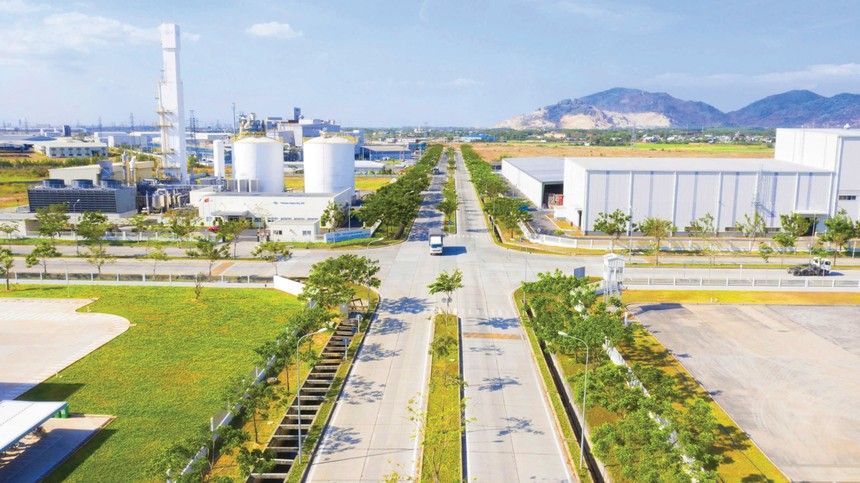
The industrial parks market enters a “new rulebook”
On the eve of 2026, Vietnam’s industrial parks are undergoing a structural shift:
👉 From competing on low rental costs – cheap labor
➡️ To competing on quality – speed – international standards
For more than a decade, Vietnam’s advantage in industrial development was largely built on cost efficiency. However, that model is gradually losing relevance as global supply chains become more sophisticated and sustainability requirements tighten.
Today, global manufacturers are prioritizing industrial parks that meet green and operational standards over those offering lower rents. Speed to market, reliability, and compliance now outweigh cost savings in strategic decision-making.
This shift is driven not only by internal pressure but also by increasingly stringent requirements from multinational corporations, especially those in electronics, semiconductors, and high-value manufacturing.
👉 In this context, the competitive landscape is being fundamentally redefined.
Growth foundation: Vietnam remains an FDI “bright spot”
According to assessments by S&P Global and Bloomberg Economics:
Manufacturing orders continue to grow
Exports maintain positive momentum
Vietnam is emerging as an alternative manufacturing hub
Despite global uncertainties, Vietnam continues to benefit from supply chain diversification, particularly the “China+1” strategy adopted by many global manufacturers.
👉 Key advantages include:
Competitive labor costs compared to regional peers
A stable political and investment environment
Strong participation in free trade agreements (FTAs)
Manufacturing capabilities increasingly aligned with global standards
These factors collectively position Vietnam as a long-term destination rather than a short-term alternative.
Infrastructure & policy: Game-changing factors
New elements are reshaping the market:
The 2026 land price framework adjustment
Gradual reduction of tax incentives
Improved legal framework & planning transparency
👉 At the same time, infrastructure such as:
Deep-sea ports (enhancing export capacity)
Interregional expressways (reducing transit time)
International airports (supporting high-value logistics)
is fundamentally upgrading Vietnam’s industrial real estate landscape.
Notably, infrastructure is no longer just a supporting factor—it has become a core determinant of investment decisions. Industrial locations connected to major logistics corridors are gaining a clear competitive edge.
From “land acquisition” to “factory leasing”: A clear trend
A major structural shift in the market:
👉 Demand for industrial land is gradually declining
👉 Demand for ready-built factories is rising sharply
This reflects a change in investor behavior—from long-term land holding to operational efficiency and capital optimization.
Why ready-built factories are gaining traction
Faster deployment (cutting setup time by months)
Lower upfront investment costs
Greater flexibility for scaling operations
Reduced exposure to regulatory and construction risks
👉 This model is particularly suitable for:
New FDI entrants testing the market
High-tech manufacturers requiring rapid setup
Companies operating under tight global supply timelines
New standard: Speed – flexibility – immediate operation
Modern industrial parks are evolving into integrated service platforms rather than simple land providers.
They now offer:
Completed factory units
Certified fire protection systems
Reliable high-capacity utilities
Integrated logistics and internal transport systems
👉 The ultimate goal:
Tenants can begin operations almost immediately after signing a lease
This “plug-and-play” model significantly reduces time-to-production, which is now a critical KPI for global manufacturers.
ESG becomes a mandatory “passport”
A decisive factor shaping the future of industrial parks is ESG (Environmental, Social, Governance).
Global corporations now require:
Carbon emission reduction commitments
Renewable energy integration
Compliance with international environmental standards
👉 As a result:
Industrial parks that fail to meet ESG standards risk losing tenants
ESG-compliant parks can command premium pricing and achieve higher occupancy rates
In many cases, ESG compliance is no longer a differentiator—it is a baseline requirement for participation in global supply chains.
Value-added services: A new competitive edge
According to Vũ Minh Chí, investors are increasingly focused on operational support services rather than just physical infrastructure:
Legal advisory
Customs clearance support
Certificates of origin
End-to-end logistics services
👉 Objective:
Reduce administrative friction
Accelerate operational timelines
Optimize supply chain efficiency
This signals a shift toward a “service-driven industrial ecosystem” rather than a purely asset-based model.
Logistics & warehousing: An essential piece
Rapidly growing segments include:
Cold storage (for pharmaceuticals and food supply chains)
Distribution centers (supporting e-commerce growth)
Transit hubs
Last-mile delivery warehouses
👉 Emerging trend:
Direct integration within industrial parks
Formation of end-to-end industrial ecosystems
This integration allows manufacturers to reduce handling time, cut logistics costs, and improve responsiveness to market demand.
Market divergence: Who wins – who loses?
Leading group:
Industrial parks located near ports and airports
ESG-compliant developments
Fully integrated infrastructure and services
Weaker group:
Projects in remote locations
Limited infrastructure connectivity
Non-compliance with environmental standards
👉 The gap between these two groups is expected to widen significantly in the coming years.
Location strategy of manufacturers
Manufacturers are increasingly selective in site selection, prioritizing:
Proximity to deep-sea ports
Access to international airports
A 1–2 hour logistics radius
👉 Benefits:
Lower logistics costs
Greater supply chain resilience
Improved operational efficiency
Location is no longer just about land availability—it is about connectivity and ecosystem integration.
The market shifts from “quantity” to “quality”
According to John Michael Campbell:
👉 Vietnam is entering a new phase characterized by:
Larger-scale operations
Higher technical and environmental standards
A focus on attracting high-quality FDI
This marks a transition from rapid expansion to selective, quality-driven growth.
Conclusion
Vietnam’s industrial parks market has officially:
❌ Ended the era of price-based competition
✅ Entered the era of quality & ESG-driven competition
👉 Developers that:
Invest in infrastructure
Provide integrated services
Align with sustainability standards
will emerge as long-term winners
👉 Meanwhile, projects that fail to adapt risk being left behind in an increasingly competitive and selective market.
References:
Free access to exclusive information on warehouse, factory, and land rentals in Dong Nai, Binh Duong, Long An, Ho Chi Minh City, and more.
KHU CÔNG NGHIỆP 247 is a company operating in the field of buying, selling, and leasing factories and real estate.. We are proud to be a leading provider of real estate services in Vietnam. We have a team of highly qualified and experienced real estate consultants who always place trust and credibility at the core of everything we do.
Phone: 0901 490 348
Email: datkhucongnghiep247@gmail.com
Website: datkhucongnghiep247.com.vn