
Vietnam enters a turning point from mass FDI attraction to strategic investment selection
As global supply chains undergo major restructuring, competition for foreign capital intensifies, and high-tech industries rapidly expand, Vietnam’s foreign direct investment (VietNam FDI) strategy is entering a critical transformation phase. After nearly 40 years of attracting foreign investment, Vietnam is no longer focused on simply bringing in as much capital as possible. Instead, the country is shifting toward selecting high-quality FDI projects that deliver technology transfer, innovation, sustainability, and stronger integration into global value chains.
This is more than an investment policy adjustment—it is a strategic shift that could determine the quality of Vietnam’s economic growth between 2026 and 2045.
Vietnam’s FDI landscape: growth continues, but quality concerns remain
FDI inflows remain strong, but structural limitations persist
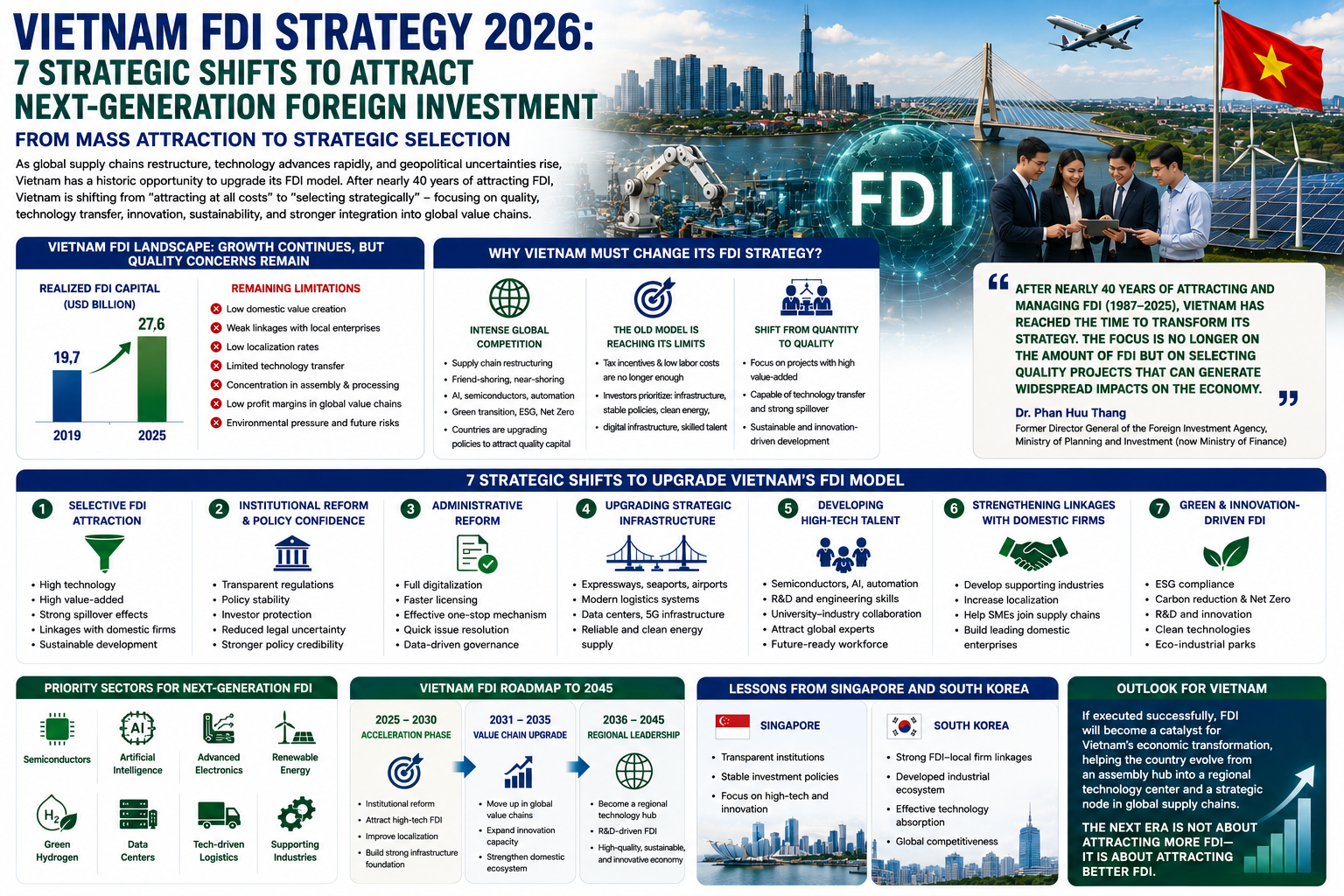
FDI continues to play a vital role in Vietnam’s economic growth. According to the analysis, realized FDI increased from USD 19.7 billion in 2019 to USD 27.6 billion in 2025, reflecting sustained investor confidence in Vietnam’s business environment.
However, several structural weaknesses remain:
- low domestic value creation
- weak linkages between foreign-invested firms and local businesses
- limited technology transfer
- low localization rates
- continued concentration in assembly and processing industries
- low profit margins within global value chains
These factors suggest Vietnam has not yet fully captured the long-term benefits of foreign capital.
Why Vietnam must change its FDI strategy
Global competition is becoming increasingly intense
The international investment landscape is changing rapidly due to:
- global supply chain restructuring
- friend-shoring
- near-shoring
- artificial intelligence
- semiconductors
- green transition
- ESG requirements
- Net Zero commitments
Countries worldwide are upgrading investment policies to compete for higher-quality capital.
Without strategic changes, Vietnam risks losing competitiveness.
The traditional FDI attraction model is reaching its limits
Vietnam’s earlier investment strategy relied heavily on:
- tax incentives
- low labor costs
- geographic advantages
- manufacturing and assembly
But next-generation investors now prioritize:
- infrastructure quality
- regulatory stability
- administrative efficiency
- clean energy access
- digital infrastructure
- highly skilled talent
This means the old model is no longer sufficient.
7 strategic shifts to upgrade Vietnam’s FDI model
1. Selective FDI attraction instead of quantity-driven growth
Vietnam’s new approach should prioritize projects with:
- advanced technologies
- strong technology transfer potential
- economic spillover effects
- domestic business linkages
- high value-added output
- sustainable development impact
The question is no longer “How much capital?” but “What value does this capital create?”
2. Institutional reform and stronger policy confidence
Investors need long-term certainty.
Vietnam should focus on:
- transparent regulations
- policy consistency
- investor protection
- reduced legal uncertainty
Institutional quality is becoming a core competitive advantage.
3. Administrative reform and digital governance
One of Vietnam’s biggest bottlenecks remains administrative complexity.
Key solutions include:
- full digitalization of approval processes
- shorter licensing timelines
- effective one-stop mechanisms
- faster issue resolution
- data-driven governance
This is especially critical for technology-focused investors.
4. Upgrading strategic infrastructure
High-quality FDI requires world-class infrastructure.
Priority areas include:
- expressways
- seaports
- airports
- logistics systems
- data centers
- 5G infrastructure
- reliable power supply
Better infrastructure directly strengthens competitiveness.
5. Developing high-tech human capital
Strategic sectors require advanced talent in:
- semiconductors
- artificial intelligence
- automation
- research and development
- green technologies
Vietnam should:
- strengthen university-industry partnerships
- align education with market demand
- attract international experts
Talent readiness will be a decisive advantage.
6. Strengthening FDI-local business integration
To maximize economic spillovers, Vietnam must build a stronger domestic ecosystem.
Key actions include:
- expanding supporting industries
- increasing localization
- helping SMEs join supply chains
- developing leading domestic enterprises
South Korea’s development model offers important lessons here.
7. Transitioning toward green and innovation-driven FDI
Next-generation FDI should align with:
- ESG standards
- carbon reduction
- Net Zero goals
- R&D expansion
- clean technology
- innovation ecosystems
Eco-industrial parks will likely become increasingly important.
Priority sectors for Vietnam’s next-generation FDI
High-tech industries become the core focus
Strategic sectors should include:
- semiconductors
- AI
- advanced electronics
- renewable energy
- green hydrogen
- data centers
- technology-driven logistics
- supporting industries
These industries generate higher long-term value.
Vietnam’s FDI roadmap through 2045
Three strategic development phases
2025–2030: Acceleration phase
Focus on:
- institutional reform
- attracting high-tech FDI
- improving localization
2031–2035: Global value chain upgrade
Objectives:
- move higher in global value chains
- expand innovation capacity
2036–2045: Regional technology leadership
Long-term goals:
- become a regional technology hub
- strengthen R&D-driven FDI
- build a high-quality advanced economy
Lessons from Singapore and South Korea
Successful FDI strategies require national alignment
Singapore succeeded through:
- transparent institutions
- stable investment policies
- high-tech investment focus
South Korea succeeded through:
- strong FDI-local business integration
- industrial ecosystem development
- effective technology absorption
These models offer useful strategic lessons for Vietnam.
Outlook for Vietnam’s FDI future
If Vietnam executes this transition successfully, FDI will become more than a source of capital—it will become a catalyst for economic transformation.
Vietnam has the opportunity to evolve from an assembly-based economy into:
- a regional technology hub
- a green FDI destination
- a strategic global supply chain node
- an innovation-driven economy
The message is clear: the next era is not about attracting more FDI—it is about attracting better FDI.
References:
Free access to exclusive information on warehouse, factory, and land rentals in Dong Nai, Binh Duong, Long An, Ho Chi Minh City, and more.
KHU CÔNG NGHIỆP 247 is a company operating in the field of buying, selling, and leasing factories and real estate.. We are proud to be a leading provider of real estate services in Vietnam. We have a team of highly qualified and experienced real estate consultants who always place trust and credibility at the core of everything we do.
Phone: 0901 490 348
Email: datkhucongnghiep247@gmail.com
Website: datkhucongnghiep247.com.vn