
Business results for Vietnam’s industrial real estate sector in the first half of 2026 showed a clear divergence among major companies. While Viglacera delivered positive growth thanks to industrial infrastructure leasing, Becamex, Sonadezi Chau Duc and several other developers faced pressure from revenue-recognition timing, financial costs and accounting changes. Even so, signed but unrecognized contracts, new industrial land supply and continued FDI growth are supporting expectations that profits will be more heavily concentrated in the second half of 2026.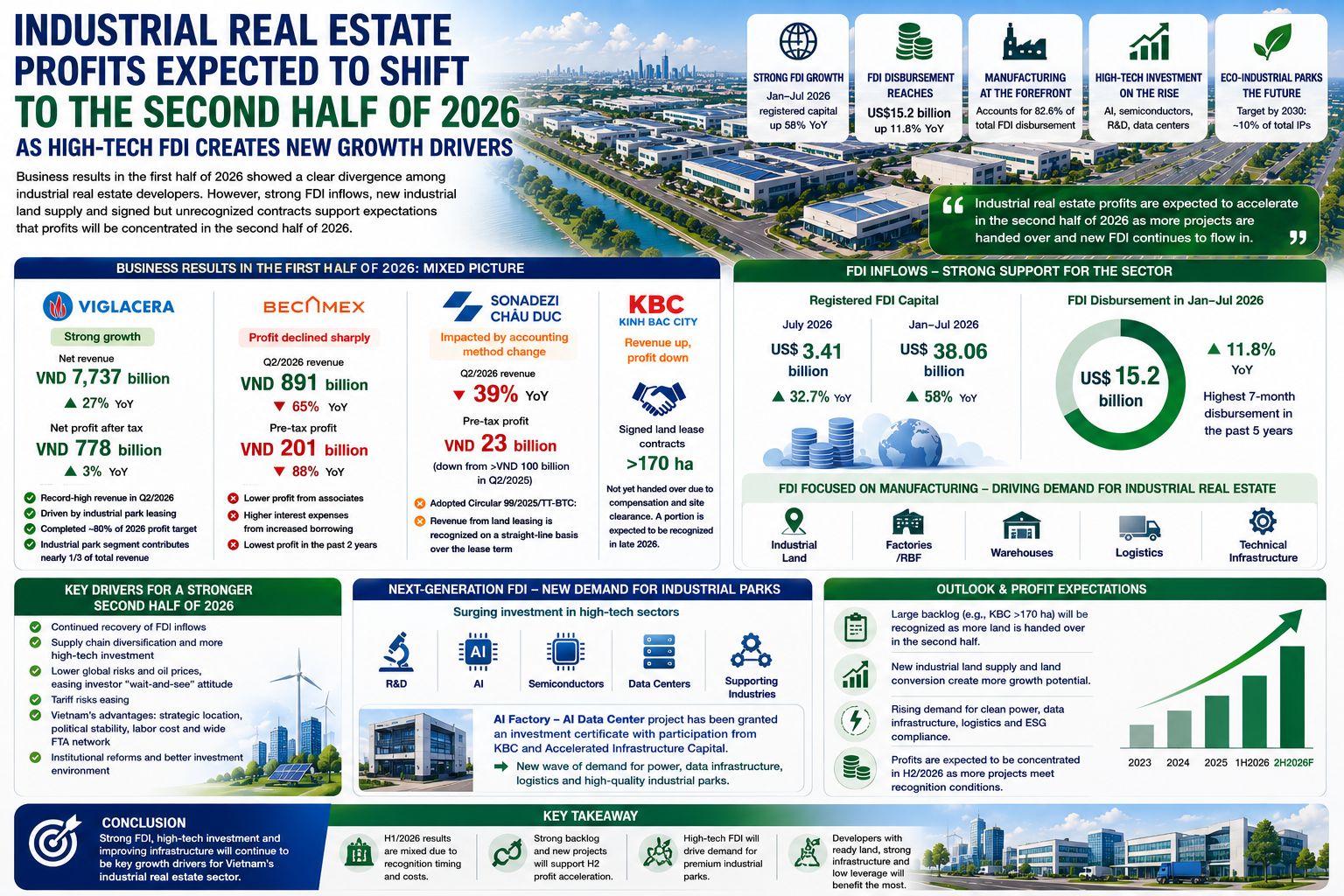
Vietnam’s industrial real estate market is entering a particularly interesting phase.
Demand for industrial land, ready-built factories and logistics facilities continues to be supported by foreign direct investment, while the financial results of listed industrial park developers remain uneven.
This means first-half earnings do not necessarily reflect the true level of leasing demand.
One major reason is the timing gap between signing a lease, handing over land and recognizing revenue.
For many industrial park developers, signed contracts may already be substantial, but revenue cannot be recognized immediately because land clearance, infrastructure completion or accounting requirements still need to be satisfied.
This is why the second half of 2026 is expected to be more important for sector earnings.
Industrial Real Estate Performance Diverged Sharply in H1 2026
The results of major industrial park developers reflected two very different trends.
One group benefited from land handovers, contract recognition and improving business conditions.
Another group was affected by:
- slower handovers;
- accounting recognition methods;
- lower profit margins;
- higher interest expenses;
- weaker contributions from associates and joint ventures.
As a result, a single quarter or six-month profit figure may not fully capture the actual state of industrial land leasing activity.
Viglacera Recorded Nearly VND 7.737 Trillion in H1 Revenue
One of the sector’s most notable bright spots was Viglacera Corporation.
In Q2 2026, the company recorded its highest quarterly revenue since establishment.
Profit also reached its highest level in three years.
Management said the result was primarily driven by stronger profit from industrial infrastructure leasing, while the building materials segment also improved year on year.
In the first six months of 2026, Viglacera reported:
- nearly VND 7.737 trillion in net revenue;
- more than VND 778 billion in net profit after tax;
- revenue growth of around 27%;
- profit growth of around 3% year on year.
Viglacera Completed Around 80% of Its Annual Profit Target
A particularly important point is that Viglacera had already completed approximately 80% of its full-year profit target after the first six months.
This gives the company a relatively strong cushion for the second half.
Industrial park infrastructure is not only a major growth driver but also a core business segment.
According to the reported figures, it contributes close to one-third of total revenue.
This demonstrates the importance of industrial land assets within Viglacera’s overall business structure.
Industrial Infrastructure Remains Viglacera’s Core Growth Engine
Viglacera benefits from owning industrial parks in several locations that continue to attract significant FDI.
This enables the company to directly benefit when foreign manufacturers expand production in Vietnam.
An industrial park project can generate long-term cash flow from:
- land leases;
- infrastructure fees;
- services;
- ready-built facilities;
- utilities.
Industrial land can therefore create economic value far beyond the revenue recognized in a single accounting period.
Becamex Q2 Revenue Fell 65%
In contrast, Becamex Investment and Industrial Development Corporation recorded weaker Q2 2026 performance.
Quarterly revenue fell to approximately VND 891 billion, down 65% year on year.
Pre-tax profit reached around VND 201 billion.
In the same period a year earlier, the company had posted approximately VND 1.676 trillion in pre-tax profit.
This represented Becamex’s lowest profit level in roughly two years.
Becamex Profit Pressured by Associates and Higher Interest Costs
The decline was not driven by revenue alone.
Becamex also saw lower contributions from joint ventures and associated companies.
At the same time, rising borrowing and higher interest expenses added pressure to earnings.
This highlights the importance of capital structure for industrial real estate developers.
A company may hold large land reserves but still face substantial pressure if leverage rises and financing costs increase.
Cost of Capital Is Becoming an Important Factor
Industrial park development requires large amounts of capital.
Developers need to spend on:
- site clearance;
- internal roads;
- electricity infrastructure;
- water systems;
- wastewater treatment;
- legal procedures;
- service facilities.
If projects are delayed, borrowed capital can remain tied up for long periods.
Interest expenses can then erode profitability.
This is one of the key differences between newly signed leasing value and actual reported profit.
Sonadezi Chau Duc Affected by Changes in Revenue Recognition
Sonadezi Chau Duc also reported sharp declines in both revenue and profit in Q2 2026.
Quarterly revenue fell by around 39%.
Pre-tax profit reached only about VND 23 billion, substantially below the more than VND 100 billion recorded in the same period last year.
However, this case requires an important qualification.
The decline does not entirely reflect weaker leasing demand.
Circular 99/2025/TT-BTC Changed the Accounting Method
Under the new accounting regime set out in Circular 99/2025/TT-BTC, Sonadezi Chau Duc changed the way it recognizes industrial land leasing revenue.
Previously, lease revenue could be recognized largely upfront.
The company has now shifted toward allocating revenue over the lease term.
This can make quarterly and annual reported revenue and profit appear substantially lower.
However, the underlying economics of the lease contract and actual cash collection may not decline correspondingly.
Accounting Changes Can Distort Year-on-Year Comparisons
This is an important issue when comparing company results.
If a business moves from one-time recognition to multi-year allocation, current-period revenue will naturally be lower.
That does not necessarily mean leasing performance has weakened.
Investors therefore need to distinguish between:
underlying business performance and accounting recognition timing.
This is particularly important in industrial real estate.
Kinh Bac Revenue Increased While Profit Declined
Kinh Bac City Development Holding Corporation showed another type of divergence.
Revenue increased.
But profit declined.
The main reason was a weaker profit margin.
The more important factor, however, may be the volume of signed contracts that has not yet been recognized.
KBC Has Signed More Than 170 Hectares but Has Not Fully Handed Them Over
According to KBC Deputy General Director Pham Phuc Hieu, the company has not yet recognized all signed contracts.
Industrial land leases already signed exceed 170 hectares.
However, some of that area has not yet been handed over because compensation and land clearance are still ongoing.
The company expects part of the area to be recognized toward the end of the year.
This is one of the main reasons analysts expect stronger H2 earnings.
More Than 170 Hectares of Signed Contracts Represent Significant Backlog
In industrial real estate, signed but unrecognized contracts can be viewed as future revenue backlog.
Once handover conditions are met, revenue can rise sharply in a single quarter.
This makes quarterly earnings highly volatile.
For this reason, contract backlog can be just as important as current profit.
The Gap Between Contract Signing and Revenue Recognition Is an Industry Characteristic
Industrial land leasing usually goes through several stages:
- tenant sourcing;
- negotiation;
- contract signing;
- land clearance;
- infrastructure development;
- land handover;
- revenue recognition.
A contract signed early in the year may not be recognized until the end of the year.
That means first-half financial results can understate underlying demand.
H2 Earnings Could Be Supported by Existing Backlog
This is one of the main reasons analysts expect industrial real estate profits to be concentrated in the second half of 2026.
Potential supporting factors include:
- handover of previously signed contracts;
- completion of land clearance;
- new FDI tenants;
- new industrial land supply;
- improved legal progress.
If these factors converge, reported revenue could increase quickly.
Rubber Companies Are Also Benefiting from Industrial Land Conversion
Another notable trend is that some rubber companies are recording significant profits from land converted to industrial use.
This has become increasingly relevant in recent years.
Rubber companies often control large land reserves.
When part of this land is rezoned for industrial development, its economic value can increase substantially.
Rubber Land Is Becoming a New Source of Industrial Park Supply
Converted rubber land can become an important source of new industrial land.
This is especially relevant in areas with:
- strong transport connectivity;
- proximity to Ho Chi Minh City;
- seaports;
- airports;
- established manufacturing ecosystems.
Such land can help expand supply in regions where older industrial parks already have high occupancy rates.
New Industrial Land Supply Is Essential for Long-Term Growth
Industrial park developers need a continuing pipeline of new projects.
If existing parks are almost fully leased, future revenue growth will eventually slow.
Companies with the ability to:
- expand industrial parks;
- develop new projects;
- convert land;
- complete legal procedures;
will have a stronger position in the next growth cycle.
FDI Continues to Support Industrial Real Estate Demand
Despite the divergence in company earnings, underlying sector demand remains relatively positive.
According to official statistics, total registered FDI in July 2026 alone reached approximately USD 3.41 billion, up 32.7% year on year.
For the first seven months of 2026, registered FDI increased by around 58%.
This is a very strong rate of growth.
Implemented FDI Reached USD 15.2 Billion
The positive signal is not limited to registered capital.
Implemented FDI reached around USD 15.2 billion in the first seven months of 2026, up 11.8%.
This was also the highest seven-month disbursement level in five years.
Implemented FDI is particularly important for industrial real estate because it reflects projects that are actually moving into execution.
FDI Disbursement Creates Direct Demand for Land, Factories and Logistics
When FDI is disbursed, companies begin to:
- lease land;
- build factories;
- rent warehouses;
- install equipment;
- recruit workers.
This creates direct demand for industrial real estate.
It provides the fundamental revenue base for industrial park developers.
Manufacturing Remains the Main Destination of FDI
A particularly important point is that FDI continues to concentrate heavily in manufacturing.
This is the sector that consumes the most industrial real estate.
A manufacturing project typically requires:
- land;
- electricity;
- water;
- factories;
- warehouses;
- logistics.
Industrial real estate therefore remains one of the most direct beneficiaries of FDI growth.
H2 2026 Is Expected to Be More Positive
According to Nguyen Thi Trang, an analyst at KB Securities, the outlook for industrial real estate companies in the second half of 2026 is relatively positive.
Key supporting factors include:
- continued FDI recovery;
- increasing high-tech investment;
- easing global macroeconomic risks;
- lower oil prices;
- reduced investor hesitation;
- softer tariff risks.
These factors could help accelerate investment decisions.
Investor “Wait-and-See” Behavior Could Ease
During periods of uncertainty, companies often postpone investment decisions.
They may wait for clarity on:
- tariff policy;
- interest rates;
- energy prices;
- trade conditions.
As these risks ease, delayed investment decisions can move forward.
That can generate new demand for industrial land.
Lower Tariff Risk Supports Vietnam’s Position
Trade uncertainty has been one of the biggest concerns for investors.
After the United States announced the results of its USTR Section 301 investigation, some experts said Vietnam’s role in global supply chains had not changed significantly.
This reduces uncertainty.
For long-term investors, predictability is extremely important.
Vietnam’s Manufacturing Ecosystem Is Difficult to Replicate
Vietnam has already developed several major manufacturing clusters.
Key sectors include:
- electronics;
- mechanical engineering;
- textiles;
- logistics;
- supporting industries.
New investors can plug into existing supply networks.
This is an advantage that competing destinations cannot build overnight.
Supply-Chain Diversification Continues to Benefit Vietnam
Global companies are still pursuing supply-chain diversification.
They do not want to depend excessively on a single country.
Vietnam remains one of the locations considered in these strategies.
That supports demand for industrial land.
Vietnam’s FTA Network Is a Long-Term Advantage
Vietnam has a broad network of free trade agreements.
This allows manufacturers based in Vietnam to access multiple export markets.
That is a meaningful advantage in investment site selection.
It is particularly important for export-oriented industries.
Institutional Reform Could Create More Room for FDI
According to VNDIRECT analysts, institutional reforms and improvements in the investment environment are expected to create additional room for capital inflows.
For investors, fast and transparent procedures can be just as important as tax incentives.
A project delayed by several months can generate significant costs.
Administrative reform therefore directly affects industrial park competitiveness.
Logistics Will Be a Major Determinant of Industrial Park Competitiveness
According to Nguyen Minh Duc, an analyst at MBS, Vietnam remains an attractive FDI destination.
One major growth driver will be continued improvement in transport and logistics capacity.
Industrial parks with strong connectivity tend to have a clear advantage.
Investors look closely at:
- seaports;
- airports;
- expressways;
- ring roads;
- transport times.
New Industrial Land Supply Is Another Important Driver
Another major factor is the availability of new industrial land.
In many core markets, occupancy rates are already high.
Without new land supply, Vietnam could lose large-scale investment opportunities.
The development of:
- new industrial parks;
- expanded industrial parks;
- converted land;
will therefore remain important.
High-Tech FDI Is Emerging as a New Growth Engine
A key theme for the second half of 2026 is the rise of high-tech investment.
According to KBSV, the industrial real estate outlook is being supported by capital moving into:
- R&D;
- AI;
- semiconductors;
- data centers.
These sectors offer higher value added.
They also require much more sophisticated infrastructure than traditional factories.
AI Is Creating a New Type of Industrial Real Estate Demand
AI projects do not require only office space.
They also need physical infrastructure.
This includes:
- data centers;
- large-scale power supply;
- cooling systems;
- data networks;
- security infrastructure.
This is creating a new layer of demand for industrial real estate.
AI Factory – AI Data Center Is an Important Signal
The Management Board of Export Processing and Industrial Zones of Ho Chi Minh City has granted an investment certificate to the AI Factory – AI Data Center project, involving KBC and Accelerated Infrastructure Capital.
This is a notable development.
It shows that future industrial land demand will not come only from traditional manufacturing.
Digital infrastructure is becoming a new segment.
Data Centers Require Specialized Infrastructure
A data center needs:
- high-capacity electricity;
- backup power;
- fiber connectivity;
- cooling systems;
- security;
- fire protection.
Not every industrial park can accommodate these requirements.
Parks with superior infrastructure will therefore have a major advantage.
Power Is Becoming One of the Most Important Competitive Factors
For semiconductors, AI and data centers, electricity is critical.
Investors no longer ask only:
“Is industrial land available?”
They also ask:
“Is sufficient power available?”
In the future, they may increasingly ask:
“Is the electricity green?”
This is a major market shift.
Renewable Energy Could Become a New Competitive Advantage
Large technology companies often have Net Zero commitments.
They therefore prefer locations offering:
- rooftop solar;
- PPAs;
- clean power;
- carbon data.
Industrial parks capable of providing renewable energy can attract higher-quality tenants.
Industrial Real Estate Will Become More Segmented by Quality
Not every industrial park will benefit equally from the next FDI wave.
Parks with:
- strategic locations;
- ready land;
- strong infrastructure;
- reliable power;
- ESG capability;
- good logistics;
will have a clear advantage.
This will increase differentiation among developers.
Companies with Large Backlogs Have an Advantage
In the second half, companies with large signed contract backlogs will receive particular attention.
Backlog improves revenue visibility.
If land handovers proceed as planned, profit can rise quickly.
KBC is a clear example with more than 170 hectares of signed leases.
Backlog Only Matters If Land Can Be Handed Over
A signed contract does not automatically produce immediate revenue.
Investors still need to monitor:
- land clearance;
- legal procedures;
- infrastructure construction.
These determine whether revenue can actually be recognized.
Land Clearance Remains a Major Bottleneck
Land clearance is one of the most persistent industrial park issues.
A project may already have tenants but still be unable to hand over land.
This delays revenue.
Companies with stronger execution in land clearance will therefore have an advantage.
Accounting Rules Also Need to Be Monitored
The Sonadezi Chau Duc case shows how accounting policy can have a major impact on reported profit.
Investors need to understand:
- how revenue is recognized;
- over how many years it is allocated;
- what actual cash flow looks like.
Without this, company results can be misinterpreted.
Cash Flow Can Be More Important Than Accounting Profit
A company may receive cash upfront but recognize revenue over several years.
In that case, reported earnings may look weak.
But cash generation can still be strong.
Investors therefore need to examine:
- customer advances;
- deferred revenue;
- operating cash flow.
These can be important indicators.
Profit Margins Also Matter
Revenue alone is not enough.
Margins determine the quality of growth.
KBC’s case—higher revenue but lower profit—illustrates this clearly.
A company may lease more land but still face rising costs.
Profit may not increase proportionally.
Compensation Costs Can Pressure Margins
Land compensation is becoming more expensive in many areas.
If compensation costs rise sharply, industrial park margins can fall.
Developers that accumulated land reserves earlier can therefore have an advantage.
Older Land Banks Can Generate Higher Margins
Companies that acquired land many years ago often have lower cost bases.
When lease rates increase, margins can be strong.
This is why land reserves remain one of the most valuable assets of industrial park developers.
Industrial Land Rents Could Remain Supported
If FDI continues to increase while ready land remains limited, rental rates may remain supported.
However, growth will vary by region.
Areas close to:
- ports;
- airports;
- expressways;
will generally have an advantage.
Northern Vietnam Continues to Attract Electronics and High-Tech Investment
Northern Vietnam has a strong position in:
- electronics;
- semiconductors;
- high technology.
Provinces with established manufacturing ecosystems are often preferred by investors.
This supports both occupancy and rental rates.
Southern Vietnam Remains Strong in Logistics and Diversified Manufacturing
Southern Vietnam has different advantages:
- a large consumer market;
- major seaports;
- logistics networks;
- Long Thanh International Airport;
- a mature industrial park network.
Demand therefore remains broad-based.
Long Thanh Could Be a Major Growth Driver for Southern Industrial Parks
Long Thanh International Airport and related infrastructure could create a new growth cycle.
Potential beneficiaries include:
- logistics;
- warehousing;
- manufacturing;
- technology.
Industrial parks near this corridor could gain long-term advantages.
Ready-Built Factories Remain an Attractive Segment
New FDI projects do not always want to lease land and build from scratch.
Many companies want to enter the market quickly.
They prefer:
- Ready-Built Factories;
- ready-built warehouses;
- flexible industrial facilities.
This segment still has strong growth potential.
RBF Helps Shorten Project Implementation Time
Building a factory from scratch can take many months.
Ready-built facilities allow companies to:
- lease space;
- install machinery;
- begin production faster.
This is particularly useful during ongoing supply-chain shifts.
Logistics Demand Continues to Be Supported by Manufacturing and Trade
As manufacturing grows, logistics demand also grows.
Companies need:
- warehouses;
- distribution centers;
- transportation services.
Industrial logistics is therefore inseparable from the broader industrial real estate market.
High-Tech FDI Will Raise Industrial Park Standards
Projects in R&D, semiconductors, AI and data centers have very demanding requirements.
Industrial parks will need to upgrade:
- electricity;
- data infrastructure;
- water;
- fire protection;
- ESG systems.
This creates investment pressure.
But it also creates opportunities for higher-quality developers.
Green Industrial Parks Could Become More Competitive
Clean energy and ESG are increasingly important investment criteria.
Industrial parks with:
- rooftop solar;
- advanced wastewater systems;
- green buildings;
- carbon data;
will be more attractive.
This is a long-term development trend.
Smart Industrial Parks Will Also Expand
Digital technology can help industrial parks:
- monitor electricity;
- monitor water;
- improve security;
- optimize maintenance.
This can reduce operating costs.
It can also improve service quality.
FDI investors increasingly value these capabilities.
Service Quality Could Influence Rental Rates
In the future, industrial parks will not compete only through land.
They will compete through:
- service quality;
- data;
- ESG;
- response speed.
A higher-quality park may be able to maintain higher rental rates.
H2 Will Be the Key Test for Existing Backlog
Expectations for stronger second-half earnings still need to be confirmed by actual performance.
Investors should watch:
- area handed over;
- revenue recognized;
- profit;
- cash flow.
These will be key indicators.
Viglacera Has an Advantage After a Strong First Half
Completing around 80% of its annual profit plan gives Viglacera a relatively comfortable position.
The company is under less pressure in H2.
If its industrial park segment continues to perform well, full-year results could remain strong.
Becamex Needs Stronger H2 Profitability
For Becamex, H1 was more challenging.
Investors will monitor:
- joint venture profit;
- interest expenses;
- project progress;
- cash flow.
These will determine the pace of recovery.
Sonadezi Chau Duc Needs to Be Evaluated Under the New Accounting Basis
Because of the change in revenue recognition, year-on-year comparisons for Sonadezi Chau Duc need to be treated carefully.
Accounting profit may appear lower.
But actual leasing and cash flow remain more important.
This company therefore requires deeper analysis.
KBC Could See Revenue Concentrated Toward Year-End
With more than 170 hectares of signed leases not yet fully recognized, KBC could record additional revenue once land is handed over.
This makes KBC one of the companies with significant backlog.
However, compensation progress remains the key condition.
Investors Should Not Rely Only on Short-Term P/E
Because industrial park profits can fluctuate sharply depending on recognition timing, a single-quarter or single-year P/E can be misleading.
Investors should also evaluate:
- land bank;
- backlog;
- rental rates;
- project progress;
- cash flow.
This provides a more complete picture.
Land Bank Value Remains the Most Important Long-Term Factor
An industrial park company with large, strategically located land reserves can hold substantial long-term value.
Especially if the land has:
- clear legal status;
- clean handover conditions;
- strong infrastructure.
This creates multi-year revenue potential.
Legal Progress Can Create Huge Differences Between Developers
Two companies may have similar land reserves but very different legal readiness.
One project can lease immediately.
Another may wait for years.
Legal status is therefore extremely important.
H2 2026 Could Be a Turning Point for Industrial Real Estate
If FDI remains strong, signed contracts are handed over and new projects advance, sector earnings could improve substantially.
This could make full-year 2026 results much better than the first-half picture suggests.
However, improvement will not be uniform across companies.
Divergence Will Continue
Companies with:
- ready land;
- large backlog;
- lower leverage;
- strong infrastructure;
will benefit more.
Those with:
- high debt;
- slow legal progress;
- limited ready land;
may continue to face pressure.
This divergence will remain an important theme.
Strong FDI Does Not Mean Every Industrial Park Stock Will Perform Equally
FDI growth creates a favorable sector backdrop.
But each developer has different asset quality and execution capacity.
The sector should therefore not be assessed only through headline FDI data.
Company-level analysis remains necessary.
High-Tech FDI Could Create a New “Premium” for Industrial Parks
Industrial parks capable of serving AI, semiconductors or data centers may be able to command higher rents.
This could create a new infrastructure premium.
It may reshape the value of industrial land.
Data Centers Add a New Layer of Demand
Historically, industrial real estate demand mainly came from factories.
Data centers now create an additional layer.
These projects require large capital commitments.
They also need specialized infrastructure.
This creates a new market opportunity.
R&D Also Requires Specialized Real Estate
Research centers need:
- offices;
- laboratories;
- power;
- data connectivity.
Future industrial parks may therefore integrate multiple functions.
Not only factories.
Industrial Real Estate Will Become More Diverse
Future industrial real estate portfolios may include:
- industrial land;
- RBF;
- warehouses;
- data centers;
- R&D space;
- logistics facilities.
This is a natural evolution of the sector.
Power and Data Infrastructure Are Becoming Decisive
In the past, roads and ports dominated site-selection criteria.
Today, electricity and data connectivity are becoming increasingly important.
This reflects the changing composition of FDI.
High-tech projects require new types of infrastructure.
High-Tech Investment Policies Create Opportunities
Vietnam is seeking to improve the quality of FDI.
This supports industrial parks that can accommodate advanced technology projects.
It also encourages developers to upgrade standards.
New Capital Flows Could Increase Occupancy
If FDI continues to rise, industrial parks with available land can improve occupancy.
This supports:
- revenue;
- cash flow;
- asset value.
These are direct benefits.
H2 Profit Will Depend Heavily on Handover Timing
This remains the most important short-term factor.
A company may sign many contracts.
But until land is handed over, accounting profit may not appear.
Q3 and Q4 will therefore be important periods to monitor.
Year-End Could Bring Sharp Profit Spikes
Because of revenue-recognition timing, an industrial park developer can report weak Q2 earnings but very strong Q4 results.
This is not unusual in the sector.
Quarterly volatility should therefore be viewed in a longer-term context.
The Sector Still Has Positive Long-Term Fundamentals
Despite mixed H1 results, the sector’s core fundamentals remain positive.
These include:
- rising FDI;
- manufacturing expansion;
- supply-chain relocation;
- infrastructure development.
These are long-term growth drivers.
National Infrastructure Projects Continue to Support Industrial Parks
Projects such as:
- expressways;
- airports;
- seaports;
- ring roads;
are reshaping Vietnam’s industrial map.
Industrial parks located near these corridors could benefit significantly.
This should be considered over a multi-year horizon.
H2 2026 Could Mark the Beginning of a New Cycle
If high-tech FDI continues to increase, Vietnam may enter a new industrial real estate cycle.
This cycle will differ from the previous one.
Growth will no longer depend only on:
- land;
- rental rates.
It will depend increasingly on infrastructure quality.
Industrial Parks Face Opportunities but Growth Will No Longer Be Uniform
The era when almost any industrial land could be easily leased is changing.
Tenants are becoming more demanding.
Developers need to invest more in:
- ESG;
- digitalization;
- power infrastructure;
- logistics.
This will increase market differentiation.
High-Tech FDI Could Be the Biggest Catalyst
Among the new growth drivers, high technology stands out.
These projects typically involve large capital commitments.
They also require high-quality infrastructure.
If Vietnam attracts more such projects, industrial real estate could benefit significantly.
AI Factory Is an Early Signal of the Trend
The AI Factory – AI Data Center project shows that this trend has already begun.
It may not be an isolated case.
More data infrastructure projects could emerge in the coming years.
This opens a new market.
Industrial Real Estate Is Entering the “Technology Infrastructure” Era
In the previous cycle, industrial parks were mainly manufacturing infrastructure.
In the next cycle, they could increasingly become technology infrastructure.
This includes:
- data centers;
- AI;
- R&D;
- semiconductors.
That is a major upgrade.
Expectations for Stronger H2 2026 Profit Have a Real Basis
The expectation of better second-half earnings is not based purely on sentiment.
It is supported by:
- contract backlog;
- strong FDI growth;
- high FDI disbursement;
- rising technology demand;
- new industrial land supply.
These are tangible factors.
Risks Still Remain
Key risks include:
- slow land clearance;
- high financing costs;
- accounting changes;
- delayed FDI decisions;
- trade volatility.
A positive outlook does not mean the sector is risk-free.
Profit Will Concentrate in Companies That Can Execute
Ultimately, the benefits of FDI will flow to companies capable of turning demand into recognized revenue.
That requires:
- land;
- legal readiness;
- infrastructure;
- handover capability.
These are the four core factors.
Industrial Real Estate Remains a Direct Beneficiary of FDI
Despite mixed earnings in the first half of 2026, the long-term fundamentals of industrial real estate continue to be strongly supported by FDI.
Registered FDI increased by around 58% in the first seven months.
Implemented FDI reached USD 15.2 billion, the highest seven-month level in five years.
Manufacturing remained the primary destination of capital.
This creates clear demand for industrial land, factories and logistics.
H2 2026 Will Be Critical for Testing the Sector Outlook
Viglacera, KBC, Becamex and Sonadezi Chau Duc are entering the second half from different starting points.
Viglacera has already delivered strong results.
KBC has significant contract backlog.
Becamex needs stronger earnings recovery.
Sonadezi Chau Duc is adjusting to a new accounting treatment.
Q3 and Q4 results will therefore be important in determining whether the expected profit rebound materializes.
Next-Generation FDI Could Open a New Growth Cycle for Vietnam’s Industrial Parks
If investment in R&D, AI, semiconductors and data centers continues to accelerate, Vietnam’s industrial real estate market could enter a fundamentally new phase.
Demand will no longer be measured only by floor area.
Investors will increasingly require:
- reliable power;
- data infrastructure;
- logistics;
- ESG standards;
- high-quality technical infrastructure.
Developers that prepare well for this shift are likely to benefit the most.
For that reason, expectations that industrial real estate profits will be concentrated in the second half of 2026 reflect more than the timing of existing contract handovers.
They also point to a broader structural change: Vietnam’s FDI is moving toward higher-quality investment, and industrial real estate must upgrade to enter the next growth cycle.
References:
Free access to exclusive information on warehouse, factory, and land rentals in Dong Nai, Binh Duong, Long An, Ho Chi Minh City, and more.
KHU CÔNG NGHIỆP 247 is a company operating in the field of buying, selling, and leasing factories and real estate.. We are proud to be a leading provider of real estate services in Vietnam. We have a team of highly qualified and experienced real estate consultants who always place trust and credibility at the core of everything we do.
Phone: 0901 490 348
Email: datkhucongnghiep247@gmail.com
Website: https://industrialland.com.vn/en