

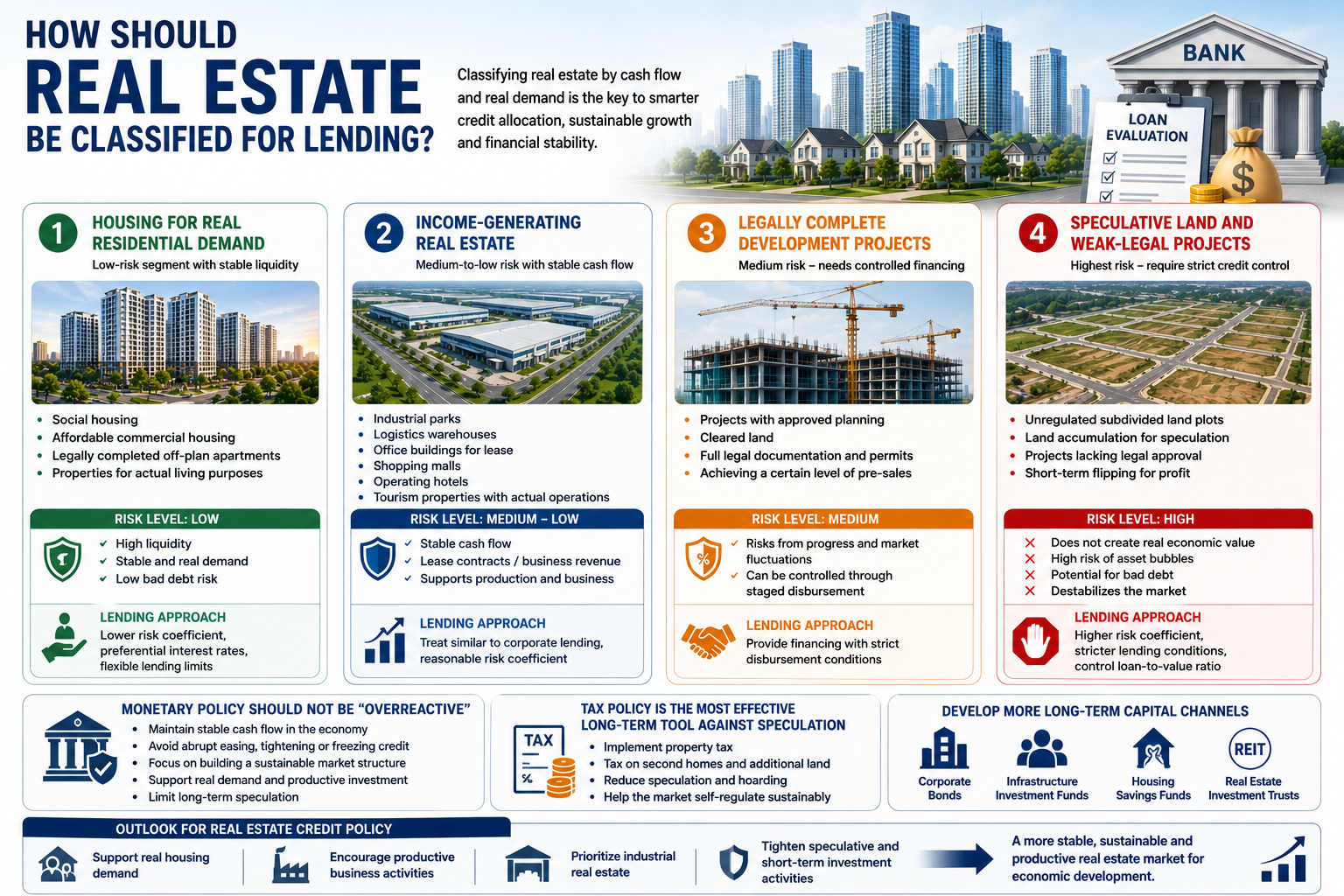
Classifying Real Estate by Cash Flow and Real Demand Is the Key to Smarter Credit Allocation
The classification of real estate assets for credit lending purposes is becoming a major topic among policymakers, banks, and economic experts in Vietnam. As the property market enters a restructuring phase, balancing credit control with support for productive sectors has become increasingly important.
Recently, during a meeting with State Bank of Vietnam regarding economic performance in the first months of 2026, Prime Minister Lê Minh Hưng instructed the central bank to study and classify different types of real estate in order to apply more appropriate credit limits and risk coefficients.
According to experts, instead of tightening credit across the entire market, Vietnam should classify real estate based on:
- Cash flow generation
- Real housing demand
- Level of speculation
- Economic contribution
This approach would allow capital to flow into sectors that create real economic value while reducing speculative risks.
1. Housing for Real Residential Demand Should Receive Priority
Low-risk segment with stable liquidity
According to economist Dr. Lê Bá Chí Nhân, the first category that should receive priority credit access is real estate serving genuine housing demand.
This group includes:
- Social housing
- Affordable commercial housing
- Legally completed off-plan apartments
- Residential properties purchased for actual living purposes
These properties typically maintain strong liquidity and stable long-term demand. Buyers usually have clear income sources and repayment ability tied to stable salaries, resulting in lower bad debt risks.
Experts believe this segment should:
- Receive lower risk coefficients
- Enjoy long-term preferential interest rates
- Have more flexible lending policies
Supporting real housing demand not only improves social welfare but also helps stabilize the broader property market.
2. Income-Generating Real Estate Should Be Treated Like Productive Credit
Industrial parks, logistics, and rental assets generate stable cash flow
The second category includes real estate assets capable of generating stable business cash flow and is considered medium-to-low risk.
This group includes:
- Industrial parks
- Logistics warehouses
- Office buildings for lease
- Shopping malls
- Operating hotels
- Tourism properties with actual business operations
According to Dr. Lê Bá Chí Nhân, these assets directly support economic production and business activities while generating stable revenue from rental contracts and operations.
Therefore, classifying them as “high-risk real estate” does not accurately reflect their nature. Instead, they should be treated similarly to productive business credit.
Industrial real estate, in particular, is increasingly viewed as a strategic sector thanks to:
- Strong FDI inflows
- Manufacturing shifts toward Vietnam
- Expanding public infrastructure investment
- Growing logistics demand
Huỳnh Duy Sang stated that Asia Commercial Joint Stock Bank has gradually expanded lending toward industrial real estate because this type of financing effectively supports Vietnam’s manufacturing economy.
According to Mr. Sang, industrial real estate will remain one of ACB’s strategic priorities in the coming years.
3. Legally Complete Development Projects Should Receive Controlled Financing
Preventing supply shortages in the market
The third category consists of real estate development projects that are still under construction but already possess full legal documentation.
These projects generally:
- Have approved planning
- Possess cleared land
- Hold valid construction permits
- Achieve a certain level of pre-sales
Experts believe the main risks in this segment relate to project progress and market fluctuations, both of which can be managed through staged disbursement mechanisms.
If credit is excessively restricted for these projects, the market may face:
- Supply shortages
- Delayed project completion
- Rising financing costs
- Supply-demand imbalances
Therefore, experts suggest that these projects should continue receiving controlled financing instead of blanket restrictions.
4. Speculative Land and Weak-Legal Projects Should Face Tight Credit Controls
Highest-risk segment in the market
According to Dr. Lê Bá Chí Nhân, the category requiring the strictest control includes speculative real estate and legally incomplete projects.
This group includes:
- Unregulated subdivided land plots
- Land accumulation for speculative price increases
- Projects lacking sufficient legal approval
- Short-term property flipping activities
These assets are considered high-risk because they:
- Do not create real economic value
- Increase the risk of asset bubbles
- Can contribute to rising bad debt
- Destabilize the market
Experts recommend:
- Applying higher risk coefficients
- Tightening lending conditions
- Strictly controlling loan-to-value ratios
The goal is to reduce speculative capital flows while prioritizing productive investment and genuine housing demand.
Monetary Policy Should Not Be “Overreactive”
Stability is more important than sudden tightening
From a broader perspective, economist Dr. Huỳnh Thanh Điền believes monetary policy should focus on maintaining stable financial flows rather than reacting abruptly to property market cycles.
According to him:
- Excessive easing
- Sudden tightening
- Or freezing credit flows
can all negatively affect economic stability.
Dr. Điền believes real estate credit classification is necessary, but it should aim to:
- Build a sustainable market structure
- Support genuine demand
- Encourage productive investment
- Reduce long-term speculation
Tax Policy Is the Most Effective Long-Term Tool Against Speculation
Fiscal policy should become the core market regulator
According to Dr. Huỳnh Thanh Điền, credit control alone is only a short-term solution for the real estate market.
In the long term, the most effective tools should include:
- Property taxes
- Taxes on second homes and additional land ownership
- Anti-speculation tax measures
He argues that if tax policies are designed properly, the market can self-regulate without relying too heavily on administrative credit controls.
In many speculative periods, a large proportion of transactions came from short-term reselling activities rather than real housing demand.
Vietnam Needs More Long-Term Capital Channels Beyond Banks
Reducing dependence on bank credit
Experts also believe Vietnam’s property market needs to develop more sustainable long-term funding channels, including:
- Corporate bonds
- Infrastructure investment funds
- Housing savings funds
- Real estate investment trusts (REITs)
This would reduce pressure on the banking system while providing more stable capital sources for the real estate sector.
At the same time, completing Vietnam’s national housing and real estate database would improve:
- Ownership transparency
- Anti-speculation monitoring
- Credit classification accuracy
- Market management efficiency
Outlook for Vietnam’s Real Estate Credit Policy
Capital flows will increasingly favor productive segments
According to experts, Vietnam’s future real estate credit policies are likely to focus on:
- Supporting real housing demand
- Encouraging productive business activities
- Prioritizing industrial real estate
- Tightening speculative and short-term investment activities
This direction is expected to help Vietnam’s real estate market become more stable, sustainable, and economically productive after several years of volatility.
References:
Free access to exclusive information on warehouse, factory, and land rentals in Dong Nai, Binh Duong, Long An, Ho Chi Minh City, and more.
KHU CÔNG NGHIỆP 247 is a company operating in the field of buying, selling, and leasing factories and real estate.. We are proud to be a leading provider of real estate services in Vietnam. We have a team of highly qualified and experienced real estate consultants who always place trust and credibility at the core of everything we do.
Phone: 0901 490 348
Email: datkhucongnghiep247@gmail.com
Website: datkhucongnghiep247.com.vn